


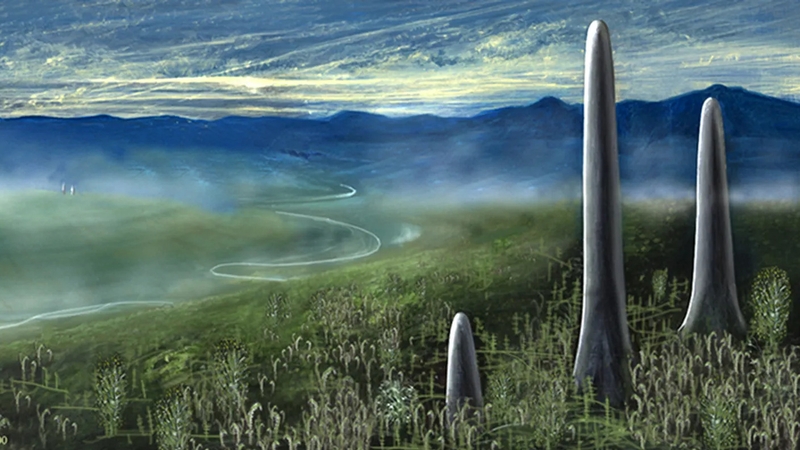


Analysis: Dwarfing every living thing around them millions of years ago, Prototaxites have long defied scientific classification
There is no shortage of controversies surrounding Earth's fossil record. Billions of years of geological history is preserved to varying degrees beneath our feet across the globe. From the tiniest blobs encased in the oldest rocks on Earth which may or may not be evidence for some of the earliest living organisms, to arguments over dinosaur behaviour, right through to debates over which hominin species lived where -palaeontology has plenty of open questions.
Of course, it's an understatement to say we know much more than we don’t know, but it is often the big unsolved mysteries that capture the imagination of scientists and the public alike. Perhaps one of the most fascinating but less well known fossil question marks is that of Prototaxites, a fossilised organism that has defied attempts at classification for over 160 years.
Originally thought to have been the remains of an ancient tree trunk, we now know that Prototaxites existed before the first trees had even evolved. Their fossilised remains are found in rocks between 420 and 370 million years old, a time when the land was covered in only very small, simple plants.
We need your consent to load this rte-player contentWe use rte-player to manage extra content that can set cookies on your device and collect data about your activity. Please review their details and accept them to load the content.Manage Preferences
From RTÉ Radio 1's Mooney Goes Wild, did you know that Ireland once had a totally separate ecosystem, with its very own nature and wildlife?
With some specimens reaching up to eight metres in height, Prototaxites would have dwarfed every living thing around them. They were the tallest land creature to have ever lived at this time, Earth’s first skyscrapers. Their designation as a tree didn’t last for long and the scientific consensus eventually shifted towards some sort of giant fungus.
This idea of a fungal affinity has persisted for decades but just didn’t sit right with some scientists. In a recent paper in Science Advances, University of Edinburgh researchers Sandy Hetherington, Corentin Loron and Laura Cooper decided to put the fungal hypothesis to the test on specimens from Scotland’s Rhynie Chert deposit.
The Rhynie Chert is a rocky outcrop in Aberdeenshire, the lithified remains of an ancient hot spring landscape, similar to parts of Iceland today. The silica-rich fluids that are emitted from these hot springs splash up on to the surrounding landscape and evaporate, trapping everything they touch in a silica mineral matrix - like a prehistoric Pompeii - all organisms preserved exactly as they were at the time they were entombed. Over time, this silica mineral is metamorphosed to chert, a very hard, glassy rock.
We need your consent to load this rte-player contentWe use rte-player to manage extra content that can set cookies on your device and collect data about your activity. Please review their details and accept them to load the content.Manage Preferences
From RTÉ Radio 1's Mooney Goes Wild, Terry Flanagan and Prof. Maria McNamara explore fossils in Clonmel’s courthouse
The organisms undergo some changes, but their structures are still remarkably preserved. Chert deposits like this offer a truly unique window into the past, and the Rhynie Chert is one of the best examples, filled with 400 million year old microbes, plants, animals, fungi, and of course the enigmatic Prototaxites.
The specimen of Prototaxites focused on for this paper was exceptionally well preserved, even by chert standards. This allowed for advanced microscopic and chemical analysis to be carried out providing new insights into the origin of this species. Together with a team of scientists from several universities, myself included, Sandy and colleagues created detailed 3D reconstructions of the structure of Prototaxites which is made up of multiple tubes all bound into a single trunk.
They showed that these tubes are much too different from those observed in fungi to be related to them. They also performed chemical analysis of the specimen itself and the surrounding material of the Rhynie Chert. This was done by shining an infrared laser on the rock which causes the chemical bonds to vibrate in very specific ways allowing researchers to identify the source of the molecules within the rock.
We need your consent to load this rte-player contentWe use rte-player to manage extra content that can set cookies on your device and collect data about your activity. Please review their details and accept them to load the content.Manage Preferences
From RTÉ Radio 1's Drivetime, Prof Yvonne Buckley, Professor of Zoology at Trinity College Dublin, on what is known about fungus.
Both modern and ancient fungi contain very specific molecules such as chitin which they use to build their cell walls. None of these were observed in the Prototaxites specimen. In fact, by applying machine learning techniques to these chemical data, researchers could show that while the bulk Rhynie Chert material contained signals for plants, fungi, and animals, Prototaxites did not match any of them.
For my own part in this work, my team used geochemical techniques to extract molecules from the rocks allowing us to characterise the chemical composition in more detail. We showed that perylene, a common molecular fingerprint or biomarker molecule for fungi, was present in the bulk Rhynie Chert material but not in Prototaxites.
Putting all of this evidence together leads us to what Prototaxites actually is: to put it simply, we don’t know. This is a 'we don’t know’ in the most extreme sense - Prototaxites is likely a eukaryotic organism (the domain to which all fungi, plants, and animals belong) but it is not a fungus, a plant, or an animal.
This strange Devonian giant appears to belong to a group of eukaryotes that no longer exists. At some point in Earth’s history this entire lineage of life went extinct. Perhaps in the future more examples of this group will be found in the fossil record, but for now Prototaxites is the only evidence that it ever existed.
Follow RTÉ Brainstorm on WhatsApp and Instagram for more stories and updates
The views expressed here are those of the author and do not represent or reflect the views of RTÉ
