

Analysis: Irish roads are now full of potholes after weeks of rain and the economic cost of fixing this vital infrastructure will run into tens of millions
There is something philosophically clarifying about a pothole. Unlike the abstract failures of public policy like the unbuilt hospital, the delayed rail line or the other procurement strategies buried in a Government report that nobody reads, a pothole is immediate, democratic, and personally addressed to you. It finds your front left tyre at 7.40am on a Tuesday. It rattles your fillings. It sends a brief, violent message about the relationship between the Irish state and its infrastructure, and then it moves on, leaving you to discover, somewhere around lunchtime, that you now need a new alloy wheel.
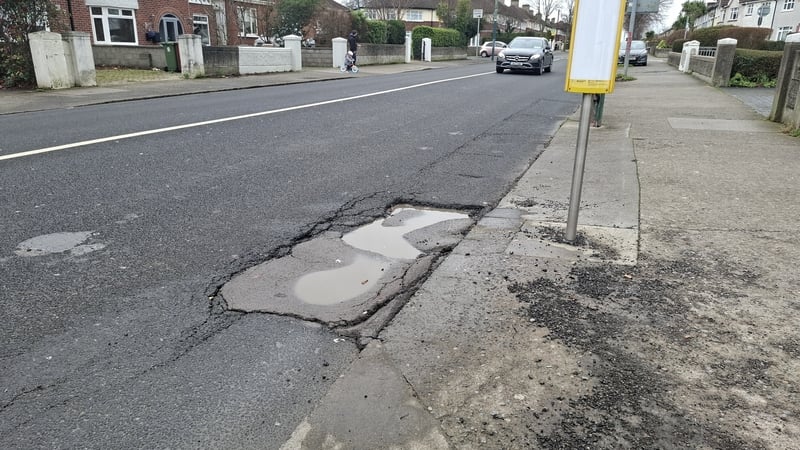
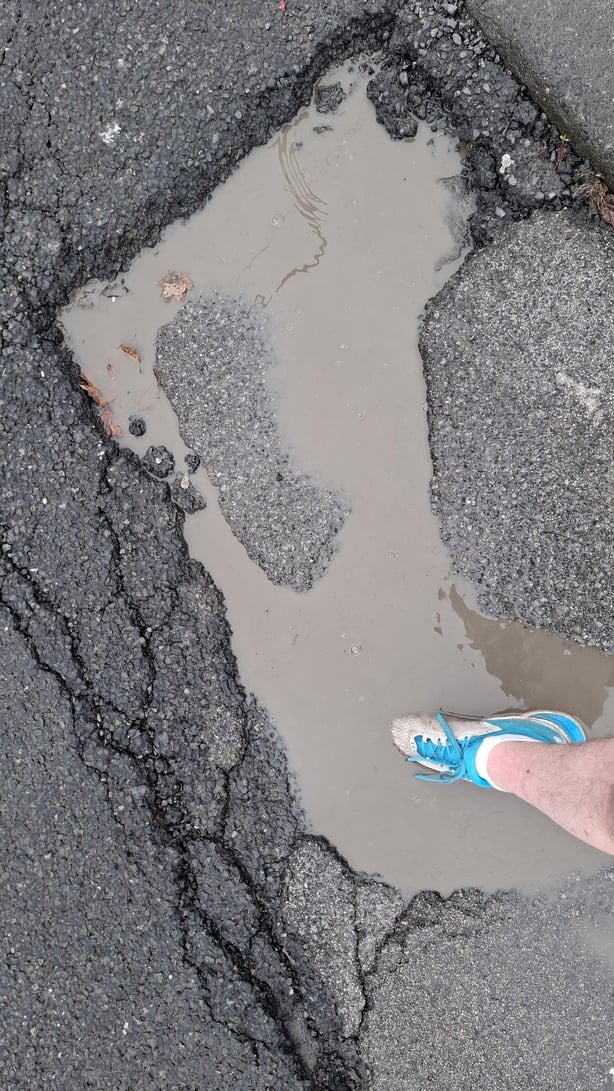
After six consecutive weeks of rain and storms, Irish roads are now an extraordinarily rich environment for potholes. They have proliferated and deepened, and a few have now achieved a kind of geological ambition, less surface defect than minor canyon system. Rural roads that were already testing the philosophical resilience of motorists have entered a new phase of structural candour. They are now simply telling the truth about decades of deferred maintenance.
We need your consent to load this rte-player contentWe use rte-player to manage extra content that can set cookies on your device and collect data about your activity. Please review their details and accept them to load the content.Manage Preferences
From RTÉ Radio 1's Today with Claire Byrne, could we tax 'supersized' cars to fix potholes?
To their credit, local authorities are responding. Crews are out. Contractors are mobilised. Emergency allocations have been announced with the reliable enthusiasm of a government that has discovered, once again, that rain falls in Ireland in winter.
But question that is worth asking is whether any of this represents a system working, or just a system performing the appearance of working. If you want a recent case study, the Collins Avenue Extension in north Dublin has been performing its own quiet piece of civil engineering theatre.
After the January downpours, the surface didn’t so much fail as confess. What began as a few shallow depressions became, within days, a sequence of axle‑testing craters that forced drivers into a kind of improvised slalom. Local residents will tell you the road wasn’t in great shape to begin with, but the speed with which it deteriorated was a reminder that drainage, sub‑base saturation and deferred maintenance are not abstract concepts. They are what you feel through the steering wheel at 30 km/h while hoping your tyre survives the morning.
We need your consent to load this rte-player contentWe use rte-player to manage extra content that can set cookies on your device and collect data about your activity. Please review their details and accept them to load the content.Manage Preferences
From RTÉ News in 2022, new machine to fix potholes to be deployed across the country
A pothole is not, in the first instance, an engineering failure. It is a data point. It tells you that water has penetrated a road surface, that sub-base material has shifted or saturated, that drainage adjacent to the carriageway is either absent, inadequate, or and this is in the great Irish tradition, technically present but realistically functional. It tells you that the lifecycle management of that particular road segment did not anticipate the conditions it has now encountered.
Which is fine, except that the conditions it has now encountered are, six consecutive weeks of heavy rainfall, not exactly unprecedented in a country whose entire cultural identity is organised around the meteorological fact of persistent dampness. We are, collectively, surprised by Irish weather with a regularity that would embarrass a visiting tourist who packed for rain.
The economic consequences are not trivial. Conservative estimates suggest storm damage to road infrastructure across this period runs into tens of millions. Insurance claims for vehicle damage from potholes, which local authorities are legally liable for in certain circumstances, add a further, quieter cost that rarely makes the headline but consistently tests the patience of claims departments and, more importantly, ordinary motorists who simply wanted to get to work.
We need your consent to load this rte-player contentWe use rte-player to manage extra content that can set cookies on your device and collect data about your activity. Please review their details and accept them to load the content.Manage Preferences
From RTÉ Archives, Today Tonight looks at the state of Irish roads in 1980. 'Irish roads are ill equipped for modern traffic and many routes are showing significant signs of wear and tear. Potholes are appearing in Irish roads faster than they can be filled in'
Here is the structurally awkward part. Irish road funding is predominantly annual and predominantly reactive. Capital resurfacing schemes generate political visibility. Emergency repair announcements generate ministerial appearances. What generates rather less excitement is the unglamorous preventative work, drainage reinforcement, culvert enlargement and verge stabilisation that would make the emergency less necessary if consistently funded.
The economics are not subtle. Reactive reconstruction costs more per kilometre than planned prevention. Post-storm contractor markets experience price inflation with the brisk efficiency of any market that understands it has leverage. Mobilisation premiums apply. The state, essentially, pays a premium for having deferred the cheaper intervention. It is the infrastructure equivalent of ignoring a slow puncture until you are changing a wheel in the rain on the hard shoulder of the M50, except in this case, the wheel belongs to the national road network and the rain has been falling for six weeks.
Emergency procurement provisions under EU law allow for rapid mobilisation when extreme urgency exists. This is legitimate and it functions. The governance controls remain in place. But there is a reasonable question about what happens when exceptional procedures become the routine operating posture, when the emergency is, quietly, the plan.
We need your consent to load this rte-player contentWe use rte-player to manage extra content that can set cookies on your device and collect data about your activity. Please review their details and accept them to load the content.Manage Preferences
From RTÉ Radio 1's Drivetime, Dr Paul Davis from DCU on how to fix the latest batch of potholes
The solution is not complicated to describe. It is merely politically unrewarding and therefor endlessly deferred. Multiannual funding certainty, rather than the annual allocation cycle that forces local authorities to plan in 12-month bursts. Risk-based asset prioritisation distinguishes between a rural boreen and a critical freight corridor. Drainage is reclassified as capital resilience investment rather than hidden inside maintenance budgets where it competes with everything else and typically loses. Performance-based maintenance contracts incentivise contractors to prevent failures rather than simply respond to them efficiently.
Most importantly (and most overlooked) is the recognition that roads are not linear surfaces awaiting periodic resurfacing, but integrated hydrological systems. If the drainage geometry is wrong, if culverts are undersized for current rainfall intensity, if the sub-base is chronically saturated, then the pothole is a scheduled appointment and not a surprise. Predictable emergencies are not emergencies. They are policy choices, expressed in tarmac and then rediscovered every winter as if for the first time.
There is, I will admit, something almost admirable about the pothole's honesty. It does not issue press releases. It does not commission reports. It does not convene a stakeholder working group to examine the strategic framework for surface integrity under challenging meteorological conditions. It simply exists, at the interface between aspiration and delivery, waiting to be encountered.
Every minister who has announced emergency road funding while standing beside a collapsed verge has, in a very real sense, been given a briefing by the infrastructure itself. The road is explaining, with some patience, that the annual allocation cycle and the reactive maintenance model have been noted, considered, and found wanting.
The crews clearing the damage are not the problem. The contractors mobilised under urgency are doing what they are paid to do. The emergency provisions in procurement law are functioning as intended.
The question is simply whether Ireland is designing a road system that anticipates climate volatility, or one that assumes normality, responds admirably when normality disappears, and then returns to assuming normality again. The next six weeks are already forming somewhere out over the Atlantic. The potholes are patient.
Follow RTÉ Brainstorm on WhatsApp and Instagram for more stories and updates
The views expressed here are those of the author and do not represent or reflect the views of RTÉ