


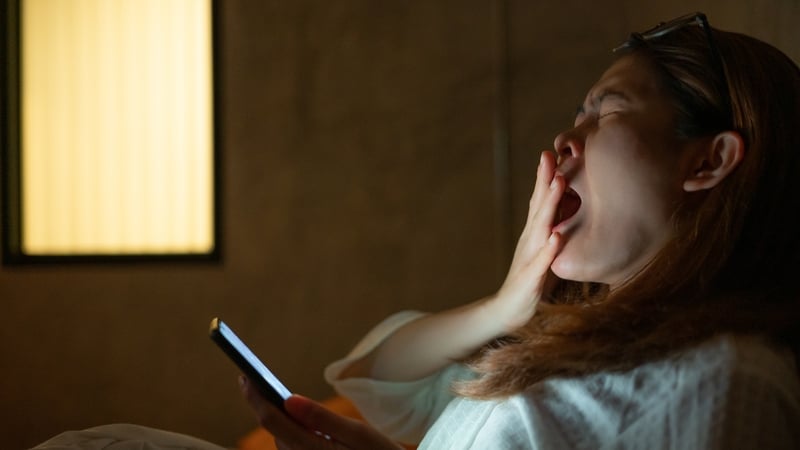
Analysis: Most of us can tolerate occasional late nights without lasting harm, but they can be deeply destabilising for people with mood disorders
By Ronan Lordan, RCSI
We've all been there. It’s 2am on a Monday. Your phone buzzes, its light cutting through the dark. You’ll just have a quick look. What’s the harm? An hour later, you’re still doom-scrolling TikTok or Instagram under a blue glow. Your eyes sting, your brain is racing and sleep is nowhere in sight.
For most people, nights like these are patched with caffeine and the promise of a lie-in. But for others, particularly those vulnerable to mood disorders, this seemingly harmless habit can trigger something much more serious.
Late-night light doesn’t just delay sleep, it can gradually shift the brain’s internal clock - our 24-hour timing system that organises sleep, wakefulness, eating, hormone release, and even brain cell activity. This system is anchored in a tiny but powerful structure deep in the brain called the suprachiasmatic nucleus, or SCN.
We need your consent to load this rte-player contentWe use rte-player to manage extra content that can set cookies on your device and collect data about your activity. Please review their details and accept them to load the content.Manage Preferences
From RTÉ Brainstorm, From body clocks and shift work to mental health and teenagers sleeping all day, just how can we have proper downtime in an always-on world?
For millennia, our clocks followed sunrise and sunset. Then, in a blink of evolutionary time, we introduced electric light, night shifts, long-haul travel, streaming platforms and smartphones, all strong enough to shift the brain’s sense of night by hours.
Light at night suppresses melatonin, the hormone that signals biological night and sleep. When melatonin is delayed, the brain shifts its interpretation of internal night, as if dawn is still hours away. The result is not just lost sleep but a shift in the entire system that regulates mood, energy, and cognition.
Circadian rhythms and bipolar disorders
Most of us tolerate occasional late nights and circadian disruption without lasting harm. But for people living with mood disorders such as bipolar disorder, the mismatch between biology and modern life can be deeply destabilising.
We need your consent to load this rte-player contentWe use rte-player to manage extra content that can set cookies on your device and collect data about your activity. Please review their details and accept them to load the content.Manage Preferences
From RTÉ Radio 1's Brendan O'Connor show, body clock expert Dr. Annie Curtis from the RCSI on the benefits of getting good sleep.
In Ireland, around one in 50 people lives with bipolar disorder, a complex condition shaped by genetics, brain biology and our environment. Among these influences, disruption of the body’s daily rhythms plays a particularly direct role. In bipolar disorder, the circadian system is more fragile. People may have irregular sleep-wake patterns and heightened sensitivity to changes such as jet lag or late nights.
Bipolar disorder is marked by alternating episodes of high and low mood. During manic phases, sleep often drops dramatically, yet people may feel energised or euphoric. During depressive phases, sleep can become fragmented or excessively long. For someone vulnerable, a late night doesn't just shorten sleep, it can shift the timing of the circadian system, contributing to mood elevation, irritability, or sudden emotional crashes.
Why biology doesn't reward late nights or shifts in routine
Modern life quietly rewards circadian rebellion. Late nights working signal commitment. Early mornings signal virtue. Long hours are praised, regardless of biological cost. Yet each of us has an individual chronotype, our own optimum sleep-wake schedules. Whether you are a night owl or morning lark, forcing ourselves outside that window comes at a price.
But many people face unavoidable structural barriers to circadian stability, such as shift work, caring responsibilities, and economic pressure. Indeed, modern life is a 24-hour society.
We need your consent to load this rte-player contentWe use rte-player to manage extra content that can set cookies on your device and collect data about your activity. Please review their details and accept them to load the content.Manage Preferences
From RTÉ Radio 1's Today with Claire Byrne, why sleep apps don't improve a night's sleep
For people living with bipolar disorder, these disruptions can carry hidden risks. Even a little disruption can contribute to mood elevation, irritability, impulsivity, or a sudden emotional crash. Some people experience mania, which can feel productive at first. Racing ideas, boundless energy, reduced need for sleep: these traits are often applauded until they lead to loss of control. By then, the circadian system may already be misaligned. The very states that feel most creative and alive can be the ones that pull the internal clock furthest off balance.
At a biological level, circadian disruption affects the timing of neurotransmitter release such as serotonin and dopamine, key for mood regulation, and dysregulates cortisol, the body’s stress hormone. Artificial light extends the day, algorithms push late-night engagement, and work ignores time zones. We are essentially running an uncontrolled experiment on human circadian biology.
For most, the costs are mild. For those living with bipolar disorder, light at the wrong time or sleep disturbances can be destabilising, and potentially dangerous. This doesn’t require withdrawal from modern life but rather recognition that biology has its limits. Circadian disruption itself is considered a risk factor for developing mood disorders, not just a consequence.
We need your consent to load this rte-player contentWe use rte-player to manage extra content that can set cookies on your device and collect data about your activity. Please review their details and accept them to load the content.Manage Preferences
From RTÉ Radio 1's Nine O'Clock Show, the Sleep Care Company's Anne Marie Boyhan on improving sleep hygiene to encourage a restful sleep
The stabilising power of routine
Circadian research carries a hopeful message: small, consistent changes can make a big difference. Regular wake-up times, meals, and social activity anchor the brain’s clock. Morning daylight dimmed evening lights, and protected sleep acts as biological guardrails.
For people with bipolar disorder, these habits are not lifestyle "hacks" or "wellness tips" but essential support. Therapies such as interpersonal and social rhythm therapy treat disruptions to daily routine as a key risk factor for mood instability.
That late-night glow may feel harmless, but for some of us, it's a small flash that jolts the brain’s internal clock
Practical steps: getting 30 minutes of outdoor light before 10.00am, dimming indoor lights after 9.00pm, protecting sleep, and avoiding shift work, when possible, can help stabilise rhythms, lower the risk of mood swings, and support treatment. This perspective shifts the conversation away from blame: mood episodes are not personal failures, but reflections of biological vulnerability interacting with modern life.
That late-night glow may feel harmless, but for some, it’s a small flash that jolts the brain’s internal clock. So, the next time your phone lights up at 2am, it’s worth remembering: for some brains, it isn’t just another late night; it’s biology being pushed past its limits.
Follow RTÉ Brainstorm on WhatsApp and Instagram for more stories and updates
Dr. Ronan Lordan is a Marie Skłodowska-Curie Actions (MSCA) Postdoctoral Fellow at the FutureNeuro Research Ireland Centre for Translational Brain Science, and School of Pharmacy and Biomolecular Sciences at RCSI University of Medicine and Health Sciences.
The views expressed here are those of the author and do not represent or reflect the views of RTÉ
