


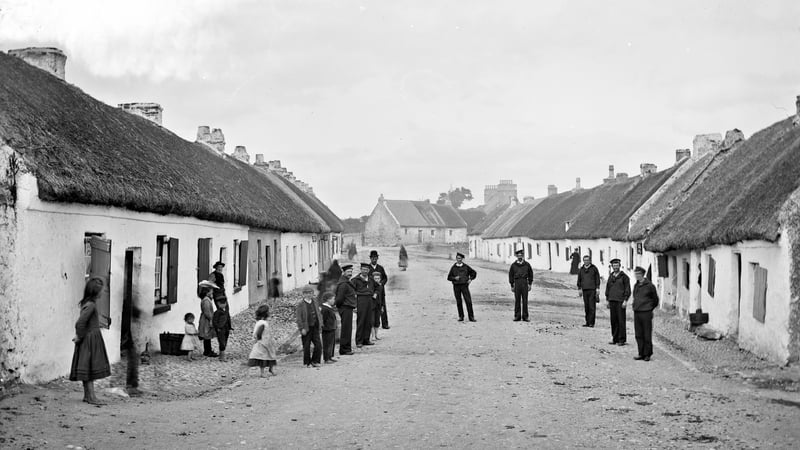

Analysis: Census records remind us that behind every statistic is a household, a family and a life carefully recorded
By Zoe Reid, National Archives and Eileen Murphy, CSO
Ireland will mark two major milestones in the next 15 months. In April, the long-awaited records of the 1926 census will finally be made public - and the next census of population will be taken on 9 May, 2027.
For the first time in Ireland, there will be an online option to complete the census. The highly popular Time Capsule section, introduced in Census 2022 as a world first, will return in 2027. This voluntary text box allows people to leave a message for future generations, which remains confidential for 100 years.
What is a census and why is it important?
The census is an important national event as it counts everyone in the country at a particular time. The first known census was undertaken by the Babylonians in 3800 BC, and many will be familiar with the story of Joseph and Mary travelling from Nazareth to Bethlehem to take part in a Roman census ahead of the birth of Jesus.
We've come a long way since then, and the modern Irish census is a major logistical operation carried out by the CSO. It still serves the same purpose of capturing a moment in time, recording the present in order to plan for the future.
We need your consent to load this rte-player contentWe use rte-player to manage extra content that can set cookies on your device and collect data about your activity. Please review their details and accept them to load the content.Manage Preferences
From RTÉ Radio 1's Today with David McCullagh, Orlaith McBride of the national archive talks about the first census going online
Why does a census matter?
Public service providers use census data for evidence-based decision-making. Knowing who we are and where we live helps us plan effectively for the future.
For example, the number of people aged 65 and over rose by 22% between 2016 and 2022. Statistics like these allow policymakers to prepare for an ageing population and ensure appropriate services are in place.
The census also informs planning for school-age populations, highlighting where more school places may be needed. Local authorities rely heavily on census data when preparing county development plans, while businesses and community organisations use it to guide their decisions. Census data is also used to plan for transport infrastructure needs, while electoral boundaries and the number of TDs in the Dáil are also determined using census results.
From RTÉ Archives, a look at the census being carried out by the Central Statistics Office back in 1981.
The history of the census in Ireland
The first full census of Ireland was held in 1821, with results published in 1823. The 1841 census introduced significant changes, including the use of Ordnance Survey maps, the appointment of enumerators drawn from the Constabulary and the introduction of a standard form completed by the head of the household.
Censuses were subsequently taken at ten year intervals up to 1911. The census forms from 1901 and 1911 are available on the National Archives website and have become invaluable resources for genealogists and historians. There was no census in 1921 due to the War of Independence, making the 1926 census particularly significant.
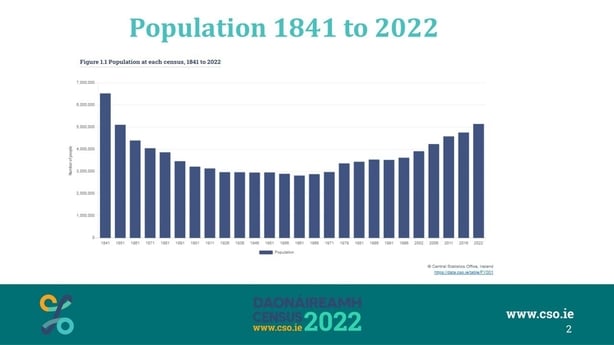
Since 1951, a census has generally been taken every five years in Ireland due to significant population changes driven by emigration and migration. However, there have been exceptions: budgetary concerns in 1976, foot and mouth disease in 2001 and the Covid-19 pandemic in 2021 led to cancellations or postponements.
We need your consent to load this rte-player contentWe use rte-player to manage extra content that can set cookies on your device and collect data about your activity. Please review their details and accept them to load the content.Manage Preferences
From RTÉ Radio 1's The Ray D'Arcy Show, Census 2027 will be the first census in Irish history where the public will have the option to complete their census form online. Head of Census Administration Eileen Murphy explains.
The 1926 census: a new nation emerges
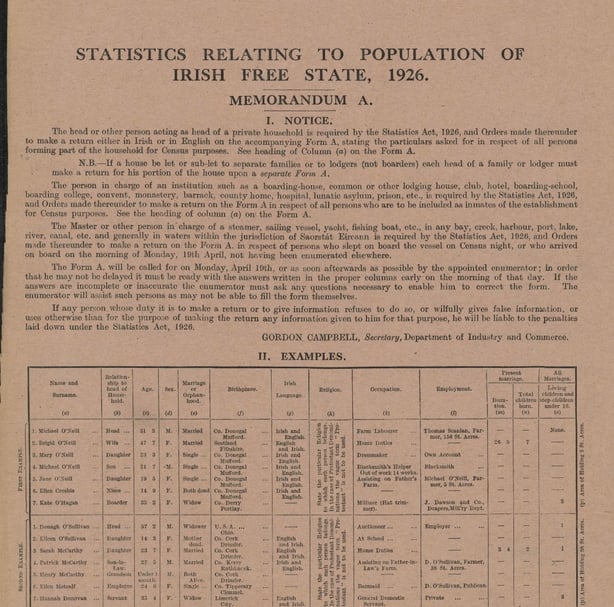
The release of the 1926 Census is an extraordinarily important moment in our national story. As the first census of the Irish Free State, it provides the earliest comprehensive snapshot of an independent nation emerging from a period of profound upheaval.
Census data is not just important for future planning. It is a permanent record of where and how people lived a century ago., The 1926 census bridges a crucial historical gap. It captures a country still shaped by the legacy of the First World War, the War of Independence and Civil War, as well as by long-standing patterns of emigration and rural life. It shows Ireland at a formative stage, economically, socially and politically.
Unlike the earlier censuses conducted under British administration, the 1926 Census was undertaken by institutions of the new State. Even in its structure and language, it reflects evolving national priorities and identity. For historians and members of the public alike, it provides an intimate view of daily life during the early years of self-governance.
From RTÉ Archives, The National Archives of Ireland made the information recorded during the 1901 census available online in 2010
Maintaining a living archive of our past
The National Archives preserves these records under the "100-year rule," which balances individual privacy with the public’s right to reconnect with its past. When the 1926 Census is released, it will be made freely available online, joining the 1901 and 1911 records as an invaluable resource for researchers and the global Irish diaspora.
For many families, this will be the first opportunity to see relatives recorded in the early years of the Irish Free State. Beyond genealogy, the records will support research in social history, economics, public health, housing, education and language use.
Most importantly, census records remind us that history is personal. Behind every statistic is a household, a family, a life carefully recorded in handwriting on a form.
Collective Storytelling
Whether through a digital portal in 2027 or a digitised image from 1926, the census remains our most collective act of storytelling.
Just as we will look at the 1926 forms to see the handwriting of our great-grandparents, in 2127, our descendants will read our digital messages. We have a unique opportunity to leave behind our story for future generations whom we will never meet.
Follow RTÉ Brainstorm on WhatsApp and Instagram for more stories and updates
Zoe Reid is the Keeper of Manuscripts at the National Archives of Ireland. Eileen Murphy is Head of the Census Administration and Digital Transformation in the Central Statistics Office (CSO).
The views expressed here are those of the author and do not represent or reflect the views of RTÉ
