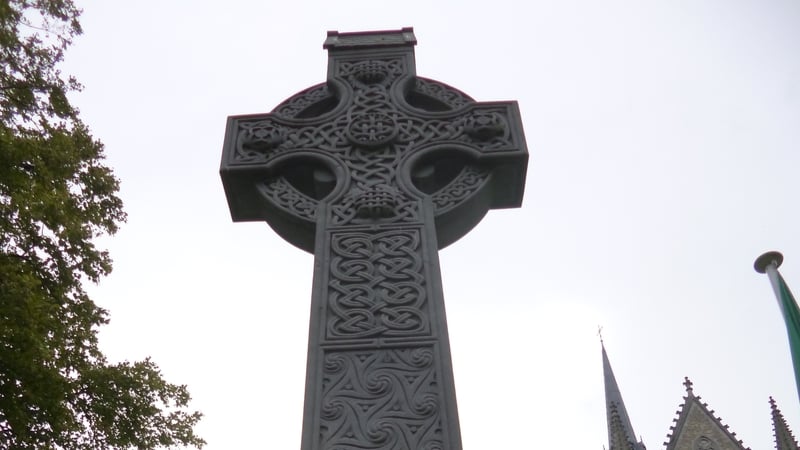


Analysis: An ancient Irish high cross sits in the Belgium city of Ieper to remember the Irish men who died in the First World War
Belgium contains countless First World War memorials. One stands out for how it tells the story of Ireland's complicated relationship with that war. A large granite Celtic cross from Cork was erected in the city of Ieper (known as Ypres during the war) in the province of West Flanders a little over 100 years ago. It was put there to remember men from Munster who died in the War.
The cross was the idea of a group of ex-servicemen known as the Legion of Irish Ex-Servicemen. They wanted to remember their fallen comrades in Ieper, which was one of the few Belgian towns that were not occupied by the Germans during the war. Ieper was held by the Allies for the duration of the conflict at great cost. In total, over 850,000 Allied and German soldiers were killed during the three Battles of Ypres and the fabric of the city was destroyed.
Practically every building lay in ruins and the city had to be entirely reconstructed in the years afterwards. Following the Armistice, Ieper was seen as 'sacred ground’ by those who fought there and became a place of pilgrimage for ex-combatants.
We need your consent to load this rte-player contentWe use rte-player to manage extra content that can set cookies on your device and collect data about your activity. Please review their details and accept them to load the content.Manage Preferences
From RTÉ Radio 1's Documentary On One, The Return to Ypres
Money was raised in Ireland to pay for the cross and it was unveiled by General Bryan Mahon on 7 July 1924. That was the plan, but contemporary newspaper accounts state that the cross did not arrive in time. Instead, the ceremony was performed on the stone pedestal.
It was erected near the ruins of St. Martin's Cathedral and the once magnificent medieval Cloth Hall (now In Flanders Fields Museum) that was reduced to a broken shell in the fighting. Prayers were read out by an Irish priest and some 170 Irish ex-soldiers were present, according to the Irish Times.
The Free State’s representative in Brussels, Count Gerald O'Kelly de Gallach, was also there but had to walk a diplomatic tightrope as he did not want to upset the British embassy in Brussels. O’Kelly and the Irish organisers of the event wanted to emphasise the ‘Irishness’ of it. The Irish flag was carried through Ieper by the visiting party.
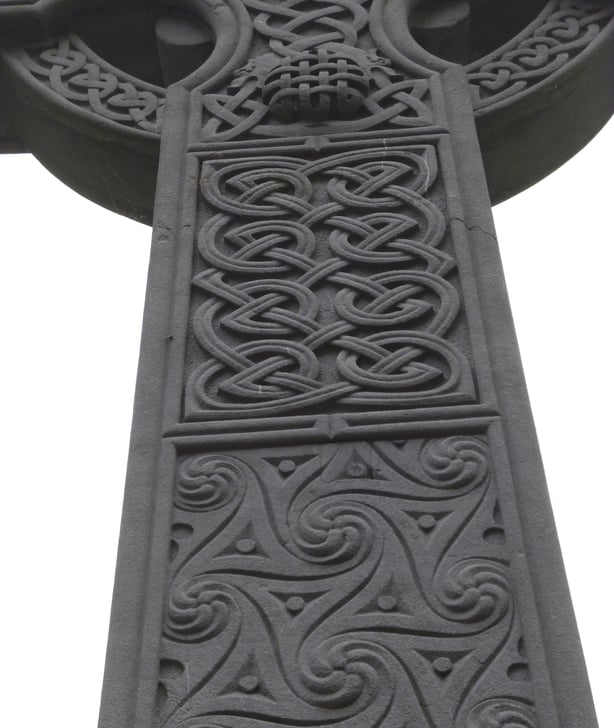
Standing at over 20ft high and made by Cork sculptor John A. O’Connell, the shaft of the cross contains several intricate panels of Celtic-style motifs on the front and on its sides. This includes the distinctive Celtic knot design. The back of the cross does not contain any decoration.
As part of the dedication ceremony, a large wreath in the shape of a harp, made of forget-me-nots and white lilies, was laid at its base. Later in the day, another harp-shaped wreath was placed on the grave of Major Willie Redmond (brother of the nationalist leader John Redmond) who died in Loker in June 1917 at the opening of the attack of the Battle of Messines.
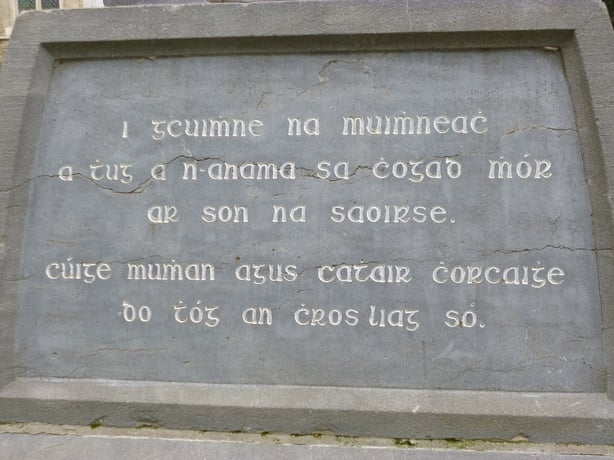
Three different inscriptions in English, Irish and French adorn the pedestal and the coat of arms of Munster is also carved into a panel on the front. "In memory of those men of Munster who died fighting for freedom, A tribute erected by the people of the province and Cork its capital city", reads the front panel. The French inscription reads "A la mémoire des soldats Irlandais de la province de Munster 1914-1918". The Irish inscription, written in Gaelic type, reads:
"I ᵹcuiṁhne na muiṁneaċ a ṫuᵹ a n-anama sa ċoᵹad ṁór ar son na saoirse. Cúiᵹe muṁan aᵹus ċanṫair ċorcaiġe do ṫóᵹ an ċrosliat só".
Over 200,000 Irishmen fought in the British army during the war and the majority were volunteers. An estimated 35,000 lost their lives. Initially, there were hopes that the cross would act as a unifying symbol between Cork and Belgium. Before the monument was inaugurated, the Burgomaster (Mayor) of Ieper told the committee responsible for it that he hoped that it "would stand for all time" and become an "everlasting emblem of the long historic connection between Cork and Belgium".
That did not seem to transpire, at least not in the long term. When the war ended, the dead were mourned and remembered by their loved ones and the communities they came from. However, historian Fionnuala Walsh has argued that the war became "marginalised in both academic scholarship and popular memory".
She added that the war occupied a "contested place in Ireland’s history". Writing in 1967, historian F.X. Martin went as far as to say that Ireland suffered from "national amnesia" when it came to remembering the Irishmen who fought in the British army during the war.
We need your consent to load this rte-player contentWe use rte-player to manage extra content that can set cookies on your device and collect data about your activity. Please review their details and accept them to load the content.Manage Preferences
From RTÉ Archives, The Kilkenny Great War Committee travel to Ypres to remember those from the county who lost their lives at the Western Front.
With the passage of time and perhaps prompted by initiatives such as the Decade of Centenaries, there is renewed interest in the role played by Irish people in the global conflict that cost the lives of up to 22 million people. Delegations from Cork City Council, including lord mayors, travelled to Ieper in 2008, 2015 and 2024.
The latest visit in April 2024, led by then Lord Mayor Kieran McCarthy, marked the centenary of the monument. Two new wooden benches, a gift from Cork City Council, were placed in front of the cross. Perhaps the connection between Cork and Belgium, as mentioned by the Mayor of Ieper in 1924, is coming to be recognised and strengthened at last.
The memorial was moved a small distance from its original location at the back of the Cathedral by Ieper City Council in 2021. They were developing a new car park at the time and did not want the cross to be put at risk by vehicles using the car park. In 2024, in advance of the ceremony that marked its centenary, it was renovated by the Commonwealth War Graves Commission. Today, with a tricolour flag behind it, the cross, resembling an ancient Irish high cross from medieval times, sits in this rebuilt medieval town as a symbol of remembrance.
Follow RTÉ Brainstorm on WhatsApp and Instagram for more stories and updates
The views expressed here are those of the author and do not represent or reflect the views of RTÉ