


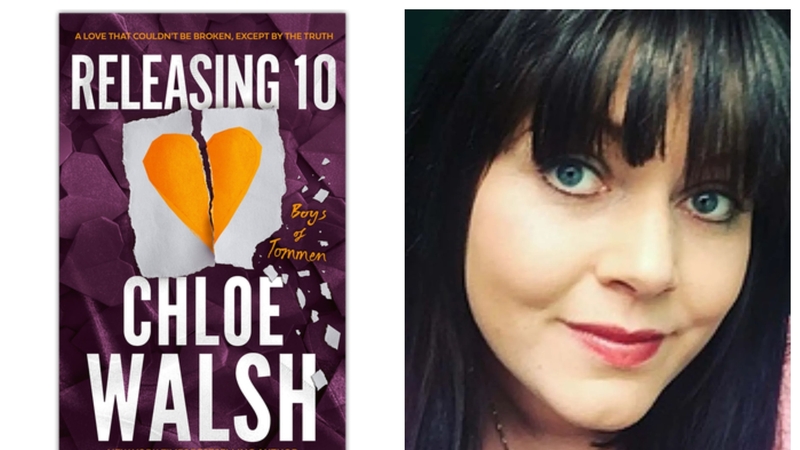
Opinion: Chloe Walsh's romance novels set in Co Cork are a hit already thanks to BookTok, but an Amazon Prime TV series will see her fanbase soar
By Maria Butler, UCD
Two years ago, one of my students gave an presentation on Binding 13, the first novel in the Boys of Tommen series, for their literary seminar. Curious about the series, I discovered a BookTok phenomenon. Written by Cork author, Chloe Walsh, the Boys of Tommen is a series of six romance novels set in her home county. The first, Binding 13, has an aggregate score of 4.45 from over 585,000 ratings on Goodreads, making it one of the most read Irish books in recent years.
As well as topping the New York Times' bestseller list, the Irish bestseller list has featured at least one book from the series every week since the most recent instalment, Releasing 10, was published in May 2025. Releasing 10 even temporarily knocked Richard Osman's We Solve Murders off the number one spot in the UK and Ireland the week of its release. Amazon Prime has just announced their plans to adapt the books for its streaming platform. So why have you never heard of it?
It's self-published
The first four books were self-published before Hachette offshoot, Piatkus, acquired the series in 2023. Self-published books are often viewed as an "amateurish" or "existential threat" to traditionally published books meaning that it was entering the traditional market at a disadvantage.
Moreover, the Boys of Tommen was already well-established before it was bought, which undoubtably influenced Piatkus’s marketing strategy. Why pump money into a mainstream media campaign when your target audience are all online?
It’s a romance series
The Boys of Tommen is a romance series which revolves around the teenage students attending the private Tommen College in the fictional Cork town of Ballylaggin. Set in the early 2000s, each book covers an overlapping time-period from their protagonist’s perspective. The first two novels follow the romance between rugby star Johnny Kavanagh and new girl Shannon Lynch. The other books in the series follow the romances between three couples we meet in the first book: Joey and Aoife, Claire and Gibsie, and Lizzie and Hugh.
We need your consent to load this rte-player contentWe use rte-player to manage extra content that can set cookies on your device and collect data about your activity. Please review their details and accept them to load the content.Manage Preferences
From RTÉ Radio 1's Today with Claire Byrne, Daisy Cummins and Edel Coffey talk about the world of romantic fiction
Romance novels have a long history of being sidelined as "sub-literature, para-literature, trash, schlock", something which the Museum of Literature, Ireland attempted to rectify with their exhibition on Irish romance fiction. The fact the Boys of Tommen is a romance which centres teenagers, makes it even less likely to receive mainstream attention.
It’s a BookTok book
BookTok is the book corner of the social media video platform TikTok. User engagement is measured in "views" - the number of times a video is watched. BookTok videos have over 188 billion combined views. The rise of BookTok as a significant force in the marketing and sales of books has been a feature of recent years.
We need your consent to load this rte-player contentWe use rte-player to manage extra content that can set cookies on your device and collect data about your activity. Please review their details and accept them to load the content.Manage Preferences
From RTÉ Radio 1's Drivetime, Tracy McEneaney from Waterford City and County Libraries on the rise of BookTok
BookTok is an affective medium wherein, books that elicit tears are praised as a marker of "good" literature. Thus, a novel's estimation and popularity become linked to its ability to make readers cry rather than its quality of form and content.
This means that Booktokers have different requirements for literature to those opinions expressed in the mainstream press. It follows that very few BookTok books cross over to achieve conventional media coverage.
It’s written by a woman for women
Remember Chick Lit? At the turn of the millennium Irish women writers likeMarian Keyes, Cathy Kelly and Cecelia Ahern started publishing to massive international success, opening the door for other Irish writers to launch their careers.
But in the grand tradition of diminishing work written by women for women, they were slated. For example, writing in The Sunday Times, Liam Fay described chick lit as "the fiction-writing equivalent of a livid pink rash" which had begun to "infect other areas of popular storytelling". We’re over halfway through the 2020s and not that much has changed: books written for women by women are less likely to be noted than those that aren’t. The Boys of Tommen falls into this category.
So what next?
Not every book needs to be critically reviewed by the mainstream press and The Boys of Tommen would not be likely to be well reviewed. Stylistically, the instalments I read would have benefited from a firm editorial hand. Thematically, they fortify already entrenched, negative gender stereotypes relating to violence, jealousy, and "baby trapping".
That being said, I don’t think that we should be ignoring such a massively successful Irish series. We should absolutely engage with those elements of the series which we find problematic. But first, we should engage with the series full stop. It is only by including all of Ireland’s successful literary outputs that we can gain an appreciation of the Irish literary landscape – self-published romance novels and all.
Follow RTÉ Brainstorm on WhatsApp and Instagram for more stories and updates
Dr Maria Butler is a postdoctoral research fellow in the Centre for Cultural Analytics in UCD. This publication has emanated from research conducted with the financial support of Research Ireland under Grant number 12/RC/2289_P2
The views expressed here are those of the author and do not represent or reflect the views of RTÉ
