


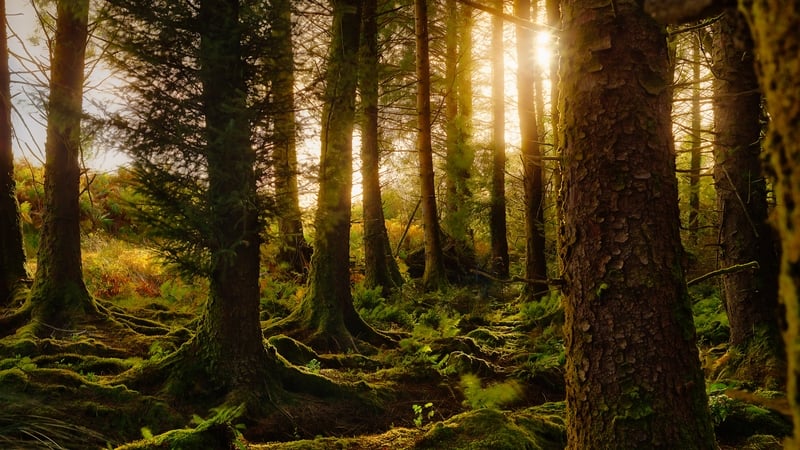

Analysis: The idea of restoring temperate rainforests in northwest Europe requires thinking in practical terms about of the possible forests of the future
By Markus Eichhorn and Katerina Chernyuk, UCC
When people think of a rainforest, it conjures up an image of lush vegetation, gigantic trees and exotic fauna. It may seem almost unbelievable to think that there were once held large tracts of rainforest on what is now our doorstep here in Ireland. Even more unbelievable is the idea that this rainforest, which has been almost entirely lost, could be brought back to life. This is the case made by two high-profile campaigns in Ireland and the UK over recent years, drawing on the current enthusiasm for rewilding.
What is a rainforest? Put simply, it's a place with trees where it rains a lot, but the similarity between tropical rainforests and those that might occur in northwest Europe ends there. Tropical rainforests are roughly four times taller and contain over a hundred times more species, none of which are shared with Europe.
Temperate rainforests, where they remain, fall at the wetter end of the spectrum of native woodlands that we’re more familiar with. In Ireland and the UK, they are mostly dominated by oak trees, although some places contain important patches of hazel, pine and birch woods.
We need your consent to load this rte-player contentWe use rte-player to manage extra content that can set cookies on your device and collect data about your activity. Please review their details and accept them to load the content.Manage Preferences
From RTÉ Radio 1's Mooney Goes Wild, Eoghan Daltun talks about his book The Magic of An Irish Rainforest about his travels across Ireland to photograph surviving areas of temperate rainforest.
This points towards one of the challenges of temperate rainforests which is defining what they actually are. Since the plant species they contain are almost all found in other habitats, there is no exclusive definition of temperate rainforests to be found in Ireland’s Fossit standards or the UK's National Vegetation Classification.
A few moss and lichen species are characteristic of some sites but none are found in all of them. Instead most studies have used environmental data to predict the places where rainforest could grow if given the opportunity to do so. These are known as climate envelopes and are a standard method in conservation planning.
How much rainforest was there in the past, how much could there be right now, and where might it be possible to have rainforest in the future? All these questions depend on the assumptions that we can confidently define the environmental conditions required for rainforest to develop and that those areas would not be covered by something else instead.
We need your consent to load this rte-player contentWe use rte-player to manage extra content that can set cookies on your device and collect data about your activity. Please review their details and accept them to load the content.Manage Preferences
From RTÉ Radio 1's Ray D'Arcy Show, Matt Smith talks about plans to create 4,000 acres of Atlantic rainforest along the west coast of Ireland.
Our new study calls into question many of the claims that have been made so far for the extent of past and potential future rainforest. There are three commonly used models for predicting the presence of temperate rainforests in Ireland and the UK, none of which were truly designed for this purpose.
The most widely-used method was originally proposed to explain the distribution of mosses in the Austrian Alps, hardly a comparable system to an Atlantic oak forest. The predictions of the three models disagree to the extent that their area of overlap for modern climates covers only 12% of Ireland and the UK, an area that captures fewer than one in five of the sites currently recognised as Atlantic oak forest.
The model that captures the most known sites (76%) manages to do so mainly by predicting implausibly vast areas of rainforest. One model predicts that two thirds of Ireland could be rainforest, whereas another suggests less than a quarter.
In the face of such wide disagreement, any claims about how much rainforest there used to be in the past or how much there should be now, must be treated with caution.
Even within those areas where we have high confidence that rainforest could occur, we see strong overlap with other protected habitats including peatland, bogs and semi-natural grasslands. Saying that a site could be rainforest is not the same as demanding that it should be rainforest, particularly if it conflicts with other conservation objectives or land uses.
None of this is to undermine the importance of maintaining and restoring our native woodlands. Only 2% of Ireland and 7% of the UK is covered by native woodlands, both far below the European average. Instead of placing an emphasis on rainforests, which are challenging to define or map as unique entities, we should aim for more native woods of all types.
This includes wet and dry sites, uplands and lowlands, coastal and inland, and embracing all opportunities for reforestation rather than setting ambitious targets for specific forms based on unreliable evidence. All woods can be valuable when we have so few.
We need your consent to load this rte-player contentWe use rte-player to manage extra content that can set cookies on your device and collect data about your activity. Please review their details and accept them to load the content.Manage Preferences
From RTÉ Radio 1's Oliver Callan Show, Catherine Cleary talks about her plan to turn 27 acres of the wettest, cheapest land in Roscommon into a forest
Our work also points towards a challenge for the protection and expansion of existing Atlantic rainforests, which is that most of the current sites where they occur are at or close to the limit of their environmental tolerance, which means that in an ever warmer and drier climate they may no longer be sustainable. This calls into question whether we should invest in expanding rainforest in its existing strongholds or instead create new rainforests where little cover currently exists.
Oak forests take over a century to fully establish and we need to anticipate the climate in which they will reach maturity. In Ireland this means west Kerry and the northwestern counties (Sligo, Leitrim and Donegal) whereas in the UK the most promising regions are Wales, Cumbria and western Scotland. This proposal is quite different from the usual approach to restoration; instead of putting a habitat back where it used to be, we would be creating brand new habitats in places we expect them to thrive in the future.
We can - and should - restore the temperate rainforests of northwest Europe. The idea has captured the imagination of many and this impetus should be used to our advantage. Achieving this goal requires us to think in practical terms about of the possible forests of the future, not to dwell on the unknowable forests of the past.
Prof Mary O'Shaughnessy, Dr James Buckley and Dr Thomas Murphy also contributed to this research
Follow RTÉ Brainstorm on WhatsApp and Instagram for more stories and updates
Dr Markus Eichhorn is Senior Lecturer in Plant Ecology at University College Cork. Katerina Chernyuk is a PhD student at UCC studying Atlantic oak restoration in Ireland and Britain and co-author of the State of Temperate Rainforest: Southwest England Report.
The views expressed here are those of the author and do not represent or reflect the views of RTÉ
