


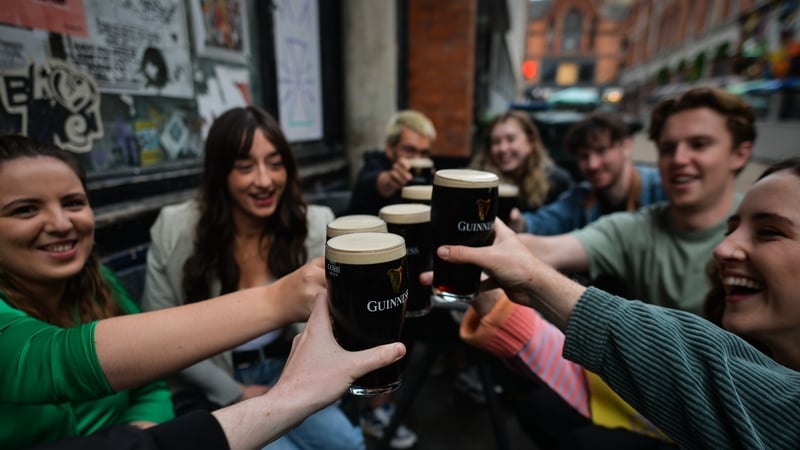

Opinion: While there are considerable challenges to running student bars, there are compelling reasons to add to Ireland's existing on-campus pubs
By Rory Kirby, TU Dublin and Perry Share, ATU
Of the roughly 30 or so third-level institutions in the Republic of Ireland, only seven have a pub on campus. All are 'traditional universities' such as Trinity College (The Pav), UCC (New Bar), DCU (NuBar) and the University of Limerick (The Stables).
The remainder, including all the newly-established technological universities, are bereft of such a service. Factors may well include a negative perception of alcohol consumption, financial factors, changing alcohol consumption patterns, and the presence of existing private businesses in the vicinity of college campuses.
But should we be worried? What is at stake here? While this is a complex and sometimes emotive issue, there may be compelling reasons to open more bars or pubs in our colleges.
Pubs as a third space
University or college is first and foremost about furthering one’s education. But it is also about growing as a person, both individually and in a social context. One of the activities that can help in this is going to the pub for a drink with friends or would-be friends.
We need your consent to load this rte-player contentWe use rte-player to manage extra content that can set cookies on your device and collect data about your activity. Please review their details and accept them to load the content.Manage Preferences
From RTÉ Radio 1's Oliver Callan Show, could opening more on-campus pubs help revitalise student life?
For many, third level education is a whole new world, where many young (and not so young) people can be away from families and friends for extended periods for the first time. They may find themselves in a course with hundreds of others, and this can be daunting as well as exciting. While all higher education institutions offer a broad range of clubs and societies, these do not necessarily offer the openness, informality, and access of a student bar.
There is much concern in Ireland and internationally about ‘student engagement’ especially in the wake of the Covid-19 pandemic. Colleagues often remark on the ‘quietness’ of campuses and there has been an observable change in student social life. In college towns such as Sligo, once-thronged student bars and nightclubs have closed down. What are the implications for student experience and identity? What are the longer term implications of these changes?
To date, there has been scant research in this area. As outlined in the recent book, The Irish Pub: Invention and reinvention, the pub has been at the heart of Irish culture and communities for over two centuries. As well as offering a range of social functions, from hosting wakes to acting as an informal labour exchange, pubs are classic examples of what the American sociologist Ray Oldenburg has defined as a ‘third space’.
We need your consent to load this rte-player contentWe use rte-player to manage extra content that can set cookies on your device and collect data about your activity. Please review their details and accept them to load the content.Manage Preferences
From RTÉ Radio 1's Today with Claire Byrne in 2021, how are third level students coping with missing out on campus life during Covid lockdowns?
Third spaces are of their nature open and democratic. Neither ‘home’ nor ‘work’, they provide opportunities for people of diverse backgrounds and interests to meet up and interact, with little more commitment required than to relax and be tolerant of others. So popular has the unique ambience of the Irish pub become, that thousands have been established across the world.
Changing drinking habits
While Irish pubs may be ubiquitous from Boston to Bucharest, they are absent from most of our college campuses. Why is this? The financial challenges of running a pub with a limited clientele and short season are considerable. For campuses located in city centre areas, the competition from well-funded pubs and pub companies is intense.
The drinking habits of younger people are changing quite rapidly, and not just in Ireland. While they still make up the most significant clientele for pubs, young people are drinking differently and drinking less, which is part of a global pattern of declining alcohol consumption. 30 years ago in Ireland, two-thirds of alcoholic consumption took place in public settings; now two-thirds is in a domestic environment.
Largely due to cost factors, students report that much consumption is now limited to ‘pre-drinking’ supermarket alcohol in student accommodation, prior to going out, if ‘going out-out’ at all. This takes place in a private, unregulated and potentially riskier environments.
We need your consent to load this rte-player contentWe use rte-player to manage extra content that can set cookies on your device and collect data about your activity. Please review their details and accept them to load the content.Manage Preferences
From RTÉ Radio 1's Late Debate, Matt Carthy TD (Sinn Fein), Senator Patricia Stephenson (Social Democrats), Séamus McGrath. TD (Fianna Fáil) and Muiris Ó Cearbhaill (Daily Mail) discuss the latest rise in the price of a pint
Furthermore, many universities and colleges, including both Atlantic Technological University and TU Dublin, have student welfare policies that prohibit alcohol consumption on campus, except at specially authorised events or functions (such as art students’ graduation shows). This is reflective of the ‘dry’ approach in public health that views alcohol as no more than an addictive and socially harmful drug.
When the Oireachtas and the public can be deeply sceptical of government expenditure, should the state (which largely funds higher education) be involved in providing pubs to students? When Government campaigns consistently warn of the dangers of alcohol consumption, would such a move be irresponsible at worst, or counter-intuitive at best? Given the global trends, the financial risks and the existing policy frameworks, why would (or should) a college consider opening – possibly even subsidising – a bar or pub on campus?
While students have long been associated with heavy drinking, there is potential now to 'reinvent' the student pub as a more inclusive, flexible and welcoming space
On the other hand, there are some reasons worth considering. First, pubs remain at the centre of Irish identity. They are celebrated in literature and film, from the poems of Paula Meehan to the Banshees of Inisherin, and promoted as our prime tourist attraction. They constitute a significant export industry and source of Irish ‘soft power’.
Does it make sense to deny the majority of Irish people who engage in higher education this experience when on campus - where they spend so much of their time? Are we saying to our students – the future workforce and leaders of our country – that pubs no longer matter?
From RTÉ Archives, Lorraine Smith reports for RTÉ News on students returning to college at UCD after the 1994 summer break
Second, pubs can provide a real basis for community. We see this in places all across the country and the globe. As third places, they can provide a setting for conversation, debate, interaction, and fun. All should be part of the student experience. Indeed, initiatives such as ‘Pint of Science’ encourage people into pubs in Ireland and across 28 countries worldwide to find out about and to debate academic research.
Third, trends in Ireland and elsewhere reflect a growing popularity of both coffee shops and low-alcohol or alcohol-free alternatives. College bars could move beyond the provision of alcohol to also include alternative drinks and experiences. This would cater to the many college students and staff who do not consume alcohol.
While students have long been associated with heavy drinking, there is potential now to ‘reinvent’ the student pub as a more inclusive, flexible and welcoming – and properly regulated - space for all who seek community and relaxation on campus. This may be difficult to justify financially, but is it something we should support for the benefits it brings to community, engagement and the wider student experience?
Follow RTÉ Brainstorm on WhatsApp and Instagram for more stories and updates
Rory Kirby is a Media Technician on the Creative Digital Media course at TU Dublin Blanchardstown. Dr Perry Share is Head of School of Social Science and Humanities at Atlantic Technological University. He is the co-editor with Moonyoung Hong of The Irish Pub: Invention and reinvention (Cork University Press).
The views expressed here are those of the author and do not represent or reflect the views of RTÉ. Drink responsibly
