

Analysis: The 2026 midterms will be deeply consequential both within the US and abroad - especially with regard to jobs and the economy in Ireland
Anyone doing their best to avoid the toxic trials and tribulations of recent US politics may have failed to notice that the 2026 midterm elections are looming. Whilst these congressional elections do not receive the same attention as their presidential counterparts, they are nonetheless deeply consequential both within the US and abroad.
As ever, there is much speculation about the fragile state of the nation's democracy, and the current threat to it. Polling day will take place in November, halfway through Donald Trump's second presidency. Generally considered to be a referendum on the Oval Office occupant, they offer voters a chance to recalibrate the balance of power in Washington.
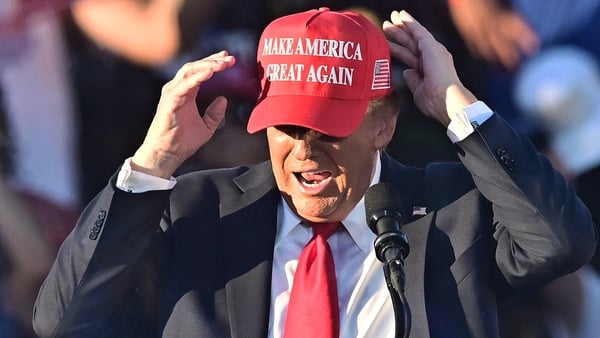
As Trump passes his first-year anniversary back at the White House, and the public now has a fair sense of his priorities and progress, the midterms will determine the fate of his legislative agenda.
We need your consent to load this rte-player contentWe use rte-player to manage extra content that can set cookies on your device and collect data about your activity. Please review their details and accept them to load the content.Manage Preferences
From RTÉ Radio 1's Today with Claire Byrne, Greg Swenson Chairman of Republicans Overseas and Patti Shields, Vice-Chair of Democrats Aboard, Chair of Democrats Abroad Ireland, talk about the first year of Trump's election
What decided in these polls?
All 435 seats in the House of Representatives are up for grabs. Members serve two-year terms, meaning the entire chamber faces voters every cycle. This makes the House perpetually volatile and responsive to the political mood of the moment. In the Senate, one-third of the 100 seats (33 or 34, depending on the cycle) are contested.
Senators serve six-year terms, with elections staggered so only a portion of the chamber is up for re-election at any given time. Beyond Congress, voters will also decide numerous state governorships and state legislature seats. These races might seem local, but they have outsized influence over hot-button policy areas like abortion access, voting laws, and education.
What's the big prize?
That would be control of Congress. Whichever party holds the majority in the House and Senate wields enormous power. They set the legislative agenda, control committee assignments, and decide which bills get a hearing and which die in obscurity. If Trump's Republican Party retains or expands its congressional majority, his policy ambitions will have a clearer path forward. If Democrats win back one or both chambers, gridlock will follow.
We need your consent to load this rte-player contentWe use rte-player to manage extra content that can set cookies on your device and collect data about your activity. Please review their details and accept them to load the content.Manage Preferences
From RTÉ Radio 1's News at One, Niall Stanage, White House Columnist with The Hill, reports on Zohran Mamdani's victory in the New York mayoral race.
Committee leadership matters too. The majority party chairs all congressional committees, granting them investigative powers. A Democratic majority would likely initiate probes into Trump's policies, not to mention his personal activities, whilst a Republican majority would most likely shield him from scrutiny.
The midterms also set the runway for the 2028 presidential race. A strong performance by either party will build momentum heading into the next election cycle. At the state level, the stakes are equally high. The outcomes of gubernatorial and legislative races will determine the direction that a range of polarising issues take.
How does it look at this stage?
The picture is still emerging right now, but history can be helpful. The president's party usually loses seats in midterm elections. Since World War Two, this pattern has held in nearly every cycle. Midterms often serve as a protest vote, and the party in power tends to be less energised than the opposition.
If this historical trend holds, Democrats could make gains. That said, Trump has defied political gravity before, and his base remains intensely loyal. Whether that loyalty translates into turnout in a non-presidential election year is tricky to predict.
The map matters, too. In the Senate, the specific seats up for election will determine which party has a realistic shot at control. Key battleground states, such as Arizona, Pennsylvania, Georgia, will dominate the conversation as Election Day approaches. These are the places where races are decided by razor-thin margins, and where both parties will pour energy and resources.
What will be on people's minds when they go to vote?
The issues that will dominate 2026 are already taking shape. The economy is paramount for voters. If it's humming along, Trump and his party will take credit. If it's spluttering, Democrats will hammer home the message that Republican policies have failed working families. Immigration is another perennial flashpoint. Trump built his political brand on border security, and it's likely to be a cornerstone of Republican messaging.
Healthcare remains contentious, particularly around access and affordability. Abortion rights, particularly since the Supreme Court's Dobbs decision in 2022, continue to energise voters on both sides. For Democrats, it's a rallying cry. For Republicans, it's a complicated issue that can alienate moderate voters even as it galvanises the base. Then, to misquote Donald Rumsfeld, there are the unknowns, known and otherwise. Any controversies or crises emerging from Trump's current term could shift the political landscape in unpredictable ways.
We need your consent to load this rte-player contentWe use rte-player to manage extra content that can set cookies on your device and collect data about your activity. Please review their details and accept them to load the content.Manage Preferences
From RTÉ Radio One's Morning Ireland, Fr Jerry Boland discusses the impact of Ice raids on his community in Chicago
Why should Ireland care?
For Irish readers, the 2026 midterms aren't just an American story. US-Ireland relations are deep and multifaceted, rooted in history, culture, and economics. Ireland is home to the European headquarters of many American tech and pharmaceutical giants, and trade between the two countries is substantial. Political shifts in Washington can have consequences in the boardrooms in Dublin. If Democrats gain power and push for changes to corporate tax policy or international trade agreements, Ireland could feel the impact.
All will be revealed on 3 November this year, though close races can take days or even weeks to resolve as mail-in ballots are counted. The broader implications, however, will unfold over the following two years. If the midterms deliver a divided government, legislative stalemate will ensue. The upside would include potential checks on executive power. If they consolidate power in one party's hands, expect bold action.
Either way, the 2026 midterms will be a critical juncture. The inevitable cliché rolled out at every election is that democracy is on the ballot. Whilst this Aesopian wolf has been called repeatedly over time, recent political developments in the US demonstrate that there are moments when clichés have deep resonance. The wolf is here, and US democracy is in its sights.
Follow RTÉ Brainstorm on WhatsApp and Instagram for more stories and updates
The views expressed here are those of the author and do not represent or reflect the views of RTÉ