Analysis: Decarbonising the emissions associated with flights from Dublin Airport would need much more land and electricity than you might think
By Ciara Doherty, Vahid Aryanpur and Hannah Daly, UCC
If Ireland were to fully decarbonise the carbon emissions associated with flights from Dublin Airport, how much land and power would it take? The scale of the task would be striking: depending on the pathway chosen, it could require diverting an area of land greater than the size of Co Tipperary for growing fuels and offsetting, or new electricity demand equivalent to more than current electricity usage.
Aviation is widely recognised as one of the most difficult sectors to decarbonise. Unlike road transport or electricity generation, there are currently no mature alternatives to fossil jet fuel available at commercial scale. In Ireland, the challenge is particularly acute given our growing dependence on aviation: Irish residents fly more frequently and further than our EU counterparts, with air travel trips per capita almost double the European average.
We need your consent to load this rte-player contentWe use rte-player to manage extra content that can set cookies on your device and collect data about your activity. Please review their details and accept them to load the content.Manage Preferences
From RTÉ Radio 1's Late Debate, discussion on the lifting of the passenger cap at Dublin Airport
Aviation emissions have an unusual position in climate policy: international aviation is excluded from Ireland's legally binding national carbon budgets, even though its emissions are substantial. In 2024, aviation accounted for 6% (3.3 million tonnes) of Ireland's total emissions, which is equivalent to around half of all emissions from power generation. Dublin Airport is responsible for around 85% of this figure.
Dublin Airport's passenger cap is being lifted and this will increase demand, and in turn, emissions. Estimates suggest emissions linked to Dublin Airport will rise by 22% by 2031. To put this in perspective, this increase is equivalent to the emissions from heating around 250,000 Irish homes.
Reducing demand for flying is the most direct way to cut emissions, but it is also politically sensitive. Several technological pathways for deep decarbonisation are at an early stage of development, but scaling any of these comes with enormous physical resources and great practical challenges. To understand what these trade-offs might look like in practice, we explored four potential approaches for decarbonising Dublin Airport’s aviation emissions and estimated the land and energy requirements if Ireland were to pursue them at home.
What are the options?
Broadly, the options fall into two categories: replacing fossil fuels with lower-carbon alternatives, or continuing to use jet fuel while removing carbon dioxide from the atmosphere.
Replacing fossil fuels
Sustainable aviation fuels are currently the only available low-carbon fuel option compatible with existing aircraft. Compared to conventional jet kerosene, these fuels can reduce emissions by up to 80% . However, global supply remains extremely limited, accounting for less than 1% of jet fuel use.
For this analysis, we consider a hypothetical scenario in which all jet fuel demand associated with Dublin Airport is replaced with sustainable aviation fuels produced in Ireland.
Biofuels
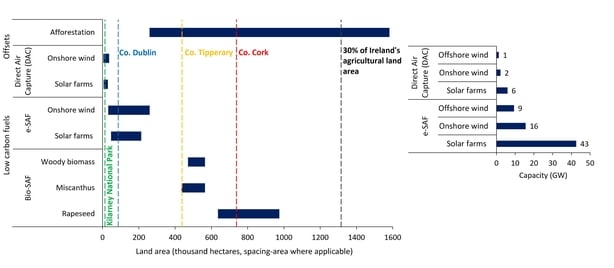
Bio-SAF is a biofuel that can be produced from energy crops such as rapeseed, willow and miscanthus grown in Ireland. However, the land required to grow enough crops would be huge. Producing enough bio-SAF domestically could require between 0.4 and 1 million hectares, which is equivalent to between 9% and 21% of Ireland's agricultural land.
We need your consent to load this rte-player contentWe use rte-player to manage extra content that can set cookies on your device and collect data about your activity. Please review their details and accept them to load the content.Manage Preferences
From RTÉ Radio 1's Today with Claire Byrne, is sustainable aviation fuel a silver bullet to reduce aviation emissions or a white elephant?
Waste-based fuels avoid this land pressure, but resources are very limited. Diverting every litre of used cooking oil generated in Ireland would only cover about 0.5% of Dublin Airport’s current jet fuel demand. Diverting some of the biofuel currently blended in road transport fuel could contribute – cars and trucks can be electrified – but more than three quarters of this is currently imported.
Synthetic, or electro-fuels
Synthetic fuels are created by combining green hydrogen, generated via electrolysis using renewable electricity, with carbon dioxide captured from the atmosphere. This pathway avoids the huge land area needed for growing crops but is enormously energy intensive.
Fully replacing jet kerosene with e-SAF would require around 42 TWh of electricity – about 15% more than Ireland’s entire electricity demand in 2024 (36 TWh). Meeting this demand could be possible with renewables: it would mean building 16 GW of new onshore wind capacity or 43 GW of solar, far exceeding today’s capacity of 5 GW of wind and 2 GW of solar.
Using mid-range land footprint estimates, the renewable infrastructure alone would require approximately 71,000 hectares of utility-scale solar farms or 78,000 hectares of wind farms – equivalent to over three quarters of the area of Co Dublin. While other land uses can co-exist with wind and solar farms, unlike dedicated bioenergy crops, these figures nonetheless illustrate the physical scale of infrastructure required.
We need your consent to load this rte-player contentWe use rte-player to manage extra content that can set cookies on your device and collect data about your activity. Please review their details and accept them to load the content.Manage Preferences
From RTÉ Radio 1's News At One in July 2025, EPA report that Ireland's greenhouse gas emissions are down, but are unlikely to meet climate change targets
Alternatively, offshore wind could supply this electricity, and unlike onshore renewables and bioenergy, is not associated with a direct land footprint, and produces electricity more steadily than onshore wind. However, the scale remains substantial: around 9 GW of offshore wind capacity would be required to generate electricity for these fuels for Dublin Airport alone, equivalent to around 10-times the capacity of one of Ireland’s first planned offshore wind farms.
Continuing fossil fuel use, but remove the carbon
An alternative approach is to keep using conventional jet fuel while "offsetting" the emissions by removing an equivalent amount of carbon dioxide from the atmosphere.
Direct Air Capture
Direct Air Capture uses chemical and physical processes to separate carbon dioxide from air, then stores it underground. While technically viable, the technology is highly energy intensive, expensive and at a very early stage of deployment. Offsetting Dublin Airport annual emissions using this process would require around 5.7 TWh of electricity per year, 15% of national electricity use, and renewables covering an area the size of Killarney national park.
We need your consent to load this rte-player contentWe use rte-player to manage extra content that can set cookies on your device and collect data about your activity. Please review their details and accept them to load the content.Manage Preferences
From RTÉ News Behind the Story podcast, is Ireland heel-dragging on climate action?
Globally, Direct Air Capture capacity remains tiny. By the end of 2025, worldwide capacity is expected to be around 0.6 million tonnes of carbon dioxide, increasing up to 5.4 million tonnes early next decade. The largest DAC plant currently in operation captures about 36,000 tonnes of carbon dioxide annually, meaning almost 80 plants of this size would be needed to offset Dublin Airport aviation emissions alone.
Planting trees
Planting trees is often viewed as the most natural way to offset emissions, but the scale of afforestation required here would be enormous. Offsetting Dublin Airport’s aviation emissions could require anywhere from 0.3 to 1.6 million hectares of new forestry, between 6% and 34% of Ireland’s agricultural land, depending on tree species and sequestration rates.
A central estimate of 450,000 hectares, based on an average sequestration rate, would require planting an area roughly the size of Co Tipperary, while the upper end estimate would require an additional area covering nearly the entire province of Connacht.This would be in addition to the current afforestation target of 8,000 hectares per year, which is already being missed by a wide margin: only 20% of the annual target was met in 2023 and 2024.
We need your consent to load this rte-player contentWe use rte-player to manage extra content that can set cookies on your device and collect data about your activity. Please review their details and accept them to load the content.Manage Preferences
From RTÉ 1's Prime Time, are we planting the right kind of trees and enough of them?
Afforestation is also a slow, uncertain and reversible carbon offset mechanism, taking years to mature and vulnerable to storms, disease, fires, climate change and pests. In 2025, for example, Storm Éowyn damaged around 24,000 hectares of forest.
Beyond these practical challenges, offsets raise broader ethical questions, including the impact of displacing other land uses. Removing carbon does not eliminate emissions at source, and success depends on long-term monitoring and land stewardship.
Critics argue that offsets are a justification to continue unsustainable behaviours and fossil fuel dependence that delay deeper systemic change. For these reasons, scientists caution that afforestation, while a worthy pursuit, should not be used to offset fossil fuel emissions.
No land-free or cheap pathway
The financial and physical costs of decarbonising aviation remain largely absent from public debate about passenger growth. There is no simple or land-free pathway to decarbonising aviation emissions. Each pathway we examined, whether measured in farmland, renewables infrastructure or industrial facilities, carries significant implications.
Any plausible strategy will involve a combination of approaches, alongside some degree of demand management. If air passenger numbers continue to rise, the scale of the solutions needed, and their associated costs, also rise. Decarbonising aviation will compete for the same land, electricity, infrastructure and capital required to decarbonise the rest of the economy.
If Ireland is serious about aligning aviation with climate goals, the amount of resources required and trade-offs of different approaches must be part of the conversation – especially as decisions are made about expanding airport capacity.
Follow RTÉ Brainstorm on WhatsApp and Instagram for more stories and updates
Ciara Doherty is Research Assistant with the Energy Policy and Modelling Group at UCC, Dr. Vahid Aryanpur is Principal Investigator and Research Fellow at the Sustainability Institute at UCC. Prof. Hannah Daly is Professor of Sustainable Energy at UCC, where she co-leads the Energy Policy and Modelling Group. She is a former Research Ireland awardee.
The views expressed here are those of the author and do not represent or reflect the views of RTÉ