




Analysis: The negative audience reaction to Sean O'Casey's The Plough and the Stars was very much rooted in the political anxieties of 1926
An evening at the theatre is usually a relatively calm and perhaps even reverential experience. Sitting in the audience, we tend to pass responsibility for what happens over to those on stage. But every so often a different dynamic takes hold, and its logic plays out for all to see. Such was the case on Thursday February 11th 1926, when the Abbey Theatre witnessed its most significant disturbances since the Playboy 'riots' of 1907.
The occasion was a performance of Sean O'Casey’s The Plough and the Stars. At a key moment in the second act a significant portion of the audience began to make its displeasure known. Disruptive noises from the auditorium would quickly escalate into a stage invasion, with actors beating a hasty retreat,but not before one of them had received a box to the nose from a protester.
We need your consent to load this rte-player contentWe use rte-player to manage extra content that can set cookies on your device and collect data about your activity. Please review their details and accept them to load the content.Manage Preferences
From RTÉ Radio 1's Liveline, listeners call in with memories of playwright Sean O'Casey
But what triggered such a hostile reaction to a play that is now so firmly established as part of the national canon? Context is, as always, everything. What we see in The Plough and the Stars is O’Casey the frustrated socialist revealing just how fully disillusioned he was with the kind of nationalism that had taken control of Ireland’s political story. This was never going to be an easy sell.
Added to this already provocative mix was the fact that O’Casey chose the Easter Rising as the subject matter for his counterblast to the nation’s self-image. A reviewer for the Evening Herald would make the claim that O’Casey’s new play was ‘repulsive for several reasons’ and that ‘no other nation would permit this insult to the nation which permeates the second act’.
Most provocatively of all, perhaps, O’Casey selected the iconic figure of Patrick Pearse as the cypher through which to channel his disillusionment. To get a sense of just what a still-raw national nerve the play was touching on, we need only reflect on the fact that Pearse’s mother, Margaret, was amongst the audience in that opening week. Febrile atmosphere is an oft misused description, but on that particular evening it probably doesn’t even come close.
We need your consent to load this rte-player contentWe use rte-player to manage extra content that can set cookies on your device and collect data about your activity. Please review their details and accept them to load the content.Manage Preferences
From RTÉ Radio 1's Arena, The Plough and The Stars turns 100
While the on-stage action of The Plough and the Stars takes place in November 1915 and Easter Week 1916, the drama's initial reception was very much rooted in the political anxieties of 1926. As O’Casey would put it, this is the story of 'two plays....one on the stage, the other in the auditorium’. The Plough and the Stars presents its audience with the distance between the event and its memorialisation, between its messy revolutionary potential and its stultification (as O’Casey saw it) by those who had inherited its legacy.
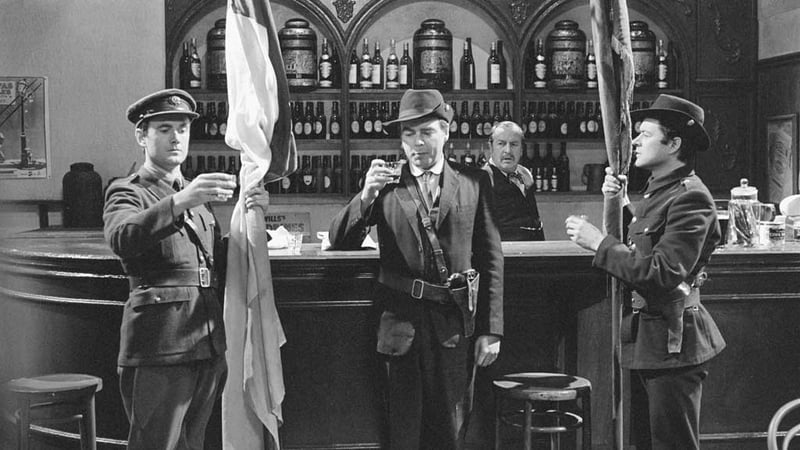
O’Casey’s main strategy in this regard was to present the disconnect between nationalist rhetoric and the lives of those who such rhetoric promises, but finally fails, to improve. This ambition haunts the key moment in the second act when, on that famous night, the play in the auditorium overwhelmed the play on-stage. The scene is set in a public house but outside its windows a political rally is taking place. As the action unfolds inside the pub, a disembodied voice booms Patrick Pearse’s powerful (if selectively edited) words from a position off-stage.
Those at the rally are being driven on towards revolutionary action – ‘It is a glorious thing to see arms in the hands of Irishmen. We must accustom ourselves to the sight of arms, we must accustom ourselves to the use of arms’ – and seduced by the rhetoric of martyrdom in the national cause: ‘the fools, the fools, the fools! - they have left us our Fenian dead, and, while Ireland holds these graves, Ireland, unfree, shall never be at peace!’.
We need your consent to load this rte-player contentWe use rte-player to manage extra content that can set cookies on your device and collect data about your activity. Please review their details and accept them to load the content.Manage Preferences
From RTÉ Archives, Sighle Humphreys from Cumann na mBan describes the riot that took place at a performance of The Plough and the Stars at the Abbey Theatre in February 1926.
Inside the pub, Pearse's words waft over, but in the end seem disconnected from the everyday concerns of characters. They include a prostitute trying to scrape a living, men and women who have let their taste for drink get the better of them, and a barman attempting to keep order with half an ear tuned to what is 'spoutin’ out’ of the man outside.
As Pearse’s voice continues to bounce around the onstage pub, men carrying a banner of the Plough and the Stars and a green, white and orange tricolor arrive into this scene. The perceived denigration of the national flag (brought into contact with the pub’s sexual rambunctiousness) provided a rallying-cry for those audience members who launched their protest.
O'Casey’s issue was not with Easter Week nor its key players, but rather with the dangers of misremembering and misappropriation
But the real site of contention was a good deal more complex, with the protestors’ actions designed to halt the production before the final two acts, set in Easter Week 1916, could play out. In the course of these final acts, and in response to the officially sanctioned ‘national’ version of Easter Week, O’Casey was intent on presenting his audience with a close-up of revolution that included the parts left out in its subsequent mythologizing (looting, fear, uncertainty).
O’Casey’s issue was not with Easter Week nor its key players, but rather with the dangers of misremembering and misappropriation. The problem, as he was to put it in 1949, with a nod to W.B. Yeats' poem Easter, 1916, was that ‘things had changed, but not utterly; and no terrible beauty was to be born. Short Mass was still the favourite service, and Brian Boru’s harp still bloomed on the bottles of beer’.
Follow RTÉ Brainstorm on WhatsApp and Instagram for more stories and updates
The views expressed here are those of the author and do not represent or reflect the views of RTÉ
