




Analysis: The issuing of 5,000 eviction notices in three months last year is quite revealing when viewed against Ireland's historical record
By Eoin McLaughlin, Heriot-Watt University and Richard Mc Mahon, MIC Limerick
New rental rules are due to come into force in Ireland next month that will allow landlords to set rents at market rates once a tenant leaves a property. At the same time, the prospect of stronger tenant protections, including six-year tenancies, has seen many smaller landlords to exit the market. This appears to have contributed to a spike in eviction notices during 2025.
Figures from the Residential Tenancies Board show that 5,405 notices of termination were issued in the third quarter of 2025, a 35% increase year on year. According to RTB data, 19,011 notices were issued in 2023, 16,546 in 2024 and 14,826 in the first three quarters of 2025. On current trends, the total for 2025 will be similar to, and possibly slightly above, 2023 levels. This is not a short-term fluctuation but part of a sustained pattern of unusually high levels of tenant displacement.
We need your consent to load this rte-player contentWe use rte-player to manage extra content that can set cookies on your device and collect data about your activity. Please review their details and accept them to load the content.Manage Preferences
From RTÉ Radio 1's Today with David McCullagh, the impact of eviction notices on tenants
These eviction notices are not primarily cases of rent arrears or tenant misconduct: 61% of notices between 2022 to 2025 were issued because landlords declared their intention to sell. This points to a rental system that many property owners no longer view as viable.
As smaller landlords exit, properties frequently transfer into owner-occupation, reducing the supply of rental housing. Each sale tightens the market further, increases pressure on remaining tenants and makes future tenancies more precarious.
Ireland's history of evictions
If the issuing of 5,000 eviction notices in three months is disturbing, it becomes more unsettling when viewed against Ireland’s historical record. Evictions were a defining social and political issue in Ireland in the 19th and early 20th centuries. They were a product of a landlord system characterised by extreme inequality in land ownership, a system where the overwhelming majority of agricultural land was owned by landlords who made up less than 1% of the overall population. The majority of the population had no legal claim to ownership and lived with the possibility and fear of eviction.
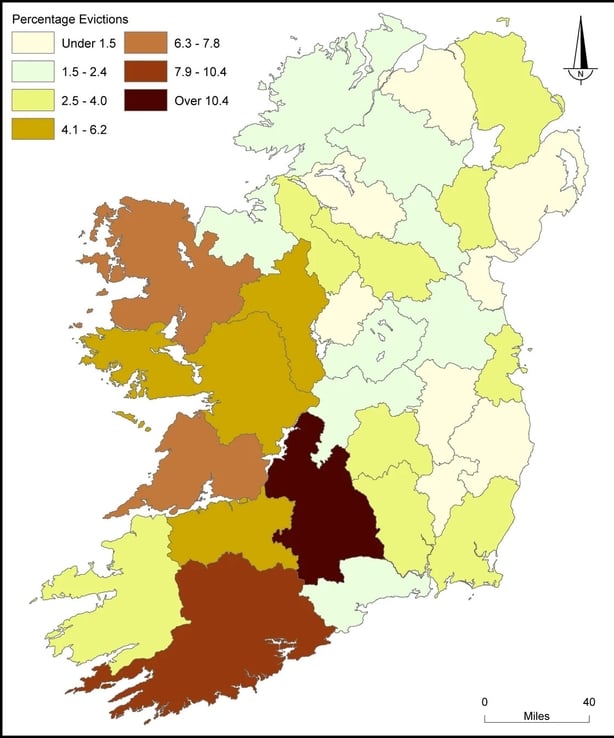
In the years immediately before the Famine, evictions were a troubling feature of Irish life. In the late 1830s and early 1840s, for example, there were, on average, 5,000 civil bill ejectment cases brought annually and, of these, over two-thirds resulted in eviction decrees. Even allowing for the fact that some decrees were used as a rent-collection tactic and not all resulted in permanent removals, the figures suggest that thousands of families were being displaced annually in the years before the Famine.
During the Great Famine, legislation that denied poor relief to tenants who held more than a quarter acre of land encouraged mass evictions and acted as a "death-dealing instrument". It is likely that over half a million people were evicted during that catastrophic period in modern Irish history. In the decades that followed, eviction numbers gradually fell: evictions averaged 885 per year between 1855 and 1877. They rose again during the Land War (1879–82), before entering a long decline as tenant right, land purchase, and political reform reshaped the system.
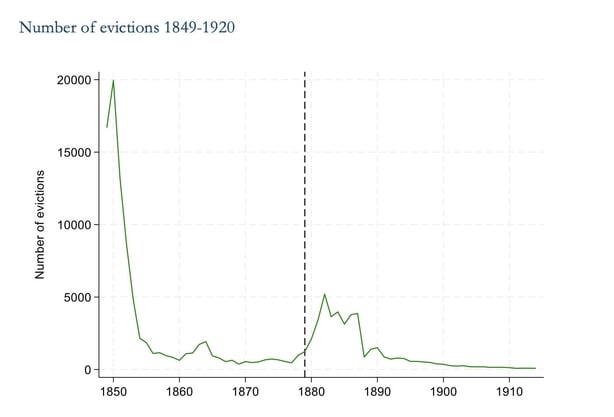
The revealing comparisons between then and now
Of course, there are important differences between then and now. Household sizes were much larger in the 19th century: an average of 4.85 people were displaced per eviction from 1849 to 1880. In the 2021 census, the average household size was 2.74. Today's eviction figures therefore imply fewer people per household affected.
But another comparison is more revealing: the rate of evictions relative to the number of households. Between 1855 and 1877, the eviction rate was 0.14 per 100 holdings, rising to 0.48 per 100 during the Land War. Again, using the 2021 census figure of 1.95 million households, the modern rate implied by recent RTB data is roughly one eviction notice per 100 households (and higher if we only consider rented households) in both 2023 and 2024.
Those who are evicted are also drawn from a much smaller share of the overall population than in the 19th century. The renter share of the market is now 33% compared with 96% in the 1800s. Even allowing for the fact that some of these eviction notices may not have led to the eviction of the tenants, it is not unreasonable to suggest that we are now seeing eviction rates that have not been seen in Ireland since the 1850s.
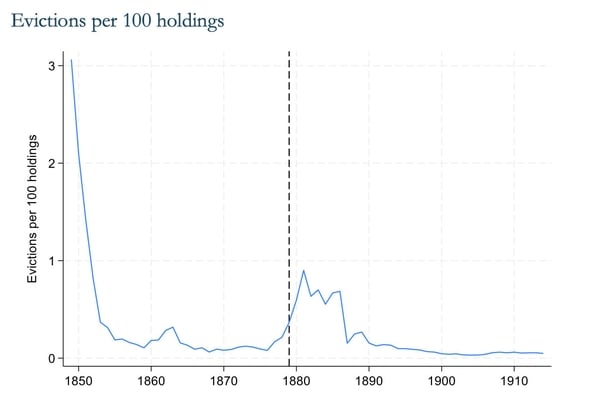
Of course, the historical analogy can be strained due to the complexity of comparing often radically different economic, social and political contexts. We are not reliving the Land War, after all. Today's housing system is urban, financialised, and centred on private rentals rather than agricultural tenancies. Yet, the scale of displacement now being recorded would not look out of place in post-Famine Ireland and arguably tenants today have less rights and customary advantages than their counterparts in the late 1800s and early 1900s. There can be little doubt but that evictions, now as then, are a destructive feature of Irish life.
The story in other countries
International comparisons are difficult because countries measure evictions differently: some report eviction procedures, others court orders and some only record physical removals. Using RTB data and the census, roughly 3% to 4% of renter households in Ireland receive a notice of termination in a typical year. This is not the same as an eviction order, it is an earlier stage in the process, but it measures how many tenants are being required to leave their homes.
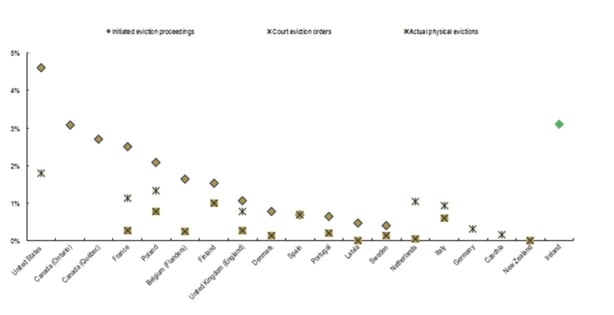
OECD data show that less than 1% of renter households are subject to eviction orders annually in many Western European countries, including the UK, Denmark, Sweden and the Netherlands. The initiation of eviction proceedings appears, at least, relatively rare compared to Ireland, which may have one of the highest proportions of renters who are subjected to notices of termination in the western world.
Put simply, the share of Irish tenants being told they must leave their homes appears larger than that of tenants in many comparable countries. This does not necessarily mean Ireland has one of the highest eviction rates in the OECD but it does show that Ireland likely has an unusually high flow of tenants entering the eviction process.
For many households, a notice of termination now means entering a frantic search for accommodation in a market with record rents, reduced availability and intense competition. Eviction is no longer a marginal event affecting a small number of vulnerable tenants, but is becoming a routine feature of life in the private rental sector.
We need your consent to load this rte-player contentWe use rte-player to manage extra content that can set cookies on your device and collect data about your activity. Please review their details and accept them to load the content.Manage Preferences
From RTÉ Radio 1's Morning Ireland, RTE Political Correspondent Mícheál Lehane on new legislation introducing changes to the rental system
Historically, eviction crises were treated as evidence that something deeper was structurally wrong. The question Ireland faced in the 19th century was what kind of reform would quell unrest and bring eviction numbers down. This prompted fundamental changes in land ownership, tenancy law and social protection. The lesson from this history is that the state intervened in ways that fundamentally reshaped property relations once evictions reached politically and socially intolerable levels.
The RTB figures suggest we may be approaching a similar inflection point in the modern rental system. When eviction reaches this scale, it ceases to be an unfortunate by-product of the market and becomes a signal that the system itself is failing to provide basic housing security.
Follow RTÉ Brainstorm on WhatsApp and Instagram for more stories and updates
Prof Eoin McLaughlin is Professor of Economics and Head of Research in the Department of Accountancy, Economics, and Finance in the Edinburgh Business School at Heriot-Watt University He is a former Research Ireland awardee. Dr Richard Mc Mahon is a Lecturer in the Department of History at MIC Limerick
The views expressed here are those of the author and do not represent or reflect the views of RTÉ
