





Analysis: Carson may well have played a game called hurley as a Trinity student, but he wasn't even the leading hurler in his own family
It is often said that Edward Carson, the Dubliner who led Ulster Unionism in its resistance to Home Rule and who helped establish the Northern Ireland state, was a hurler in his student days. Carson joined Trinity College Dublin as a law student in 1871 and according to his biographer Edward Marjoribanks took up a game called "hurley", considered by some to be a version of hurling.
An 1877 match report in the Irish Sportsman, a Unionist-leaning weekly sports newspaper, apparently listed Carson among several new hurley players in Trinity who "distinguished themselves considerably by their good play".
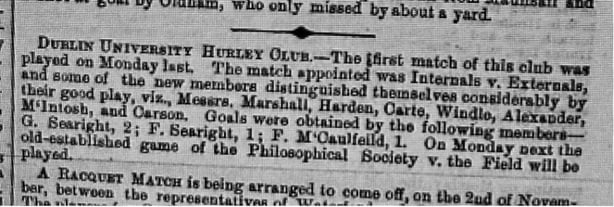
Such was the apparent regard for Carson as a hurler that then Sinn Féin leader Gerry Adams felt it only appropriate in 2010 for the winners of the Poc ar an Cnoc hurling competition at Stormont Castle to be awarded the Edward Carson Cup. Adams described his surprise at finding that "the father of unionism was also a Gael" and proceeded to explain that Carson "got an honourable mention in the Irish Sportsman" as a hurler.
Historians were quick to correct Adams at the time, explaining that hurley was some distance removed from the ancient game of hurling. Hurley was a stick and ball game played in Trinity from at least the 1860s, with challenge matches occasionally taking place against school teams and other hurley clubs in Dublin. The game died out in Trinity in 1883 but survived for a while in a small number of Dublin schools.
Trinity's hurley was more like hockey than the hurling we know and love. Played on the ground, it forbade handling the ball or raising the stick above shoulder height, it required players to remain onside and, by the 1880s, was restarting play with a "bully". Trinity students who had played hockey during their school days in England saw no meaningful difference between hurley and hockey.
From British Pathé, coverage of Edward Carson's funeral in 1935
Indeed, it’s not unreasonable for Trinity’s hurley club to be considered the world’s first university hockey club. Hockey was in English clubs and schools since the mid-19th century, but the game wasn’t played in its universities until it reached Cambridge and Oxford in the 1880s. Trinity had been playing hurley for 20 years by then.
Hurley supporters at the time and some historians since have stressed a continuity from Gaelic Ireland’s hurling to Trinity’s hurley. In 1870, hurley fan John Lawrence wrote in reference to the Trinity game that "hurling is an old Irish game, and the rising generation seem determined that it shall not be allowed to die out".
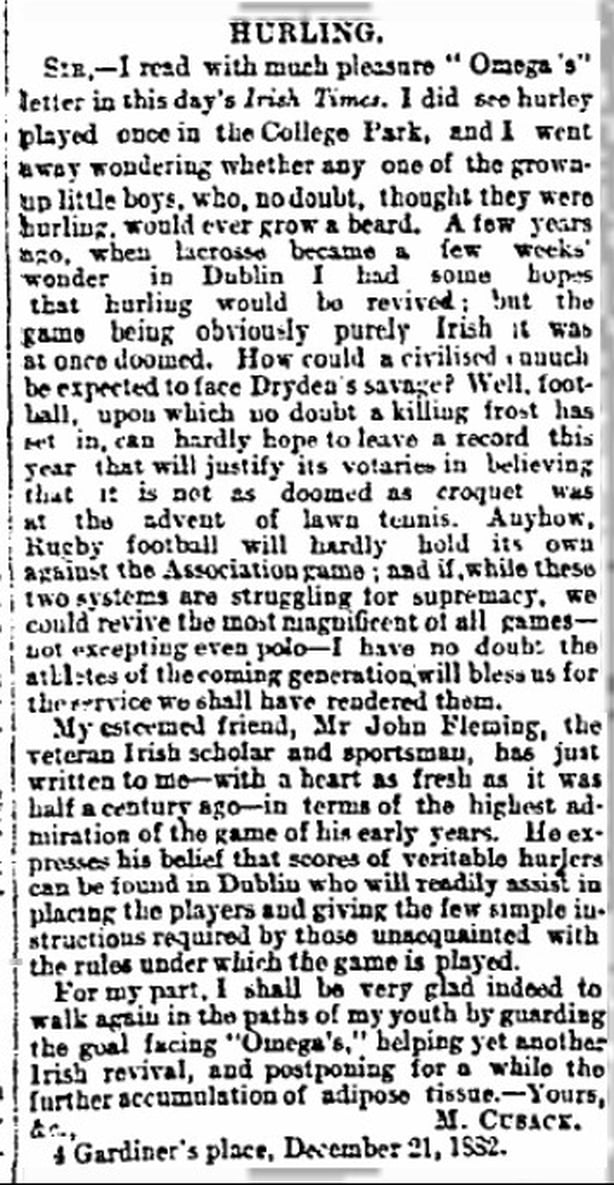
But future GAA founder Michael Cusack was having none of it. In 1882 in the Irish Times, he mocked the Trinity game by describing the players as "grown up little boys" and. wondered whether they would "ever grow a beard". Cusack wrote that the players "no doubt, thought they were hurling", but insisted that their game for "civilised eunuchs" was not the revival of "the most magnificent of all games". Reviving hurling was a responsibility Cusack took upon himself.
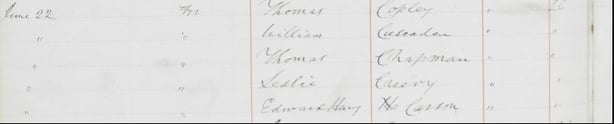
So what does this mean for Carson's sporting career? Was he distinguished as a Trinity hurley player, if not a Gaelic hurler? My research says no. Having explored hundreds of match reports from the 1860s to the 1880s and thousands of Trinity’s admissions records, I have developed a profile of the players of Trinity’s hurley. Unsurprisingly, the players were predominantly Protestant, middle-class and Irish. Many went on to achieve fame as scientists, politicians, writers, lawyers and sportsmen. But the most famous of them all, the future Lord Carson, was nowhere to be found.
In fact, the 1877 Irish Sportsman article that allegedly celebrated Carson as a "new member" of the Dublin University Hurley Club who "distinguished himself" by his play was in fact about his younger brother, James Seymour Carson.
James was an 18-year-old first-year medical student who was new to Trinity in 1877. He was five years younger than Edward who by 1877 was busy being called to the Dublin Bar. James featured in press reports on hurley matches throughout his time in Trinity, including matches in which he represented the Medical School. Not so for his brother Edward.
Matches featuring the Law School never once listed Edward Carson as a player. His friend John Ross, who would later become Lord Chancellor of Ireland, captained the Law School Hurley team while another friend, James Shannon, was an accomplished hurler who sat on the Hurley Club's committee. Both were mentioned several times in press reports, but never once alongside their friend Edward Carson.
Indeed, Carson was never renowned as a sportsman. We know from his biographers that during his secondary schooling at Arlington House he acquired the nickname Rawbones due to his poor health, much of which would continue throughout his life. Carson’s brothers, but not Carson himself, were accomplished as sportsmen in Arlington House.
The evidence that Carson played hurley at all is limited to a half sentence in his 1932 authorised biography by Marjoribanks
The evidence that Carson played hurley at all is limited to a half sentence in his 1932 authorised biography by Marjoribanks. At that time, Carson was elderly and unwell. Marjoribanks himself died before completing the biography and left behind notes and press cuttings that were used to complete the book. Perhaps one cutting was a misunderstood 1877 match report?
Carson may well have played hurley in Trinity but he was not a Gaelic sportsman. As for whether he was a leading hurler in Trinity, he wasn’t even a leading hurler in his own family.
Follow RTÉ Brainstorm on WhatsApp and Instagram for more stories and updates
The views expressed here are those of the author and do not represent or reflect the views of RTÉ
