



Analysis: Most of your electricity bill is determined by international fuel prices, the energy regulator and electricity grid operators
By Paul Deane and Duncan Mathews, UCC
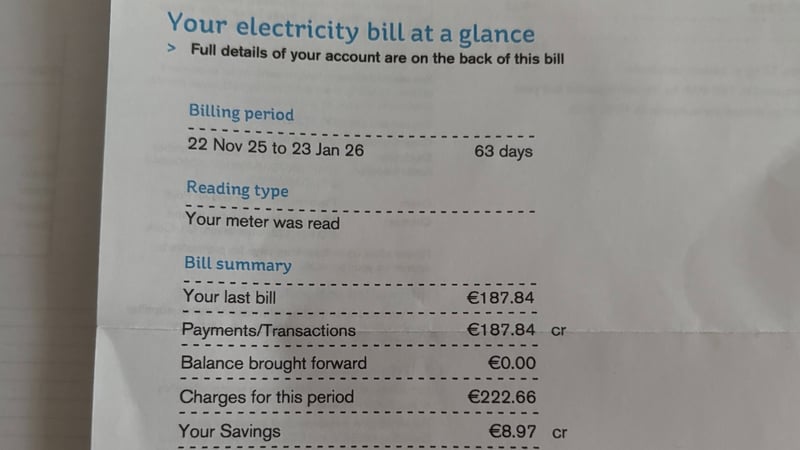
It's important to note that there isn't a 'standard' electricity bill. All bills are a little different and depend on where you are, how much electricity you use, and when you use it. Here's how electricity suppliers calculate that final amount that your eyes dart to at the bottom of the bill - and why this has changed so much over the past six years.
Your electricity supplier must charge different costs depending on whether you are in a rural or urban location, with rural customers paying more because electricity must be moved further to get to rural homes. The type of plan you are on also matters—whether it is a standard plan, where you are likely paying more, or a discount deal where you are paying less.
We need your consent to load this rte-player contentWe use rte-player to manage extra content that can set cookies on your device and collect data about your activity. Please review their details and accept them to load the content.Manage Preferences
From RTÉ Radio 1's This Week, why does Ireland have the most expensive electricity in the EU?
Most of your electricity bill is not decided by your energy supplier but is determined by international fuel prices, the energy regulator (CRU) and the electricity grid operators (EirGrid and ESB Networks), who charge costs to make sure there is enough electricity and infrastructure available to keep the lights on and that it can get to where it is needed in a reliable way.
Our bills have broad categories of costs such as ‘Standing Charges’ and ‘Other costs’ but in all there are about 15 core cost elements that go into our bill that electricity suppliers aim to recover across their full portfolio of offerings to customers over a year and longer. These 15 core elements can be bundled into five groups:
The cost of making electricity
Making up about 35% of an annual bill, this is sometimes known as the ‘wholesale cost of electricity’ and is influenced by international gas prices. Ireland is unusual in Northwest Europe because we burn more natural gas (in relative terms) to make electricity than most other countries. In Ireland, the monthly wholesale price of electricity gets a lot of attention, but it is the longer term prices that matters most.
The cost of moving electricity
About 20% of your bill is determined by the energy regulator and power system operators. Once electricity is made, it must be moved to where it is used, and this is done on big power lines called Transmission and small lines called Distribution. Ireland is once again different compared to other countries, as we have an unusually long electricity grid. Because we have a dispersed population base, we pay more here.
The cost of managing and operating the grid
This accounts for about 25% of a bill and is mainly determined by the power system operator. There is a cost to managing the power grid which includes making sure there is backup to cover times when power plants break down and periods of very low renewable generation. It also includes costs associated with redirecting electricity or even reducing renewable power output when the power lines are too congested and power can’t travel to where it is required cost effectively.
We need your consent to load this rte-player contentWe use rte-player to manage extra content that can set cookies on your device and collect data about your activity. Please review their details and accept them to load the content.Manage Preferences
From RTÉ Radio 1's Drivetime, Dr Paul Deane from UCC on how electricity prices set to rise to fund grid revamp
The cost from suppliers
This is about 10% of a bill and is determined by the supplier and it relates to the cost of doing business. It is influenced by the size of the company, including wages, advertising, digital platforms, debt and volume of customers. Supplier profit margins are in this category also, and we estimate these to be about 4% of your bill. This value will be higher if you are on a standard plan and lower if you are on a new discounted plan.
Tax
In total, this is about 10% of a bill. The level of tax is determined by government policy, including VAT (9%), but this also includes a small support for renewables
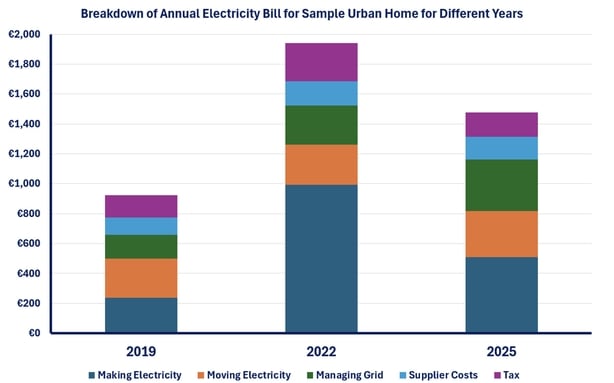
The chart above shows how a sample annual bill for an urban customer using an average amount of electricity has changed over the past six years. Prices are in the year of the bill and exclude electricity credits from government.
We need your consent to load this rte-player contentWe use rte-player to manage extra content that can set cookies on your device and collect data about your activity. Please review their details and accept them to load the content.Manage Preferences
From RTÉ Radio 1's Morning Ireland, the average Irish electricity bill is expected to rise to €1,877 from October 2025
The main drivers of annual change in absolute euro terms between 2019 and 2025 are the cost of making electricity, which increased by €270; the cost of managing the grid, which increased by €180 and the costs of moving electricity which has increased by €50.
The cost of making electricity increased dramatically in 2022. This was driven by international gas prices that spiked because of the war in Ukraine, leading to a move away from piped Russian gas in Europe toward shipped Liquified Natural Gas from the US which has a higher price.
The cost of ensuring a stable power system with more renewables has risen as the grid operator manages complex changes with new technologies
The cost of managing the grid is in-part magnified by the cost of making electricity. For example, the cost of electricity congestion (like traffic) within power lines is a growing concern. Separately, the cost of ensuring a stable power system with more renewables has also risen as the grid operator manages complex changes with new technologies.
Finally, the cost of moving electricity has increased as we build more local and national power lines to replace old infrastructure and provide for growing electricity demand in the country.
Follow RTÉ Brainstorm on WhatsApp and Instagram for more stories and updates
Dr Paul Deane is Senior Lecturer in Clean Energy Futures at the Research Ireland-funded MaREI Centre and the Sustainability Institute at UCC. Duncan Mathews is a Research Ireland employment-based scholar at the MaREI Centre at UCC.
The views expressed here are those of the author and do not represent or reflect the views of RTÉ
