




Analysis: Solar flares and geomagnetic storms can have very significant effects on satellites, airplanes and GPS and electrical systems
Weather in Ireland is a daily topic of conversation, with the constant potential for rain, sun, heat, and snow - sometimes all in the same day. This concept of changeable weather is something that must also be considered in space. Although it may seem very far away, weather in space can have very significant effects on life and technology on Earth. As a result, weather agencies such as the National Oceanic and Atmospheric Administration (NOAA) in the USA, and the Met Office in the UK are now regularly tracking and reporting on space weather.
But what exactly is space weather, and how does it affect us here on Earth? Earth is just one of the planets orbiting our local star, the Sun, which sits at the centre of the solar system. Although it appears to be very calm if observed from the ground using the proper equipment, the Sun is a highly active star, with an internal magnetic field just like a bar magnet and a constant stream of charged plasma flowing outwards into the solar system called the solar wind.
From NOAA Satellites, 5 things to know about space weather
This is normally a slow continuous process, and satellites and spacecraft are usually designed in such a way to protect against these charged particles. The Earth is also protected by a magnetic shield, called the magnetosphere, which funnels these particles towards the poles, producing the aurorae or Northern and Southern lights.
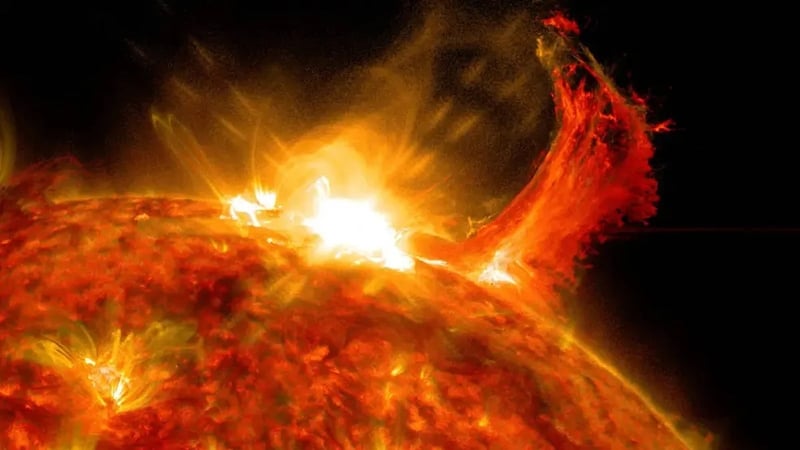
As the Sun rotates, it twists up its magnetic field, producing dark sunspots as this magnetic field bursts through the Sun's surface to form spectacular loops in its hot atmosphere. Sometimes the constant motion of the Sun's plasma forces these loops together, causing the magnetic field to break and reconfigure, releasing enormous amounts of energy in seconds.
This energy release can be seen as a flash of radiation (called a solar flare) which accelerates large blobs of charged plasma (called coronal mass ejections or CMEs for short) into the solar system, and accelerates energetic particles to near the speed of light. If directed at Earth, these eruptions can compress and leak inside the Earth's protective shield, allowing the energetic particles to affect satellites and even reach the ground closer to the equator.
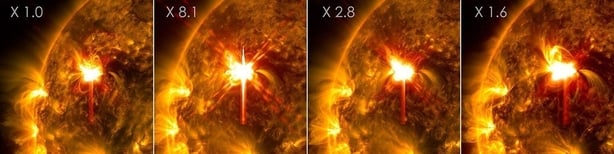
Photo: NASA/SDO
What makes these eruptions dangerous is the fact that they consist entirely of charged particles, which can overload electronic circuits and power grids, destroying transformers and causing blackouts. They can also knock out satellites, blinding the cameras they use to stay stable by keeping track of the stars, and causing them to spin uncontrollably. Global navigation systems such as GPS and other telecommunications systems can stop working as a result. Our increasingly digital world means that this can have major consequences for everything from airplane navigation to oil-well drilling and internet connectivity.
Picture the scene; a powerful solar eruption causes beautiful aurora that can be seen during the daytime. The aurorae are so bright that you need dark glasses outside at nighttime, and in fact they can even be seen as far south as Cuba. This is what happened during the Carrington Event, a major solar eruption which occurred in 1859, and was the first indication that what happens on the Sun can affect the Earth. This occurred before the modern age, so electronic effects were almost non-existent, but the magnetic effects were widespread. Compass needles swung uncontrollably, causing havoc for sailors and travellers in the age before GPS, while telegraph operators on both side of the Atlantic were able to communicate without any power flowing along the lines.
From Science Channel, what are solar flares?
If this was to happen today, things would be slightly different. A significant storm in 1989 caused a major blackout along the Eastern United States and Canada which lasted for eight hours. A series of major storms during Halloween 2003 caused a blackout in Malmo in Sweden and destroyed a power transformer in South Africa. More recent effects have included the loss of 40 Starlink satellites soon after launch in February 2022, long-lived radio blackouts in September 2017 and February 2024, and grounding of Swedish air traffic in November 2015. These may seem like isolated events, but the nature of our globally interconnected world means that these solar storms have the potential to cause knock-on effects.
Thanks to a fleet of spacecraft throughout the solar system keeping a constant watch on the Sun, we can have up to several days notice that these eruptions are going to hit the Earth. This enables operators to direct flights away from the poles, put satellites into sleep mode and monitor power grids. As a result, it is possible to mitigate against some of the effects of these storms.
From The History Guy, a look at the 1859 Carrington Event, the largest solar event in history
But we still don’t know enough about space weather. At the moment, we can only prepare for a solar storm when we see it coming rather than forecasting or predicting them. If it's a particularly big storm, that doesn’t give us much time to prepare.
Space weather is an area of ongoing research, and teams of scientists and space weather forecasters around the world are actively trying to better understand and predict how these eruptions start and affect Earth and the near-Earth environment. Ultimately, our Sun is an incredibly complex star and predicting that it is going to do something and erupt more often than not comes down to guesswork. Fortunately, our guesses are getting better the more we learn about how these eruptions start and evolve.
Follow RTÉ Brainstorm on WhatsApp and Instagram for more stories and updates
The views expressed here are those of the author and do not represent or reflect the views of RTÉ
