


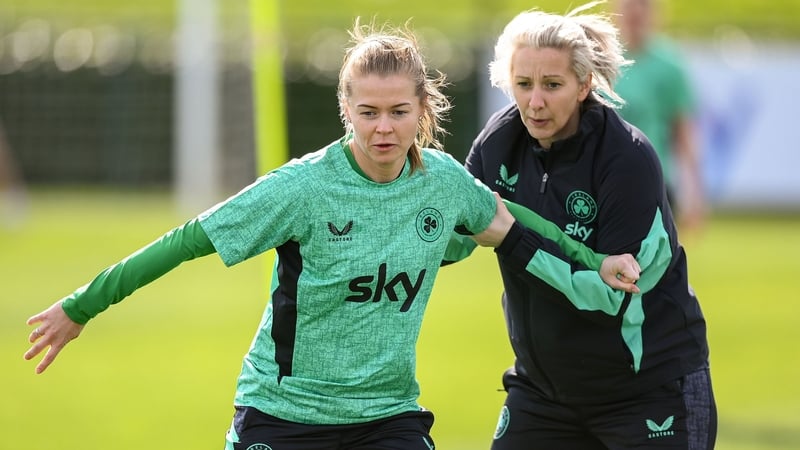
Analysis: Research shows that women in sport are disproportionately targeted by abuse and hate, which can have a huge impact on all in the sports ecosystem
By Dr Katie Liston, Ulster University
When Republic of Ireland's women's team head coach Carla Ward described the abusive online comments directed at Irish women's international, Ruesha Littlejohn, as 'disgraceful’, she was not the first coach to do so. She joined a lengthening list, including Sarina Wiegman (England), Emma Hayes (US), Andrea Soncin (Italy) and Bev Priestman (Canada), of coaches who have seen this happen.
Of course, Littlejohn was not the only female footballer to experience this. A 60-year old man recently pleaded guilty to sending abusive messages to England professional footballer, Jess Carter, during the UEFA 2026 Women’s Euros. When 19 year old Swedish player, Smilla Holmberg, signed for Arsenal this month, the club had to disable comments on the online posts announcing her signing. This was because replies and quote tweets were flooded with overtly sexualised descriptions of women’s football as a beauty contest, GIFs alluding to masturbation and varied portrayals of a beautiful Swedish Viking girl.
We need your consent to load this rte-player contentWe use rte-player to manage extra content that can set cookies on your device and collect data about your activity. Please review their details and accept them to load the content.Manage Preferences
From RTÉ Radio 1's Inside Sport, Republic of Ireland manager Carla Ward on the online abuse received by Ruesha Littlejohn
This abuse can have a significant impact on sportspeople, women included, and others in the sports ecosystem. How do we define it and why is it such a challenging issue? Online abuse and hate is a subset of the growing problem of online harms. These include the use of pejorative terms and slurs; derogatory, demonising and dehumanising language and statements; and identity-based insults; through to threats (aggression and violence); doxing, sextortion, bribery, catfishing, swarming and mis/disinformation.
Sporting examples of online abuse include comments targeted at individuals and groups on the basis of gender, disability, race, ethno-national or religious identity or belief and sexual orientation. Online abuse is more than a spillover of the more traditional fan-on-athlete responses, expressed live, and often regarded as crowd banter. Much more than this, online abuse extends to all stakeholders in the sports ecosystem, it occurs at all times of the day and night, and it can be sustained, long after the event in question.
There are a number of facets to it: the corporate response; tech solutions; government and legal responses and how those at the coalface in sport deal with this. Precisely because of these layers, online abuse can feel like it is 'uncontrollable'. No one organisation either wants to, or can, own the problem. It’s as if we’re walking up a down-elevator.
We need your consent to load this rte-player contentWe use rte-player to manage extra content that can set cookies on your device and collect data about your activity. Please review their details and accept them to load the content.Manage Preferences
From RTÉ Radio 1's Morning Ireland, "appalled but unsurprised": Sports Against Racism Ireland react to online abuse directed at Irish athlete Rhasidat Adeleke
All of this feels worse because of the ubiquity and reach of social media. Along with athletes themselves, a host of other stakeholders can be impacted, directly or indirectly. Family members of athletes, volunteers and paid staff at sports clubs and organisations, journalists, media production staff, officials, pundits, coaches and fans all receive online hate.
Research demonstrates that women in sports like football are disproportionately targeted by this abuse. For Littlejohn, Carter, and girls aspiring to careers in football, they are potential ‘sitting ducks’ for online abuse and harms in a rapidly expanding industry.
The widespread abuse directed at women in sport has a distinctive purpose: to police social boundaries with ‘virtual manhood’ and keep girls and women ‘in their place’. It can also be understood as pushback against the slow but evident movement towards gender equality. Therefore, it is not just poor or ill-judged online behaviour, or even banter, nor can it be downplayed or ignored by those charged with developing the women’s game. An Elite Development officer told me that a player refused to play for a national team because of online abuse directed at family members.
Coalitions of the willing in communities, organisations and at government and society level will be crucial.
One player’s account is revealing in this context and is typical of most players’ responses. "I spent about three hours reading what people were saying", she said. "And it was probably the loneliest moment of my life because I thought ‘what chance have I got?’. I honestly didn’t know if I could survive it"
In 2025, the Tackling Online Hate in Football (TOHIF) research team, comprised of academics at Ulster University, Dublin City University, Loughborough University, Leeds Beckett University and Sheffield Hallam University published findings from a three-year long investigation of online hate in football and other sports. Prominent findings included the following:
- Female footballers, like Littlejohn, are routinely targeted for playing football, a perceived lack of skills, and on the basis of their sex, gender, sexuality and appearance;
- Anti-feminine slurs are very common in football and across all sports. Prominent among these are ‘bitch’, ‘c***’, ‘twat’, ‘pussy’, ‘bird’ and ‘whore’. One ex-female professional said:
"People would just call me things like a dirty whore, a dirty scumbag, a slag, a prostitute, they would comment on my body parts … I would see people having full-blown conversations about me on their platforms, and people interacting back … Reading your name like you’re a piece of dirt on someone’s shoe"
- Between 0.5 and 1% of social media posts related to major sports events include online abuse and offensive language. This varies by sport, platform and event, reaching 3.5% in some cases. This demonstrates a not insignificant underbelly of negative attitudes;
- Online abuse directed at sports journalists is now so ubiquitous as to be habitually accepted by them. Worryingly, journalists are already self-censoring as a coping mechanism.
- Like journalists, athletes expect online abuse too, but many are ill-prepared for the consequences. Clubs and national sports federations also expect it but their preparedness for, and responses to, the issue are hampered.
The reseach team have already worked with women’s academy players in the UK to help them understand how to respond appropriately. The aim is to control the controllables and build a proactive consensus among those committed to tackling the issue. Coalitions of the willing in communities, organisations and at government and society level will be crucial.
Given the attraction of the English WSL for aspiring young players across the island of Ireland, it is vital that clubs and national associations too adopt proactive policy responses to this issue. TOHIF will be working with elite girls’ teams and national sports federations in Ireland over the next 12 months.
If you would like to be part of the solution, visit the United Against Online Abuse, an international coalition, or contact the TOHIF team. If you have been affected by online abuse or would like to speak to someone about it, please contact the National Parents Council, Women's Aid or Teach Tearmainn.
Follow RTÉ Brainstorm on WhatsApp and Instagram for more stories and updates
Dr Katie Liston is a Senior Lecturer in the School Of Sport and a member of the Sport and Exercise Sciences Research Institute at Ulster University
The views expressed here are those of the author and do not represent or reflect the views of RTÉ
