


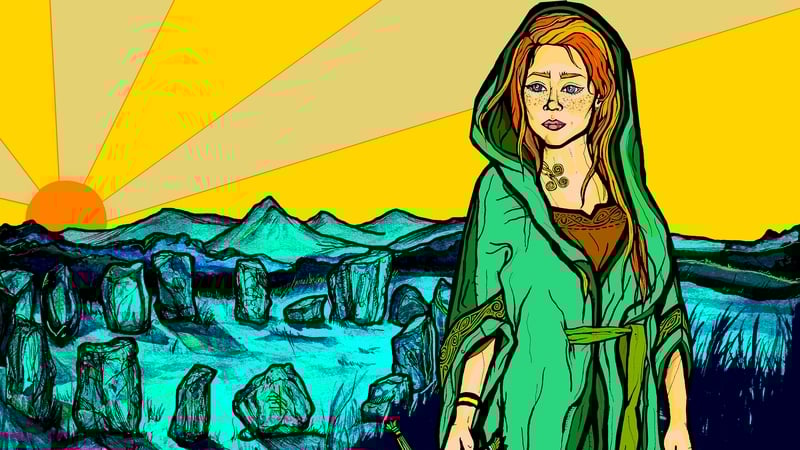

Analysis: The emergence of St Brigid's Day as a public holiday marks a renewed engagement with Indigenous Irish ways of understanding time, land and belonging
In early February, when the days finally begin to lengthen and the land stirs after winter’s stillness, Ireland marks a threshold. Long before the modern calendar divided the year into months, quarters, or fiscal cycles, this moment mattered. Known as Imbolc, it signalled the return of light, the beginning of the agricultural year and the fragile promise of renewal.
Today, its re-emergence as a nationally recognised holiday represents more than an additional day off work. It marks a renewed engagement with Indigenous Irish ways of understanding time, land, and belonging.
We need your consent to load this rte-player contentWe use rte-player to manage extra content that can set cookies on your device and collect data about your activity. Please review their details and accept them to load the content.Manage Preferences
Ó Beo ar Éigean, Imbolc, Brigid agus Piseoga
Imbolc is the feast day of St Brigid, one of Ireland’s patron saints, but it is also a pagan festival that marks the beginning of spring held in the name of a Celtic pagan Goddess, also Brigid. The two figures have become incontrovertibly linked and have merged into a single legendary figure embodying inclusivity, feminine strength, healing and a deep connection to nature. She is the greeter of Spring, signalling warmer and brighter days ahead. She is an amalgam of Celtic and Christian mythology.
St. Brigid is the Christianisation of the Goddess Brigid, tapping into a deep spirituality that preceded Irish Christianity. She was, though, a real woman, born in the 5th century, a time of transition between the pre-Christian and Christianisation of Irish society. Medieval Ireland was a largely misogynistic and feudal society, but St Brigid emerged from this restrictive and hierarchical society as patron and founder of the formidable church of Kildare.
St Brigid had a lot of qualities of a goddess. She was a remarkable woman rising through history with a legend as a spiritual leader, a woman of the land, an advocate for the poor, a peacemaker and a woman of illustrious hospitality. This reputation and the proselytization which occured during this period may be why the mythology of the Celtic Goddess Brigid has become imbued with the history of St Brigid.
We need your consent to load this rte-player contentWe use rte-player to manage extra content that can set cookies on your device and collect data about your activity. Please review their details and accept them to load the content.Manage Preferences
From RTÉ Radio 1's History Show, Dr Niamh Wycherley from Maynooth University on the life and times of St Brigid
Brigid was a goddess of pagan Ireland and a member of the Tuatha Dé Danann, a mythical race inhabiting Ireland before the arrival of the Celtic people. She was the daughter of the chief of the gods, The Dagda, and a triple goddess – the goddess of healing symbolised by the element of water, goddess of the alchemical force of fire, and goddess of poetry.
Neither Brigid ever got the full recognition they deserved. Goddess Brigid morphed into St Brigid, and St Brigid was overshadowed in Ireland by the legacy of her male counterpart St Patrick. But Brigid is an iconic figure in modern Ireland. She fuses our ancient pagan past with a more traditional Ireland but, more importantly, she is a woman. The stories of the two Brigids contrast drastically with how women in Ireland have been treated throughout history.
The colonisation of Ireland certainly seized land, but it also reordered values. The year became something managed by institutions rather than observed through nature. The landscape became enclosed, regulated and stripped of its Indigenous meanings, and women’s roles were narrowed and curtailed. Colonial systems imposed to control territory also constrained bodies, labour, and knowledge, particularly those traditionally held by women. Indeed, as we know only too well, Irish women's lives and bodies were regulated and controlled well into the modern era.
We need your consent to load this rte-player contentWe use rte-player to manage extra content that can set cookies on your device and collect data about your activity. Please review their details and accept them to load the content.Manage Preferences
From RTÉ Radio 1's Our Divine Sparks, guests explore the legacy of St. Brigid
Imbolc honours a seasonal threshold rooted in Indigenous cosmology and Irish womanhood. A public holiday named after an Indigenous female figure is an empowering symbol for Irish women. Brigid was relegated to the shadows by a male-dominated past of colonisation and religious oppression, but she is now remembered as a powerful woman to be celebrated.
The bulk of today's public holidays in Ireland largely commemorate political events, religious observances or international norms. In aligning with an ancient seasonal rhythm in early February, Ireland acknowledges a deeper Indigenous cosmology, one that predates both colonisation and modern nationalism. The presence of Imbolc in public life signals that Indigenous Irish ways of knowing have not vanished. In an era of climate crisis and environmental degradation, Imbolc’s emphasis on seasonal awareness and restraint feels more relevant than ever as it asks to us pay attention to weather patterns, soil health and the slow return of light.
Public holidays rooted in Indigenous cosmology are part of a global reawakening to celebrate cultural heritage
There has been a revival worldwide of practices and customs oppressed by colonial pasts and ignored in contemporary sociopolitical landscapes. In 2022, New Zealand (Aotearoa to its Indigenous Māori population) established a public holiday during Matariki, which recognises the Māori New Year. A much more contentious debate recognising Indigenous culture can be seen in the United States, where people are increasingly recognising Indigenous Peoples' Day, as opposed to celebrating Columbus Day.
In this sense, Imbolc is less a celebration than a reawakening. It encourages a reconsideration of how time is marked and invites us to reflect on who and what is valued in contemporary Ireland.
Follow RTÉ Brainstorm on WhatsApp and Instagram for more stories and updates
The views expressed here are those of the author and do not represent or reflect the views of RTÉ
