


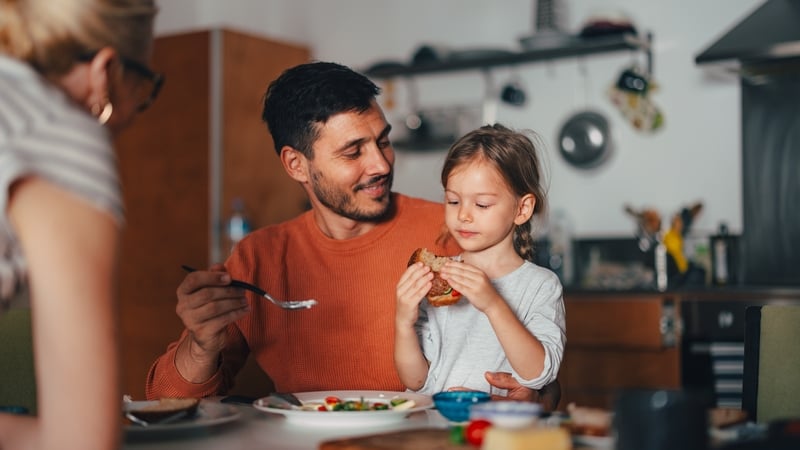


Analysis: Just as our children often mirror our own interests, voice and mannerisms, they also notice and absorb our attitudes and behaviours towards food
Healthy eating plays a huge role in supporting children's growth and development, with early childhood in particular a critical time for establishing lifelong healthy eating habits. Here are five ways to help develop healthy eating habits in children.
Parent provides, child decides
Do mealtimes often feel like a battleground? Establishing clear mealtime roles creates a positive, structured environment and reduces mealtime stress for both parents and children.
As a parent or caregiver, your focus is to decide what foods are offered, when meals and snacks are offered and where eating takes place. Your child's role is to decide whether they eat and how much they eat. Allowing them to regulate their intake, without pressuring them to eat, helps them to recognise their own hunger and fullness cues.
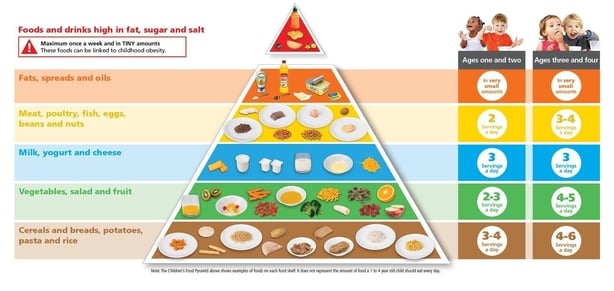
Use the Healthy Ireland Food Pyramid to guide food choice and offer a variety of foods from each food group throughout the day. When paired with clear mealtime roles, letting your child control how much they eat supports independence, confidence and the development of lifelong healthy eating habits.
Persistence is key
Children often take eight to 10 tries before they are willing to accept and enjoy new foods. Offer new or previously rejected foods alongside familiar favourites to avoid overwhelming your child. While persistence is important in offering new foods to your child, avoid forcing or pressuring your child to try foods.
Instead, praise and encourage any small step they take in exploring new foods. Even touching, smelling, or playing with new foods counts as progress! Gentle, positive experiences encourage your child to explore new foods and increase acceptance over time.
Be a role model
Just as our children often mirror our own interests, voice and mannerisms, they also notice and absorb our attitudes and behaviours towards food.
We need your consent to load this rte-player contentWe use rte-player to manage extra content that can set cookies on your device and collect data about your activity. Please review their details and accept them to load the content.Manage Preferences
From RTÉ Radio 1's Today with Claire Byrne, dietician Louise Reynolds on healthy kids' snacks
Eating together allows your child to see you enjoying a wide variety of foods, including those they may find challenging. Speaking positively about foods, showing curiosity, and demonstrating a willingness to try new foods can influence your child's own eating habits, creating a supportive environment where your child feels comfortable to explore new foods.
Even involving your child in simple meal preparation tasks like washing vegetables, choosing ingredients in the shop, or stirring ingredients helps to build their confidence at mealtimes. Be prepared for a little more mess though!
Blitz, blend, grate or chop
Sometimes, despite our best efforts, children continue to resist certain healthy foods, especially fruit and vegetables. In these cases, using "hidden heroes" might help. Blitzing, blending, grating, or finely chopping problematic veggies or fruits into sauces, soups, smoothies or even homemade meatballs, can improve the nutritional content of meals, without unnecessary mealtime stress.

This allows your child to benefit from nutritious foods while enjoying familiar flavours and textures. Over time, repeated exposure to these ingredients, even while hidden, can increase familiarity and reduce future resistance. This can be a temporary strategy to increase variety in your child’s diet and build acceptance, leading to offering these foods in full later.
Switch off to tune in
Mealtimes are an important learning opportunity for young children, allowing them to explore new foods and build positive eating experiences. While offering screens or devices can seem helpful, over time, regular distractions like TVs, phones or tablets can affect your child’s ability to recognise their own hunger and fullness cues.
A calm, screen-free environment allows your child to engage with mealtimes. Start small by choosing just one screen-free meal per day. Maybe try offering a themed plate or utensil to keep them engaged.
The NURTURE-Diet Study from the School of Food and Nutritional Sciences in UCC is a 12-week dietary programme for children aged 24 to 42 months, exploring practical and sustainable strategies for improving children’s diets. If you and your child (or children) want to get involved, please complete this short questionnaire
Follow RTÉ Brainstorm on WhatsApp and Instagram for more stories and updates
The views expressed here are those of the author and do not represent or reflect the views of RTÉ
