

Analysis: A decision by the Trump administration to invade Greenland would have deep consequences for NATO and the EU
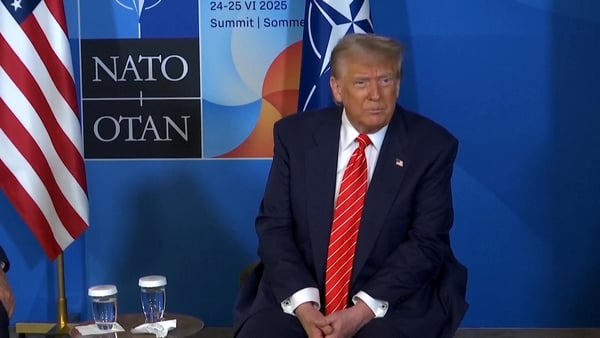
It is less than a year since Donald Trump was inaugurated as US president for a second term. In that time, he has upended the world order, financially and militarily, with the dramatic scenes in Venezuela last week a prime example. His sights now seem to be on the Danish territory of Greenland, and he has refused to rule out military force in that quest.
This has been a recurring theme in the past 12 months. During a news conference at Mar-a-Lago on 7 January 2025, he floated the possibility of bringing this territory into the US. A year later, on 5 January 2026, Trump was interviewed aboard Air Force One and insisted that the US "needs Greenland" for national security reasons.
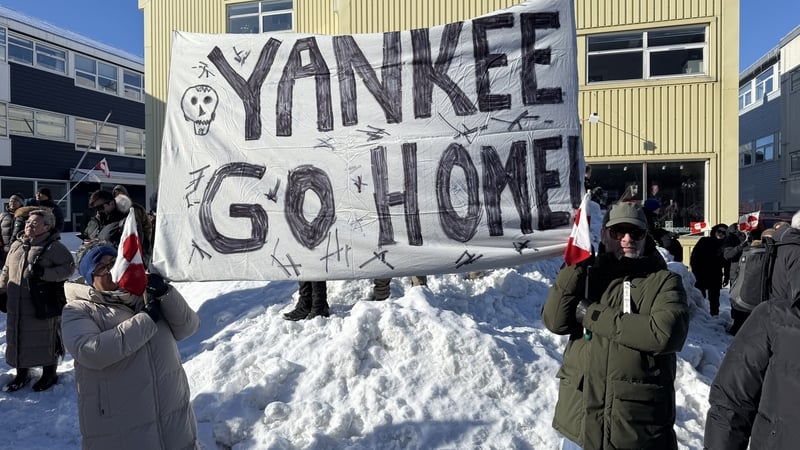
From RTÉ Radio 1's This Week, Greenland united in opposition to US takeover bid
In a recent CNN interview, Trump's Deputy Chief of Staff for Policy and Homeland Security, Stephen Miller, repeatedly dodged the question of whether the US would seek to take Greenland by force. "The real question", he said, "is, by what right does Denmark assert control over Greenland? What is the basis of their territorial claim? What is their basis of having Greenland as a colony of Denmark?
"The United States is the power of NATO", he continued. "For the United States to secure the Arctic region, to protect and defend NATO and NATO interests, obviously Greenland should be part of the United States’. This followed a post on X by Miller’s wife Katie showing Greenland in US flag colours with the caption ‘SOON’.
So what happens if Trump invades Greenland? A 1951 agreement, which was amended in 2004, exists between the US and Denmark concerning the defence of Greenland and remains valid to this day. While this agreement underscores the collaborative defence relationship between the two NATO nations, it's an executive agreement which Trump could potentially pull out from with a swipe of his Sharpie.
We need your consent to load this rte-player contentWe use rte-player to manage extra content that can set cookies on your device and collect data about your activity. Please review their details and accept them to load the content.Manage Preferences
From RTÉ Radio 1's News At One, could the US sieze Greenland by force?
In the event of war, in line with Article I, Section 8 of the US Constitution, under the 1973 War Powers Act, the president is required to notify US Congress within 48 hours of committing armed forces to military action. Additionally, without a declaration of war or specific statutory authorisation, the military can't stay involved in hostilities for more than 60 days, plus a 30-day withdrawal period.
If Congress doesn't either provide authorisation for the use of military force or declare war against Greenland (both highly unlikely scenarios), Trump would need to end military operations within that timeframe. The resolution, however, has been violated several times in the past, and 60 days could be more than enough time to seize control of Greenland.
Situated east of the Canadian Arctic Archipelago, Greenland is the world's largest island and has been a part of Denmark since 1721. The country was granted home rule in 1979 and has functioned under a Self-Government Arrangement since 2009, providing it with the authority to negotiate and conclude agreements under international law with foreign states and international organisations, except in matters of foreign, defence, and monetary policy.
We need your consent to load this rte-player contentWe use rte-player to manage extra content that can set cookies on your device and collect data about your activity. Please review their details and accept them to load the content.Manage Preferences
From RTÉ Six One News, RTÉ Deputy Foreign Editor Edmund Heaphy on plans by US Secretary of State Marco Rubio to meet representatives of Denmark and Greenland this week
Calls for independence have been progressively growing under former prime minister Múte Egede, especially following Trump’s renewed interest in Greenland. Under the aforementioned 1951 agreement on the defence of Greenland, the island is home to the US military’s Pituffik Space Base, which hosts Upgraded Early Warning Radar (UEWR) systems for early detection and precise tracking of ballistic missiles.
So what protection would Greenland have in the event of a military invasion? While Greenland is covered by Article 5 of the 1949 North Atlantic Treaty (NAT), it might not be covered by Article 42.7, the EU’s mutual assistance clause which was brought into the Treaty on European Union (TEU) in 2009.
Article 5 NAT stipulates that for collective defence to be invoked within NATO, an armed attack against one or more NATO allies must occur in 'Europe or North America'. Article 6 further specifies that this includes attacks perpetrated ‘on the territory of any of the Parties in Europe or North America… or on the Islands under the jurisdiction of any of the Parties in the North Atlantic area north of the Tropic of Cancer’. Additionally, the NATO Status of Forces Agreement has applied in Greenland since 1955.
We need your consent to load this rte-player contentWe use rte-player to manage extra content that can set cookies on your device and collect data about your activity. Please review their details and accept them to load the content.Manage Preferences
From RTÉ Radio 1's Morning Ireland, EU backs Denmark as US esclalates efforts on Greenland
But Article 5 NAT can't be invoked by one NATO ally against another, as it would contradict the very spirit of the Alliance. Even if a NATO ally invoked the clause against another, all 32 member states would need to unanimously agree that the actions in question amount to an armed attack. Without consensus, no measures can be taken under Article 5, even if a single member objects. The US would certainly object.
By conrast, Article 42.7 of the Treaty on European Union would potentially allow an EU member state like Denmark to seek assistance from other EU members if it faced aggression from a NATO ally like the US. After all, Turkey, a NATO ally, and Greece, like Denmark a member of both NATO and the EU, have been on the brink of conflict several times, most recently in 2020, when Greece even hinted at activating Article 42.7 TEU.
For the EU mutual assistance clause to be triggered, a member state must be a victim of armed aggression "on its territory". Unlike Article 5 NAT, there is no further clarification regarding geographical coverage. There are questions whether overseas territories outside of Europe would be considered within the scope of these protections, although in principle they should be. To complicate things further, the legal difference between Outermost Regions (such as Madeira) and Overseas Countries and Territories (such as Greenland), may mean that Denmark might not be able to invoke Article 42.7 TEU if Greenland were attacked by the US.
From RTÉ News, US president Donald Trump says US must own Greenland to deter Russia and China
It is also worth noting that European nations lack the military force required to effectively stand up to the US. The EU’s only effective weapon against a US offence would be its economic leverage, particularly in the form of trade restrictions, such as tariffs, or sanctions targeting specific sectors of the US economy. Although no unanimous decision of the Council is required for Article 42.7 TEU to be implemented, the fact that the process is member state-driven and assistance would be provided bilaterally would likely lead to fragmentation within the EU. While some countries might be willing to offer support, others might not, and there is no sanctioning mechanism that could compel them to do otherwise.
A decision by the Trump administration to invade Greenland would, therefore, also have deep consequences for NATO. In the best-case scenario, it could cause similar divisions within the Alliance and erode trust among its members; in the worst-case scenario, it could trigger a major identity crisis, as the very country NATO has relied on for protection over the last 76 years would now be the one it would need protection from.
As Danish prime minister Mette Frederiksen stated in an interview with TV2, "if the US chooses to attack another NATO country militarily, then everything stops, including NATO and thus the security that has been established since the end of the Second World War."
Follow RTÉ Brainstorm on WhatsApp and Instagram for more stories and updates
The views expressed here are those of the author and do not represent or reflect the views of RTÉ