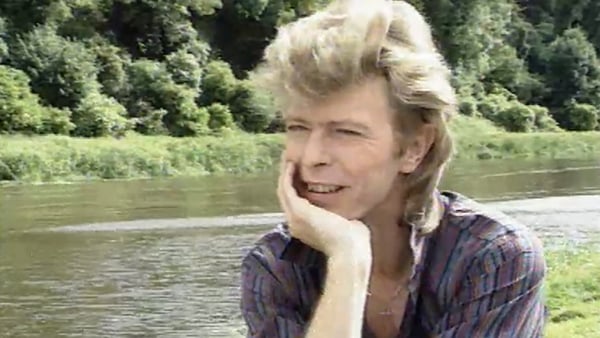

Analysis: The multitude of ways in which fans responded said much about Bowie's cultural significance, influence and reach
David Bowie's unexpected death on January 10th 2016 attracted widespread media coverage across the globe. Variously described as a chameleon, a creative genius, an 'iconic figure’ and an 'iconoclast’, much of the media’s commentary on Bowie’s life and art underplayed just how radical and subversive a figure he actually was.
But fan responses were much more illuminating about the weight of Bowie’s cultural significance and reach. The multitude of ways in which fans responded was also indicative of the sheer breadth of cultural influences which Bowie had channeled in his 50 year career.
We need your consent to load this rte-player contentWe use rte-player to manage extra content that can set cookies on your device and collect data about your activity. Please review their details and accept them to load the content.Manage Preferences
From RTÉ News in 2016, report on the death of David Bowie
Apart from the sheer volume of traffic across social media – 4.3 million tweets were posted about Bowie within 24 hours of his death – the days following his death saw spontaneous gatherings in places closely associated with the singer. Fans came together in Dublin, Berlin, New York and Brixton, for example, to talk about Bowie, share their grief, sing his songs, dress and look like him in his many guises, and crucially, express what he meant to them in their personal lives.
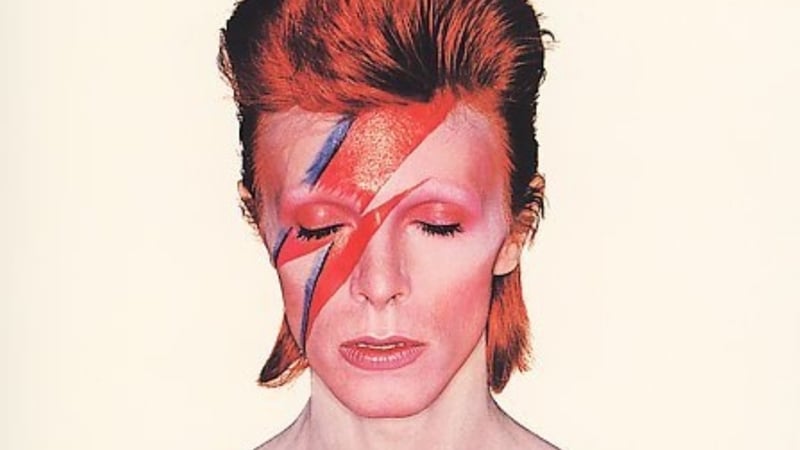
Bowie was - and remains - a reservoir of hope for his many fans. A recurring motif in the responses of older fans in the days and weeks following January 10th was the extent to which Bowie’s emergence in the early 1970s was truly radical. Fans repeatedly referred to his performance of Starman on Top of The Pops in July 1972; his ability to destabilize societal norms and values; his fluidity in terms of gender and sexual identities, his capacity to ‘queer’, to reinvent himself and his engagement with questions concerning mortality and spirituality.
As manifestations of genuine grief, many fans engaged in the production of media and other forms of content. Places, like Brixton, in South London, where he was born, saw the creation of sacred spaces dedicated to Bowie. While organised religion is in sharp decline, this serves to reminds us that the sacred is still a feature of the social world and is in evidence within many popular culture settings. Fan-created Bowie shrines sprung up with offerings of flowers, pictures, posters and crucially fan essays. Pilgrimages were made. Communities – real and virtual – were created and recreated.
As a researcher (and fan), I travelled to and photographed these shrines. I observed, for example, various versions of Ziggy Stardust, the Bowie ‘Flash’ and the Black Star icon on display on the wall to the side of Morley's department store on Tunstall Street, Brixton. Most notably, Bowie’s version of Pierrot the Clown was centre-stage in much of this fan ‘produser’ activity. Pierrot, the sad and sometimes insolent clown is, of course, a recurring and highly significant figure in Bowie’s creative work, most notably in the promotion of the album Scary Monsters (and Super Creeps) (1980).
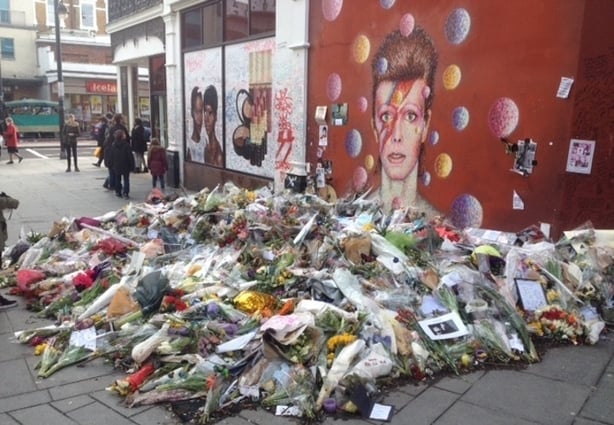
Fan essays posted in the places associated with Bowie were particularly revealing. One of the many post-it notes in Brixton stated: "RIP Starman, You Blew Our Minds"; another hand-written note said: "Without you I would be a different person. Thank you for the songs, they made me realize I wasn’t alone in how I felt." A longer fan essay posted on the wall at Heddon Street, London (the site of the Ziggy Stardust album cover photo of Bowie) detailed the imaginative relationship that a young female fan had with Bowie’s 2013 album The Next Day.
The overarching and recurring theme of these fan creations was their significance in terms of people’s affective or emotional lives, evidencing powerful connections between Bowie’s art and people’s own biographies. This is not surprising as Bowie’s work engaged with feelings of dislocation and alienation or anomie. He was a survivor who managed to overcome drug dependency and significant mental health issues through using his creative genius. His final album recordings The Next Day and Blackstar deal openly and honestly with the complex issues of existence and mortality.
From RTÉ Brainstorm, David Bowie's Irish links: music, art, literature and Tipperary
Over five decades Bowie managed to capture the zeitgeist (culturally, politically, spiritually) and to speak directly to millions of people. In addition to being attuned to a wide canvass of musical influences ranging from industrial, punk, electronica, hip hop, drum and bass and jazz, Bowie was a well-read and informed artist who drew upon a deep well of wider influences such as Buddhism, German Expressionism, Surrealism, Philosophy, Communications Theory, Mime, Oriental Culture and Jungian Psychology.
Perhaps Bowie’s real strength was his capacity to appropriate and synthesize complex ideas, influences and insights and make ample use of them in his unique creative work across many art forms. His vast contribution as a songwriter, performer, recording artist, music producer, actor, film producer and painter meant that he was truly a Renaissance man. A decade on, he remains a truly iconic figure whose creative canvas allowed for infinite interpretations and lasting connections amongst his many, many fans.
Bowie was fully aware of this. His 2016 parting gift Blackstar contained not only some of his best and most powerful songs, but its vinyl version came with a series of encoded messages embedded in the design and in the text which will undoubtedly continue to keep his fans guessing and imagining.
Follow RTÉ Brainstorm on WhatsApp and Instagram for more stories and updates
The views expressed here are those of the author and do not represent or reflect the views of RTÉ