


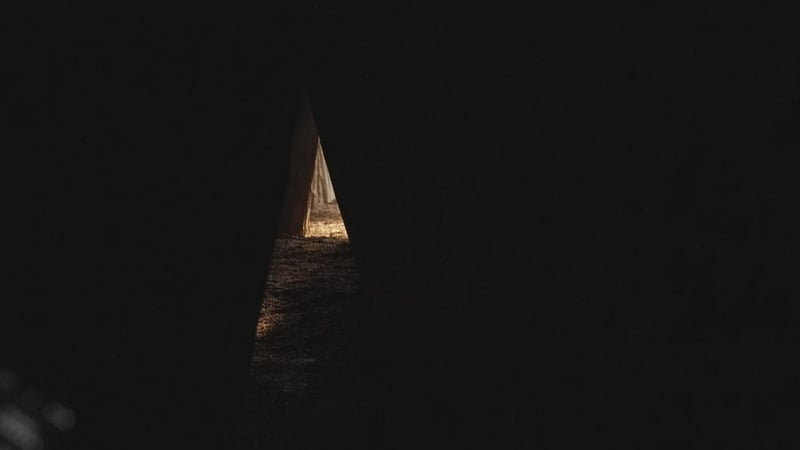
Analysis: Those who flock to Newgrange on 21 December owe much to the excavation work of archaeologist Michael J O'Kelly in the 1960s
By Terry Clavin, Royal Irish Academy
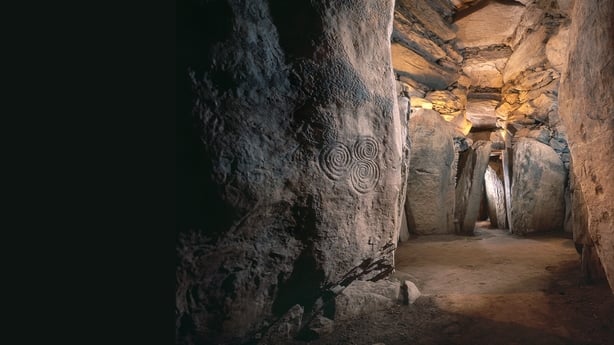
The timing would have been perfect 5,000 years earlier, but changes to the earth's tilt meant it was four and a half minutes past dawn on 21 December 1967 before the beam of light struck the sandy floor and crept forwards, illuminating the high, rock-vaulted chamber around Prof Michael J. O’Kelly. It was the winter solstice at Newgrange and, as O’Kelly watched the renewal of a long-dormant ritual on that first occasion, he began to fear that he might have stirred the wrath of the Dagda Mór, the barrow’s resident spirit.
Every year, more than 30,000 people worldwide now apply to emulate O’Kelly’s experience. Yet in the decade immediately following his discovery, the Irish public generally remained either unaware of or indifferent to the 17-minute light show that was once more unfolding every 21 December (weather permitting).
This is curious, given that the exceptionally grand passage tomb overlooking a turn in the River Boyne had been a major tourist attraction for over a century. Indeed, scholars had debated Newgrange’s provenance and purpose ever since 1699, when the passageway entrance was uncovered, revealing the site to be more than an overgrown mound. Going back further still, it featured under various aliases in medieval Gaelic texts, both as the supernatural abode of godlike mythological figures and as the epicentre of a vast burial complex dedicated to the pre-Christian kings of Tara.
From RTÉ News, hundreds gather at Newgrange for Winter Solstice in 2024
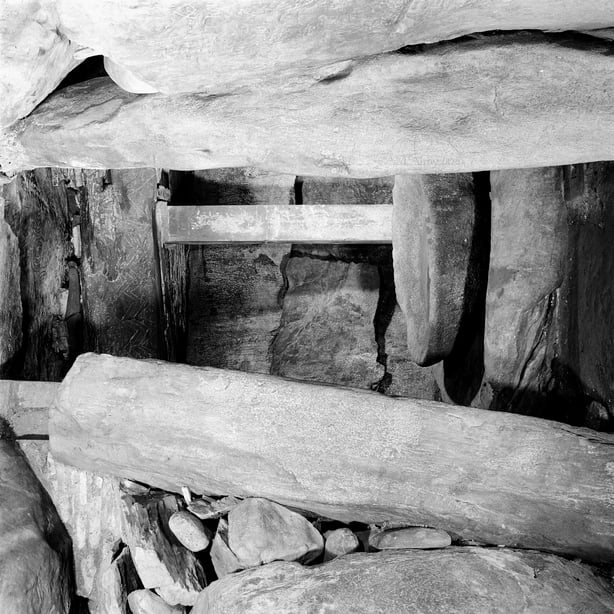
As a result, O'Kelly’s 13-year excavation from 1962 was followed with great interest. In 1963, as he set about dismantling and restoring the partially collapsed front third of the narrow passageway, the archaeologist unearthed a small rectangular structure on the cairn’s exterior, located just above and behind the entrance. Open at the front, closed at the back, the so-called 'roof-box’ straddled two passageway roof slabs, one sitting lower than the other, leaving a vertical slit, through which light could infiltrate the mound.
O’Kelly’s corrective work in raising the slumped passageway beneath preserved the slit, while creating – or rather recreating – an angle shallow enough for sunbeams shining in at low altitudes to reach the central chamber along the top of the upwards sloping passageway. On finishing the roof-box’s reconstruction in September 1966, O’Kelly noted its orientation towards the winter solstice sunrise and guessed at its purpose: hence, his presence within on 21 December 1967.
This discovery wasn’t made public until June 1971, when mentioned in a low-key report by the Office of Public Works. Early 1970s media updates on the Newgrange excavation either ignored or downplayed the winter solstice illumination, while Michael Herrity’s 1974 book on Irish passage tombs gave it only a couple of sentences. The experts maintained a wary silence even after an astronomical survey published in 1974 concluded that Newgrange’s solar alignment was deliberate.
Instead, word of mouth attracted a yearly gathering of up to 200 winter solstice sightseers, taking in occultists, UFO enthusiasts and every practising witch in Ireland. The guitar-playing and singing coming from outside rather took from the mystique for the 20 people that could be fitted into the chamber. Matters got out of hand in 1975 when a group broke through the perimeter and demanded entry until gardaí restored order.
Outlandish theories abounded. Richard Crowe, a Chicago-based luminary of the Ancient Astronauts organisation, maintained that Newgrange was a beacon for alien spaceships, with the fairies and leprechauns of Irish folklore being their crews. Then, there was the Irish farmer who declared that Newgrange had been built as a salt cellar.
The colourful and svengali-like Martin Brennan devised elaborate arguments detailing how Newgrange was stewarded by astronomer-priests capable of calculating cosmic cycles of up to 1,240 years. The New Age mania surrounding Newgrange subsided in the 1980s as the event went mainstream and the winter solstice phenomenon gained academic acceptance.
In this context, O’Kelly’s coyness makes sense. As professor of archaeology at University College Cork, he was part of a discipline that defined itself in opposition to the popularity of whimsical fallacies regarding ancient monuments. He was particularly conscious of archaeologists’ misgivings about archaeoastronomy, a methodology established around the turn of the twentieth century by Sir Norman Lockyer, who mixed dubious speculations about astronomically inclined druids with scientifically rigorous observations of ancient monuments’ celestial alignments.
Read more: Who's really buried in Newgrange's passage tombs?
Interestingly, Lockyer had suggested in 1909 that Newgrange might contain a hidden 'creep-way' capable of funnelling the winter solstice sunrise. Local traditions also spoke of sunlight reaching into the chamber during the summer solstice, but these tall tales probably derived from Stonehenge’s well-known astronomical orientation with the mid-summer dawn.
Still, Newgrange had been linked with the sun for at least 1,000 years. The medieval Irish made it the dwelling of the Celtic sun deity Aengus, inspiring the literary mystic George Russell (Æ) to write a bizarrely prophetic short story in 1897, wherein Aengus causes a cave-chamber, clearly based on Newgrange, to glow wondrously with light. Similarly, from the eighteenth century onwards, many learned visitors to Newgrange could not resist drawing comparisons with the Egyptian pyramids, leading to conjectures about Egyptian-style sun worship.
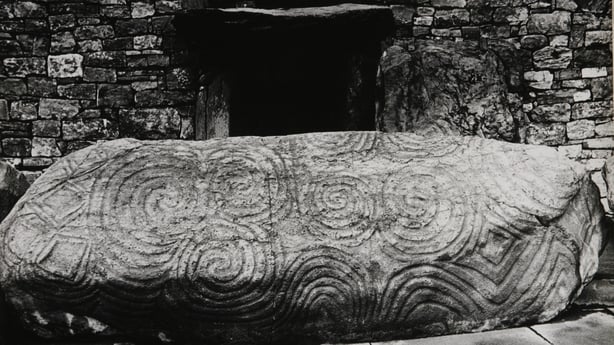
The late-18th-century antiquarian Charles Vallancey was the most infamous exponent of this school. Convinced that he had deciphered the enigmatic neolithic rock inscriptions at Newgrange, he argued that the monument was a sun temple built by colonists of Egyptian culture from the eastern or southern Mediterranean. It followed that the spiral lines carved on the rocks represented snakes and that ‘Newgrange’ was an English corruption of an Irish term ‘Griain-uagh’ – the cave of the sun. (In fact, the Newgrange place name, which dated only to around the thirteenth century, had Anglo-French linguistic origins.) For these and other flights of fancy, Vallancey was satirised mercilessly in John Boswell’s fictional Antiquities of Killmackumpshaugh (1790).
Vallancey’s name endured as a punchline for archaeologists, who looked askew at suggestions that monuments like Newgrange might possess a cosmological affinity, seeing such theories as having crackpot connotations. Indeed, just as O’Kelly was reckoning with the mysterious roof-box, this academic defensiveness was reinforced by Gerald Hawkins’s international bestseller, Stonehenge decoded (1965), which purportedly demonstrated that Stonehenge was a sophisticated prehistoric observatory.
So, it may well be that on first seeing the chamber light up on 21 December 1967, O’Kelly was spooked less by the Dagda Mór and more by Charles Vallancey and the Antiquities of Killmackumpshaugh.
Follow RTÉ Brainstorm on WhatsApp and Instagram for more stories and updates
Terry Clavin researches, writes and edits for the Royal Irish Academy's Dictionary of Irish Biography (DIB), primarily on twentieth century and early modern figures.
The views expressed here are those of the author and do not represent or reflect the views of RTÉ
