



Analysis: A new documentary tells the story of the global influence of O'Connell, 'the greatest leader the world has ever seen'.
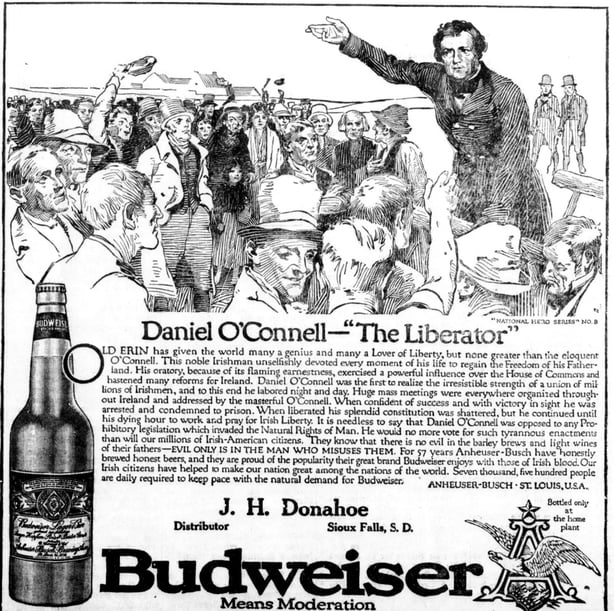
In 1914, newspapers across the United States featured a cartoon rendition of Daniel O'Connell. Part of an advertisement campaign by Anheuser-Busch for its Budweiser brand, the image featured O’Connell atop a stage gesticulating before a crowd of people and the line "Old Erin has given the world many a genius and lover of liberty, but none greater than the eloquent O’Connell." The accompanying text praised his political genius organising mass meetings of "millions of Irishmen", his unjust imprisonment, and commitment to "Irish liberty" until his dying breath.
For the makers of Budweiser, O’Connell was a powerful embodiment of personal liberty standing against the oppressive tide of prohibition. This rather outlandish example of O’Connell’s global image roughly 60 years after his death might elicit a chuckle – especially considering his close relationship to the famous Temperance campaigner Father Mathew – but it illustrates a larger truth that O’Connell was not simply an historic Irish figure, but a global icon too.
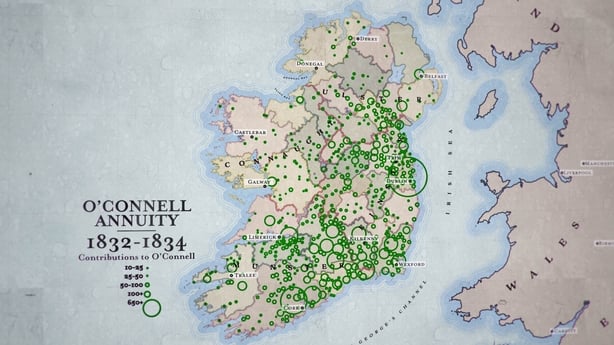
Although his legacy has often been overshadowed by the violent birth of the state, O'Connell built a tradition that has provided the crucial infrastructure for democratic politics on the island. This is easiest to see in the Catholic Association - co-founded by O’Connell in 1823 – which became the vehicle to organise a mass political movement. It was fuelled by a penny-a-month subscription from everyday Irish people. This popular movement resembles the small-scale political donations so effectively employed in modern politics, but preceded it by nearly two centuries.
Mobilising Catholics at home and abroad, O’Connell encouraged (and at times goaded) the public into recognising their own debased political circumstances and to rally themselves to demand their rights. Building a grassroots network in connection with Catholic clergy, O’Connell was able to construct a political machine from the ground-up. Crucially, however, he coupled this grassroots activism with the financial heft and social capital of middle-class Protestants and Catholics who believed in ending civil discrimination.
A coalition builder and truly savvy political operator, O'Connell identified early on that emancipation could only be won through persuasion and pressure. Every time politicians defended their illiberal views, it was a small victory exposing the immorality of their position.
In a 1827 letter to his ally, Edward Dwyer, O'Connell wrote "we should give no species of rest or relaxation until they are compelled or induced to do us justice. We are at the right side of the question …the bigots are in the wrong and therefore discussion must necessarily expose them to ridicule and contempt." While O'Connell found great pleasure in ridiculing and shaming hypocritical politicians, he also believed that most English people shared his moral opinions and simply needed to be exposed to O’Connell’s point of view – a guiding principle for all his actions.
O'Connell's global Influence
It is easy to confine O’Connell’s scope of politics to Ireland – 'emancipation’ and 'repeal’ – but this is to underappreciate his importance. As the Daniel O'Connell: The Emancipator documentary points out, Catholic liberals from across Europe saw O’Connell as their hero, a man who remained devout to his faith and yet was also a patriot.
Trailer for Daniel O'Connell: The Emancipator documentary telling the story of his global influence
His method of peaceful agitation and moral suasion offered a template for disenfranchised Catholics populations on the continent. Charles Montalembert, the eminent liberal Catholic and co-founder of the French newspaper L'Avenir, met O’Connell in Paris on the latter’s deathbed pilgrimage to Rome. He praised O’Connell as "the man of the age who has done more for the dignity and liberty of mankind … you are not only the man of one nation, you are the man of all Christendom."
Having experienced state-sponsored discrimination, O'Connell was a champion of religious tolerance and the basic principles of human dignity. He was a founding member of numerous humanitarian organisations – from the British India Society and the Aborigines Protection Society to the British and Foreign Anti-Slavery Society – that brought him into alliance with evangelical Protestants who publicly dispised him but valued his oratory. O’Connell belief that "man was born free in every country, no matter what his colour or his creed" brought him praise from men and women who saw him not simply as an Irish liberator, but "the assertor of universal freedom".
Extract from Daniel O'Connell: The Emancipator documentary
A flawed man with a moral clarity in politics
O’Connell had many flaws and stories of infidelity, reliance on contributions from poor Irish supporters, and a stubborn refusal to brook dissent are legion. But for all his flaws, his greatest legacy is the crystal clear moral clarity of his politics. O’Connell held firm to convictions despite pressure to compromise, which often brought him into tension with those who wished he would soften his tone for political convenience.
Nowhere is this more apparent than his unwavering commitment to anti-slavery. Famously, O’Connell declined to meet the US ambassador, Andrew Stevenson, and called him a ‘slave-breeder’, leading Stevenson to challenge O’Connell to a duel and created an international scandal. When Texas declared itself an independent republic, O’Connell unsuccessfully lobbied the UK government to establish a colony for free slaves under British protection, both as a counterweight to the power of southern slave states in the US and as a refuge for former slaves.
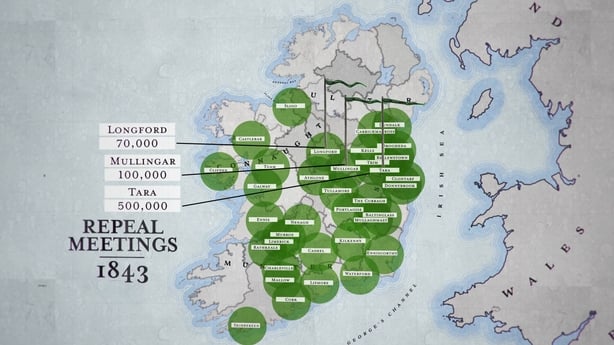
When O’Connell accelerated his political campaign in 1843 to repeal the Act of Union, he refused to remain silent on the question of slavery, or to take money from any repeal association that tolerated slavery, much to the chagrin of some who wished he would compromise. Speaking at a repeal meeting in May 1843, O’Connell said, "I do not care for the consequences, but I will not restrain my honest indignation of feeling when I pronounce every man a faithless miscreant who does not take part for the abolition of slavery."
O’Connell has much to offer us today. In an age when political leaders are tempted to temper their convictions to win a few votes, O’Connell’s example of political conviction offers instruction. Not willing to concede to political expediency, he led a people to believe in their collective power, and in the process was heralded as "the greatest leader who the world has ever seen."
Follow RTÉ Brainstorm on WhatsApp and Instagram for more stories and updates
Daniel O'Connell: The Emancipator is now available on RTÉ Player
The views expressed here are those of the author and do not represent or reflect the views of RTÉ
