


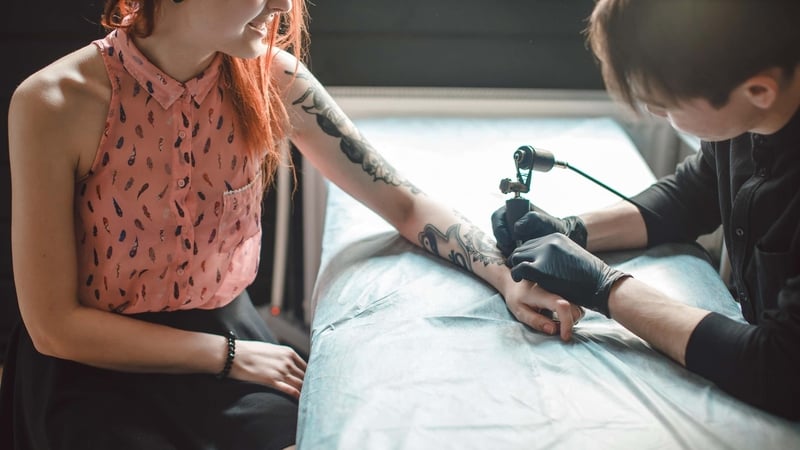

Analysis: The best tattoo artists take ink, a machine and a willing client and bend these elements into an identity akin to a luxury good
By Maurice Patterson, University of Limerick and Renata Couto de Azevedo de Oliveira, Unigranrio Brazil
If someone asked you to name some luxury goods, chances are you'd focus in on such classics as the Hermès Birkin bag or the Rolex Datejust watch. It would certainly be unusual to put tattoos into the same category. Those self-inflicted India ink tattoos from your troubled youth don’t quite have the same panache as a Louis Vuitton pochette. Backstreet tattoo parlours in your local town don’t exactly scream luxury.
Nonetheless, there is something potentially enchanting and magical about tattoos that holds the possibility of rendering them luxurious. Tradition dictates that luxury is associated with provenance, exclusivity and craftsmanship. As recent TikTok videos by Chinese manufacturers in response to US tariffs suggest, disputes over production and authenticity render the very meaning of 'luxury’ a site of cultural and economic contestation.
We need your consent to load this rte-player contentWe use rte-player to manage extra content that can set cookies on your device and collect data about your activity. Please review their details and accept them to load the content.Manage Preferences
From RTÉ Doc On One, The Tattooed Irishman looks at the life of 19th century Dubliner James F. O'Connell who brought tattooed body art to North America
But while current market practices work to commodify many luxury goods so that they are laid bare of their long-held prestige, the colourful world of tattoo is witnessing an opposite movement. Once the preserve of society's 'undesirables’, deliberate processes of artification and democratisation since the 1980s have helped lend tattoo an air of respectability.
During this time many classically trained artists turned to tattooing as a career. At the same time, mainstream media drove home the idea that tattooing was a reputable business. Television shows such as Miami Ink and London Ink depict a practice where consumption choices were predicated on deep-seated personal meanings and artistic quality. Moreover, they painted a picture of a society that was resolutely welcoming of tattoos and tattooed people.
The result has been a booming market over the last 30 years or so. With it has come an attendant high-end sector, where tattoo styles are increasingly a matter of individual choice and custom design, and tattoo aficionados seek out the most prestigious artists capable of delivering unique and stunning pieces. Tattoos with such a high degree of artistic merit naturally command significant economic value as a commercial investment.
We need your consent to load this rte-player contentWe use rte-player to manage extra content that can set cookies on your device and collect data about your activity. Please review their details and accept them to load the content.Manage Preferences
From RTÉ Radio 1's Livetline, is a tattoo artist an artist? Lucas talks about the struggle of trying to aqcuire permanent residency in Ireland while working as a tattoo artist
Tattoos are significant to us because they are often intimately tied to our sense of self. We imagine them as inked reflections of our inner character and its history which somehow bring the identities that lie beneath the skin to the surface.
They also offer us myriad possibilities for storytelling. Indeed, those of us with visible tattoos are routinely called upon to narratively justify our body art. Here, tattoos enable us to construct and reconstruct identity stories that connect past, present and future. These stories help us locate ourselves in the social world, to construct personalised symbolic portraits and to reclaim our bodies.
In important ways, the virtuosity of tattoo artists may be connected to luxuriousness through technique, imagination and caregiving. Great tattoos are understood as rare commodities, made possible only through access to highly-skilled artists whose agency is embedded in their output, thus underlining issues around authenticity, rarity, and the potential to be touched by an aura of greatness.
From Wall Street Journal, profile of celebrity tattoo artist Keith 'Bang Bang' McCurdy
Take Keith ‘Bang Bang’ McCurdy for example, who has been termed by Vogue "the most famous tattoo artist in the world, or, better yet, tattoo artist to the most famous in the world". Listing Rihanna, Justin Bieber and Adele among his celebrity clients, McCurdy can charge as much as $10,000 for a daylong tattoo session and $100,000 for a full sleeve.
There is an element of magic in the work of distinguished tattoo artists. They take tattoo ink, a machine and a willing client, and bend these elements into a form that is understood as identity. Even more, their transubstantiation of inks under the skin creates an artistic artefact - the tattoo - and further, re-constitutes unique and complex bodies into living, breathing works of art.
It is no accident then that some of the most distinguished tattoo artists have also made forays into the regular art world. Scott Campbell is both an accomplished tattoo and visual artist with over 200,000 followers on Instagram and a celebrity client list which includes Sting, Josh Homme and Marc Jacobs. As a visual artist he is best known for his Skulls Project which incorporates a series of reliefs constructed from US currency.
From CNN, report on tattoo artist Scott Campbell offering free mystery tattoos to patrons willing to put their arm through a hole and discover what the tattoo is upon completion
In addition to artistic prowess, the best tattooists possess other forms of specialised knowledge. Working on the body necessitates the ability to deal with the peculiarities of the tattooing process that include the wounding of the body and the imposition of pain. Artists must also be proficient in interpretation, rhetoric and care as they attempt to practically realise the loosely held preferences of clients and, simultaneously, to put those clients at ease.
For these reasons, connections between tattoo and luxury have begun to percolate through the social imaginary. In particular, assumptions are made about the technical excellence of artists, who are capable of producing tattoos considered luxury goods by those who carry them, and by aficionados who come into contact with them.
Naturally, these understandings rely on a client’s cultural capital, which goes beyond financial capability and the desire to get tattooed. Tattoo collectors are most able to identify and appreciate the mastery of an artist when they are immersed in the scene. Collectors become students of the tattoo universe, acquainting themselves with the best artists, their preferred styles and their techniques. Some collectors even become artists themselves. Such clients have no difficulty understanding and narrativising their tattoos as luxury goods; su misura pieces of art brought into being by skilled professionals.
Follow RTÉ Brainstorm on WhatsApp and Instagram for more stories and updates
Dr Maurice Patterson is an interpretive consumer researcher and Associate Professor in the Department of Management & Marketing in the Kemmy Business School at the University of Limerick. Dr Renata Couto de Azevedo de Oliveira is an Assistant Professor in the Postgraduate Programme at Unigranrio in Rio de Janeiro, Brazil.
The views expressed here are those of the author and do not represent or reflect the views of RTÉ
