




Analysis: The difference between curated anthems and spontaneous chanting reveals something essential about power relations in a sports stadium
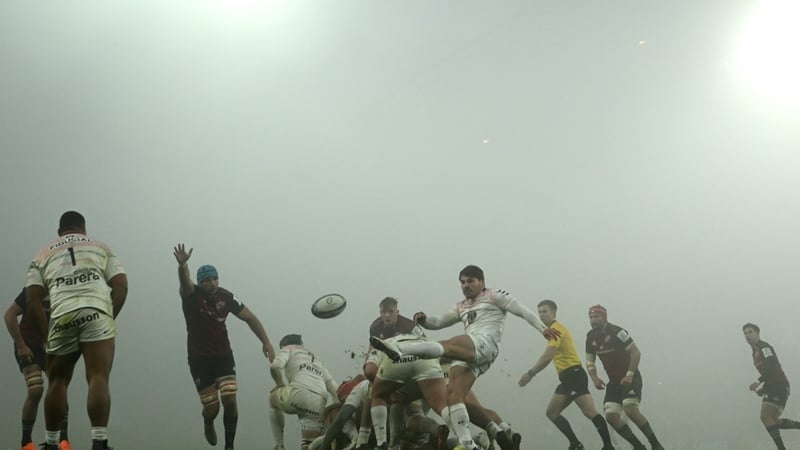
It's 11 December 2022 in Thomond Park, Limerick. Stade Toulousain are facing Munster Rugby. The stadium is swallowed by fog. You can barely see seven metres ahead. Just before kick-off, singer Jean Wallace’s voice rises through the mist with Stand Up and Fight — and the crowd answers. For a few minutes, sight gives way to sound.
The tune, once the Toreador aria from Carmen, now carries new English lyrics. Musicologists call this a contrafactum: an existing melody with new words. I immediately recognise it from years living near the Opéra Bastille in Paris, where Bizet’s opera is almost a national emblem. Such melodic migrations can be surprising but, as I documented it in my doctoral research on soccer chanting, melodies often travel across borders before becoming emblems of local pride, what scholars termed bricolage.
From Munster Rugby, Jean Wallace sings Stand Up and Fight at the Aviva in 2022
The Aviron Bayonnais rugby anthem in southwest France, for instance, began life as a 1970s Austrian pop hit (Schlager), Griechischer Wein by Udo Jürgens, later refitted with Basque-flavoured lyrics celebrating Bayonne.
Back in Limerick, that Munster–Toulouse match took place the day after a France-England soccer match in the 2022 World Cup quarter-finals. I watched it in a local pub, surrounded by Toulouse supporters and Irish people, who turned temporarily Francophiles, chanting their way through the game — not following a script or a PA, but producing the kind of spontaneous, body-driven vocality associated with Italian "Ultra" football culture since the 1960s, as described by Mark Doidge and colleagues in a seminal book.
The difference between these two soundworlds — the curated anthem and the spontaneous chanting — reveals something essential about power relations in the stadium. The first is managed and amplified; the second emerges from below. Ultra chants tend to be short, repetitive and looped (thanks to recurring rhythmic and cadential patterns), their melodies rarely exceed six consecutive notes (an hexachord) and are supported by drums rather than harmony (modal monody). Their power lies not in complexity but in collective rhythm.
We need your consent to load this rte-player contentWe use rte-player to manage extra content that can set cookies on your device and collect data about your activity. Please review their details and accept them to load the content.Manage Preferences
From RTÉ Brainstorm, you're not singing any more: where do soccer chants come from?
Official pre-match songs, by contrast, are orchestrated. They often draw on polyphonic tonal harmony and cinematic grandeur, as for example PSG’s former anthem, shared with other clubs in Europe, and based on the disco hit Go West, itself adapted from the tonal harmony model by excellence, the Pachelbel’s canon.
Yet the real charge of chanting comes from what sociologist Gary Robson calls its illocutionary force, i.e. a force driven less by lyrics textual content or musical structure than vocal delivery. When thousands at Thomond Park simply shout "Mun-ster! Mun-ster!" on two unpitched notes, what moves us is not melody but muscular sound: a community asserting itself through breath. And this is regardless of the size of this community, as, despite a limited number of spectators, Treaty United F.C. (the Limerick soccer club) has its own Ultra group, following Ultra codes of chanting, even without the resonance of larger sport crowds.
As highlighted by Finnish scholar Kaj Ahlsved, this soccer tradition of vocal support is often seen as more "authentic," giving supporters more agency, than curated sonic rituals. Stadium sound is thus a field of negotiation, a struggle over who gets to orchestrate emotion and affect, as studied by ethnomusicologist Max Jack in a recent book.
In Paris, this tension became clear with a chant of the Ultras, commemorating their return to the stadium after a six year ban by PSG leadership (following violent incidents that led to the death of a supporter in 2010), recently turned into an official anthem, by the same club leadership, who completed it with a symphonic version. The same sound that once defied authority was re-branded as institutional pride.
Fans of Racing Club de Lens chant Les Coron at Stade Bollaert-Delelis
In Marseille, by contrast, boundaries between club’s and ultras’ sounds persist. Ultra supporters of the Olympique de Marseille soccer team have been pioneers in French football chanting since the 1980s, specifically through the choral technique of antiphony, i.e. call-and-response between one chant-leader (the capo), with his back to the pitch, and a group, or between two opposite stands calling back-and-forth to the same chant, like the famous Aux armes! Even when the stadium DJ ritually plays van Halen rock anthem Jump at players’ entrance, Ultras keep singing their own chants. As one told me: "Le Jump, j’en ai rien à faire" — "I couldn’t care less about Jump."
Elsewhere in France, these boundaries blur. At Racing Club de Lens in the north – a club once owned by the local mining company – the entire stadium joins in at half-time for Les Corons, a 1980s hit by Pierre Bachelet. Though played over the loudspeakers, the crowd delivers the verse almost as a chant — five narrow notes, rough voices recalling miners’ toil — before swelling into the lyrical chorus celebrating the region’s landscape and pride.
From Munster Rugby, Munster fans sing Zombie at the Aviva Stadium in Dublin
This intermingling of vocal forms of support can also be heard when Munster supporters join in at half-time to sing along The Cranberries' Zombie. Since 2023 World Cup, this ritual even extended to Ireland rugby team’s supporters. Dolores O'Riordan's distinctive vocal style, which borrows from keening and yodelling, is taken up by the supporters to express a form of Irishness that transcends lyrics and musical structures.
So, is football chanting "classical music"? In one sense, yes: it relies on stable forms—modal monody, tight hexachords, cadential loops, antiphony—and it spreads as contrafacta, much like arias repurposed for new stages. But its orchestra is the crowd, its conductors rotate between capo, DJ and club leadership, and its score is never fixed.
In Limerick and across France, pre-match rituals sit on a spectrum from curated anthem to emergent chant, and power is audible in who sets the key, starts the pulse and decides when to cadence. Call it a popular classic: rigorous in musical logic, collective in authorship and forever up for renegotiation.
Follow RTÉ Brainstorm on WhatsApp and Instagram for more stories and updates
The views expressed here are those of the author and do not represent or reflect the views of RTÉ
