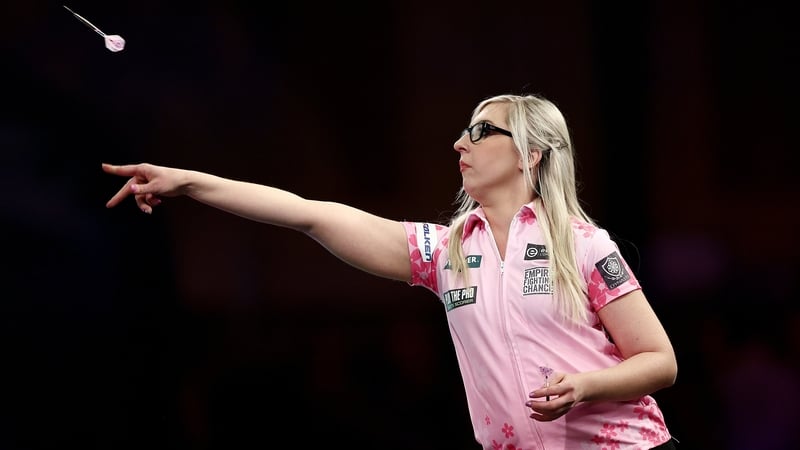


Analysis: Here's the story of how darts has transformed from a pub pastime into a professional sport with millions of spectators
It's Christmas which means it's time to stand up if you love the darts. The PDC World Championship engages massive audiences during December and into the new year. How exactly did this happen? Here's the story of how darts has transformed from a pub pastime into a professional sport with millions of spectators.
Although darts has similarities to target sports such as archery, pistol shooting and boules, its origins are speculated. Darts is thought to have developed from military training exercises, where soldiers would use the practice of throwing short spears or arrows at tree trunks or barrels to hone their skills. The first dartboards were cut from the end of tree-trunks and it is believed that the circular pattern of the rings and the way the wood eventually cracks, suggested both the design of the dartboard and the scoring segments.
We need your consent to load this rte-player contentWe use rte-player to manage extra content that can set cookies on your device and collect data about your activity. Please review their details and accept them to load the content.Manage Preferences
From RTÉ Radio 1's Today with Claire Byrne, reporter Maura Fay spends a night at the darts
The oldest version of the modern game of darts, originated in France. Known as fléchettes ('small arrows'), it was played with arrows made from wood, a metal point and a flight made from bird feathers. This game migrated to the UK via 19th century funfairs, with the dartboard divided up into different numbered segments and to win a prize, players had to reach a certain total score with their darts.
It was a regional game in the UK until the rules were codified in the 1920s. Up until then, the rules of darts were merely ‘house rules’; whatever rules a particular place played to, visitors did too. The darts pub scene continued to rise in its popularity and pub leagues were introduced in the 1930s, when the sport enjoyed a heyday.
An April 1937 tournament in Belfast was the first darts match to be broadcast on regional radio in Northern Ireland. In December of that year, King George VI and his wife, Queen Elizabeth I were photographed throwing darts in a social club near Windsor Castle. The King scored 19 with three darts; the Queen stepped confidently up to the oche and threw 21. This sparked a national curiosity for darts across the UK and darts was even a topic of debate in the House of Commons on the eve of the outbreak of World War II.
We need your consent to load this rte-player contentWe use rte-player to manage extra content that can set cookies on your device and collect data about your activity. Please review their details and accept them to load the content.Manage Preferences
From RTÉ Archives, Michael Ryan meets English darts player Joe Hitchcock in a pub in Blarney, Co Cork in November 1969. Hitchcork was on tour in Ireland giving demonstrations of the game.
The growth of darts can be linked to moves by pubs to improve their overall offering. From the 1940s, publicans faced new rivals within the leisure industry and sought to find ways of holding and attracting customers in more welcoming properties that offered greater variety of entertainment. Pubs began to have their own darts teams who played in inter-pub and inter-town leagues, boosting trade in the process. A Newsbeat report from a pub in Cork in 1968 interviewed a local who plays darts seven nights a week. He said "In Blarney there is nothing else to do apart from going to the pub and while there, people play darts".
Until the 1970s, darts remained very much a low-profile pub game in the UK of little or no international significance, but the introduction of live darts on TV came a boom in interest in the sport. The 1970s and 1980s created the first darts stars such as Eric Bristow, Alan Evans, John Lowe and Jocky Wilson, who became well-known names.
Bobby George was the first to establish theatrical entrances as a necessity for darts events and became known for his dazzling walk-ons. He would make his way to the stage adorned in jewellery, wearing a crown and cloak, and holding a candelabra, all set to the iconic Queen song We Are the Champions. This larger-than-life persona endeared him to fans and solidified his status as one of the game’s biggest personalities.
The landscape of professional darts shifted dramatically with the creation of the Professional Darts Corporation (PDC) in 1992. This new body emerged when the world's leading player Phil Taylor led 15 other top players out of the British Darts Organisation (BDO) to form a rival body which would provide more professional management and greater prize money.
In 1994, the PDC established its own world championship, which was broadcast on satellite TV in the form of Sky television. Sky’s coverage continued to increase throughout the 1990s with more new events added including the PDC’s Premier League, UK Open, Las Vegas Desert Classic, World Matchplay and World Grand Prix. Dutch station RTL-7, with Sport 1 (formerly DSF) in Germany and several of the other large TV stations across the globe, also broadcast most of the PDC darts events.
With recent breakout stars such as Fallon Sherrock and Luke Littler, darts is garnering more mainstream attention than ever before. In January 2024, Sky Sports posted their highest viewing figures for a non-football event during the PDC World Championship final between Littler and Luke Humphries. The emergence of talented young players and female players competing on the same world stage as males has shifted dated perceptions of the game as exclusively played by middle-aged. overweight white men who smoke cigarettes and drink beer while playing.
We need your consent to load this rte-player contentWe use rte-player to manage extra content that can set cookies on your device and collect data about your activity. Please review their details and accept them to load the content.Manage Preferences
From RTÉ Radio 1's Morning Ireland, Gail Conway reports how darts fever has gripped young players across Ireland, following the success of teenage sensation Luke Littler
A massive part of the appeal of darts to many spectators is undoubtedly the social gathering aspect and the nonsense from the crowd. Culturally, darts is seen by many as fun, relatable, and rooted in working-class culture. After all, its heritage is in the pub. The theatrics from the players during walk-ons, its perceived lack of physical exertion and the notoriety of the darts as an excuse for a piss-up is part of the reason why it is not taken as seriously in the pantheon of sport.
But does it really matter? Darts doesn’t need to be an Olympic sport or rely on the traditional ideals of athletic excellence to succeed in attracting big audiences and dramatic moments. Darts will continue to thrive as long as it remains synonymous with social gatherings and a good time. Throw in a few 9 darters and an underdog story and darts will stand its ground as an engaging international sport.
Follow RTÉ Brainstorm on WhatsApp and Instagram for more stories and updates
The views expressed here are those of the author and do not represent or reflect the views of RTÉ