


Analysis: There was a chance the 1925 Boundary Commission could reshape the Irish border so drastically as to make Northern Ireland unviable and thus bring about Irish unity
By John Gibney, RIA
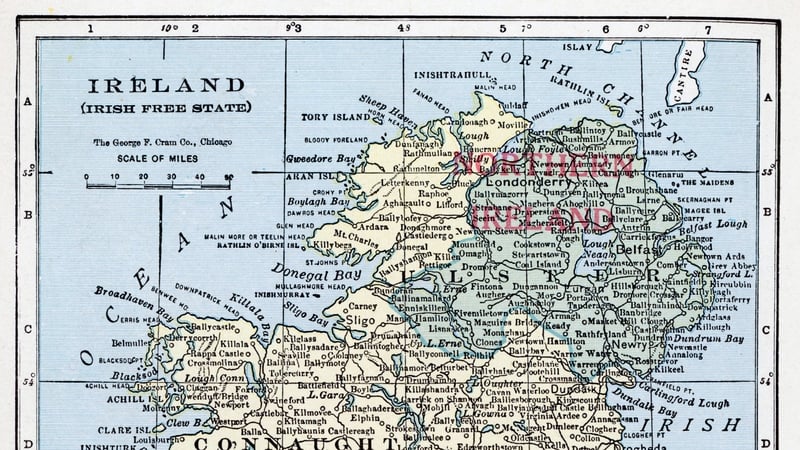
On 3 December 1925 the partition of Ireland was finally confirmed. The Irish border dates from 1920, a creation of the Government of Ireland Act that partitioned the island of Ireland into northern and southern jurisdictions. But between then and December 1925 there was a chance, in theory at least, that the border might be changed so drastically as to make Northern Ireland unviable and thus bring about Irish unity.
The reason why lies in the text of the Anglo-Irish Treaty, signed in London on 6 December 1921. By the time that Sinn Féin and the British government began to negotiate a settlement after the Irish War of Independence, the new jurisdiction of Northern Ireland had been created. But Irish unity was a key issue for both sides in the Treaty negotiations. The Irish negotiators wanted, at the very least, a path to what they dubbed 'essential unity'.
But they were negotiating with a British government that, while led by the Liberal Party's David Lloyd George, was dominated by the Conservatives, who supported the Ulster unionists whom partition had been intended to facilitate. Lloyd George sought to overcome this impasse with the idea of a 'Boundary Commission’ to adjudicate on the future line of the border, which was incorporated into article 12 of the Treaty. As interpreted by Michael Collins and others, this could potentially strip Northern Ireland of vast tracts of territory, a notion that the British, being eager to secure a deal, did not discourage.
From RTÉ Radio 1's Today with David McCullagh, historian and author Cormac Moore on the 100th Anniversary of the Boundary Commission
The Treaty was signed, the independence movement split over the terms of the deal (most especially Irish membership of the British Empire), and Civil War ensued. But once the conflict was over, attention eventually returned to article 12, and the boundary commission finally convened in November 1924.
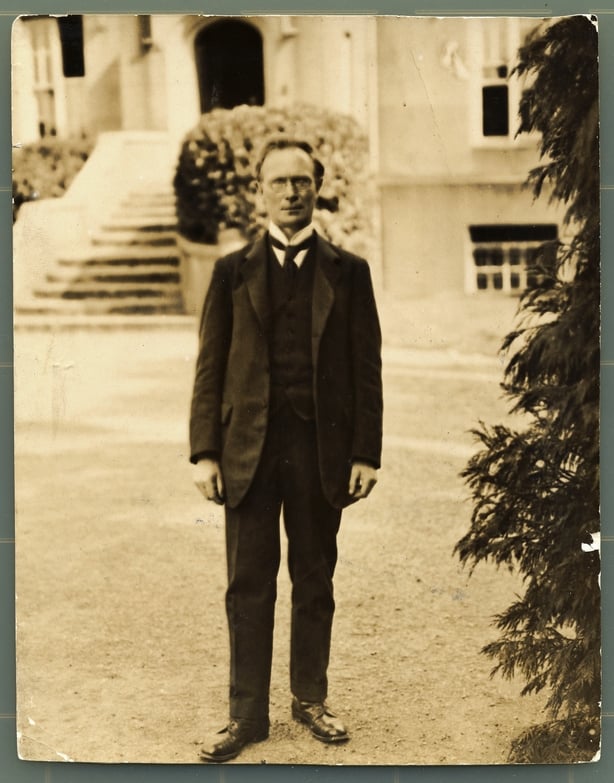
It was chaired by the South African judge Richard Feetham, a figure steeped in the imperialism of the era. The Northern Ireland government of James Craig declined to nominate a representative, so the British appointed the unionist barrister and journalist J.R. Fisher to represent them, while W.T Cosgrave’s government nominated the veteran activist and scholar Eoin MacNeill, their minister for education, to represent the Irish Free State.
Over the coming months they went on fact-finding missions along the border, consulting a somewhat narrow stratum of public opinion as they did so. After all, according to the Treaty their remit was to ‘determine in accordance with the wishes of the inhabitants, so far as may be compatible with economic and geographic conditions, the boundaries between Northern Ireland and the rest of Ireland’. How this ambiguous phrasing was to be interpreted was a matter for the commission, whose deliberations remained secret until November 1925, when a version of its final decision was leaked to the press.
We need your consent to load this rte-player contentWe use rte-player to manage extra content that can set cookies on your device and collect data about your activity. Please review their details and accept them to load the content.Manage Preferences
From RTÉ Radio 1's The History Show, historian and author Cormac Moore on the work of the Boundary Commission 100 years ago
Instead of stripping Northern Ireland of vast tracts of territory, the main changes to the border, as reported, would see a large chunk of east Donegal – Derry’s western hinterland – transferred to Northern Ireland, with sections of Fermanagh and Armagh moving to the Irish Free State; notably, Newry would not. British Prime Minister Stanley Baldwin confirmed to Cosgrave that the Irish Free State would gain 183,290 acres and 31,319 (mostly Catholic) inhabitants, while Northern Ireland would gain 49,242 acres and 7,594 (mainly Protestant) inhabitants. 'The Free State would get more then it would lose but this was very different to what had been expected by Irish supporters of the Treaty. MacNeill resigned in protest, and talks were hastily arranged in London between the three governments involved to defuse this new crisis.'
The British claimed that the commission had done what they had expected, but this was politically toxic to Cosgrave’s government. The consequences, he and his colleagues claimed, could be dire: Kevin O’Higgins stated that ‘now we have a crisis which may be the defeat of Cosgrave and lead, if not directly then eventually, to a break-up of the State based on the Treaty’. Cosgrave and Craig agreed that the boundary commission was more trouble than it was worth. Craig was content with the existing border but the Dublin government, said O’Higgins, were faced with potentially dangerous public outrage and so needed to ‘either to secure an amelioration of the conditions under which the Nationalists were at present living in North-East Ireland or to obtain some form of concession by which they would be able to deaden in the 26 counties the echo of the outcry of the Catholics in North-East Ireland’.
Cosgrave had gotten little satisfaction from Craig on that front, and so instead, his government sought the annulment of article 5 of the Treaty, which stated that the Irish Free State was liable for a portion of the UK’s public debt as of 6 December 1921. Given the economic straits in which the Irish Free State found itself in the aftermath of the Civil War, this was an obvious concession to seek.
And so, on 3 December 1925 Cosgrave, Craig and Baldwin signed an amendment to the original Treaty of 1921. The existing border was confirmed, and the Irish Free State was released from its fiscal obligations – a debt write-down, as we might say today – though it took on the British liability for ‘malicious damage’ since 21 January 1919, along with some other relatively minor fiscal obligations. Tellingly, the ‘Council of Ireland’ proposed by the 1921 Treaty to permit formal co-operation between Dublin and Belfast was also scrapped. Cosgrave and O’Higgins stated to the press that ‘born of a generous desire for peace and friendship, this agreement, accepted in the spirit in which it was negotiated and signed provides the basis of a sure and lasting peace’.
As for the principals, this would be the last time that the leaders of the governments in Dublin and Belfast would meet until the 1960s. Cosgrave’s remark to Craig during the talks that ‘one of us no doubt will hear from the other?’ proved a forlorn hope.
The Irish border of 1920 had officially become the Irish border of 1925. As of 2025, it still is.
John Gibney is Assistant Editor with the Royal Irish Academy’s Documents on Irish Foreign Policy programme.
Follow RTÉ Brainstorm on WhatsApp and Instagram for more stories and updates
The views expressed here are those of the author and do not represent or reflect the views of RTÉ
