


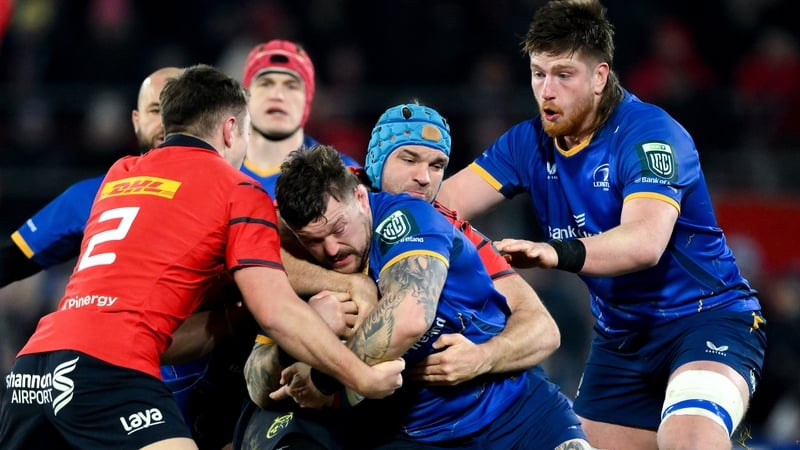
Tadhg Beirne is the latest high-profile figure to voice his displeasure at the direction of travel in rugby, stating the style of play in the game has "gone backwards".
The Munster captain joins a growing list of players and coaches to express frustration at the stop-start nature of the game which he believes is being caused by the increase in contestable kicks, which is slowing down the game as a spectacle.
His provincial senior coach Mike Prendergast spoke out against the current trends recently, while Ireland assistant Johnny Sexton also weighed in on the issue in the last month.
Beirne was speaking in the aftermath of his side's 13-8 defeat to Leinster on Saturday, which he described as a "stop-start" encounter, and when pushed further on why he believed both sides had struggled to get their attacking game flowing, the Ireland international didn’t hold back.
"Let’s be honest about it. The style of the game has gone backwards," Beirne (below) said.

"If we're being serious, teams are just kicking the ball. Why? Because it's a 50-50 chance of getting the ball back.
"Teams are going to set-pieces more because if you go up for a 50-50 in the air and you get a knock on, you get a scrum. And if you have a good scrum, you can get a penalty into the corner.
"It's just becoming a set-piece and kicking game with the way they've changed the rules. You see teams kicking more and more and I think it's just going to continue going that way unless they decide to do something about it."
The game has trended this way in the last 12 months since World Rugby clamped down on players blocking the kick-chase channel, with the view that more one-on-one aerial contests would lead to more broken play, and as a result, more opportunity for transition attack.
However, Beirne explains that with such a premium now on a team’s ability in the kicking game, more and more training resources are being allocated to that area, at the expense of skill work.
"It’s just kick, chase, scrum and then go from there. You want a bit more flow to the game, personally. I suppose that's my opinion on it," said the 33-year-old.
"I guess all teams are probably spending a lot more time on how they exit and their kicking game and all that kind of stuff.
"It'll probably take away from attack and defence a little bit because you have to spend so much time on kicking.
"How you chase a kick, what your set-up is, all that kind of stuff."
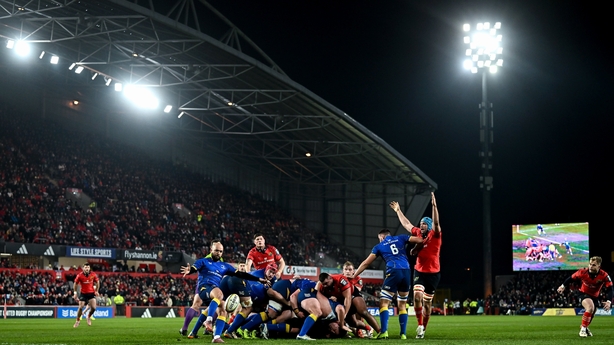
Beirne’s coach Clayton McMillan echoed that sentiment, with his focus being on the amount of stoppages in the current game.
"I actually think that ball-in-play time isn't probably the measure that we should be looking at," he said.
"Once the clock stops and you recharge the battery and then you go again, we're actually getting some long periods of play in time, it's the dead time [that is the issue].
"If we look at the time it takes from the start, from the first whistle to the last whistle, I've seen games that have taken longer than two hours. Should it? Should that be happening? I'm not sure."
And the New Zealander believes limiting the amount of "dead time" in games is key to opening up defences.
"We should be doing everything that we can to try and bring fatigue into the game, because fatigue opens up opportunities and it might take 60 minutes for that to happen but then in the last 20 minutes you get an open game and the game could swing either way," he added.
"As much as the guys are putting out on the field, I don't see players walking off absolutely spent because there's been enough stoppages in play.
"Whether that's the contestable game, whether that's the scrums, I don't know.
"But anything that I think encourages the ability to bring fatigue into the game will make it exciting for players and spectators."
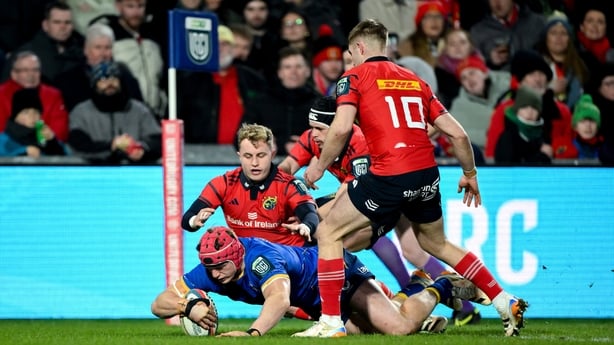
As frustrated as Beirne and McMillan were with the "stop-start" nature of Saturday’s defeat, their Munster side did have more than enough opportunities to go and win the game, with 62% possession and 63% territory, with Leinster having to make 185 tackles across the 80 minutes.
And the Munster captain admits his side allowed Leinster to play the game at their own pace.
"It's just one of those games that we'll be frustrated that we didn't win," said the Ireland forward.
"I think Leinster will probably walk away from here feeling like they got away with one too.
"We're trying to bring tempo, sometimes we need to be better at it. But a game like that, it just felt like the scrums were a bit messy. I’d say we probably lost 15 minutes and just reset scrums. It was just so frustrating.
"They [Leinster] want to scrum, they want to kick the corners. They take their time getting there.
"That's just my opinion on it. I feel like we're trying to bring tempo as best we can. I think we could have been a bit better again today.
"I think we kind of fell into their trap once or twice in terms of slowing the game down. That would be the only thing I would feel on it."
