


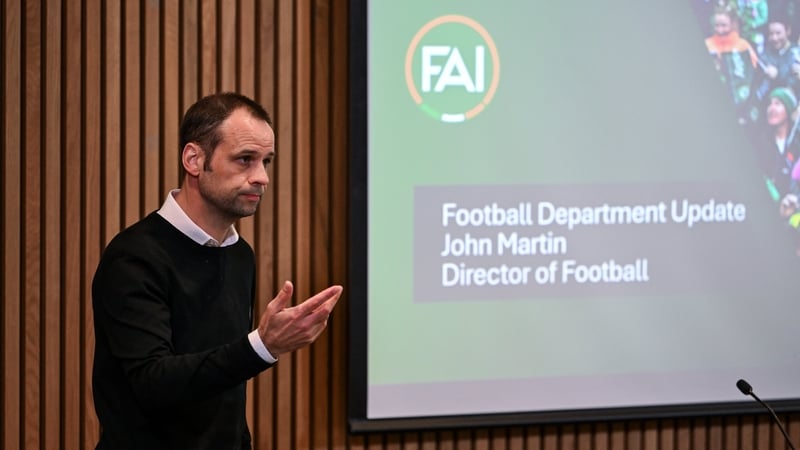

The FAI is keen for talent potentially eligible for the Republic of Ireland not to fall through the cracks, but its director of football John Martin insists "merit" will still be the main consideration when deciding whether to fast-track players.
Speaking after the association's media briefing on Wednesday, ex-Shamrock Rovers CEO Martin discussed the competition between nations in regard to dual nationality players or those eligible for multiple nations under the current FIFA rules.
It's an issue that has long been part of Irish football's story at international level, with numerous players born overseas - England and Scotland in particular - representing the men's and women's national sides over the decades.
"We're seeing a trend," Martin said. "If you look at the Nations League and you look at what the major nations are doing in European football, you’re seeing a trend towards nations (capping those players).
"You're going to see a lot of one and two cap players in about ten years’ time as a consequence of five substitutes and (the) Nations League, and it was just more in that context I was seeing it.
"Where in the past, a World Cup qualifier or a European Championship qualifier (was) probably sacrosanct in terms of the squad, (it's) maybe less so in the Nations League.
"There have been a lot of one-cappers for England over the last few years as well, so it was just more through that."
However, while there is competition between nations to secure players within their systems, Martin added that "merit" remains the key factor in regard to fast-tracking prospective players through to the senior squads.
"We'd still want it to be on merit and also you want to be careful that you don’t upset the pathway," he said.
"You could have a really talented 19, 20-year-old and they get fast-tracked by someone else and there’s a consequence and a knock-on impact.
"But sometimes it’s just easy isn’t it? Sometimes it’s just this kid comes through and they’re destined for good things so they’ll come through the system anyway."
He added: "It has to be on merit. And with a mixture of potential obviously, because it could be good for a young player's development that they’re capped.
"We’ve seen it under Stephen (Kenny), that actually by him recognising and capping players at international level, it helped them at club level as well because suddenly the club are like, 'Oh we have an international player’, and either they develop within that club or you can go onto something (else)."
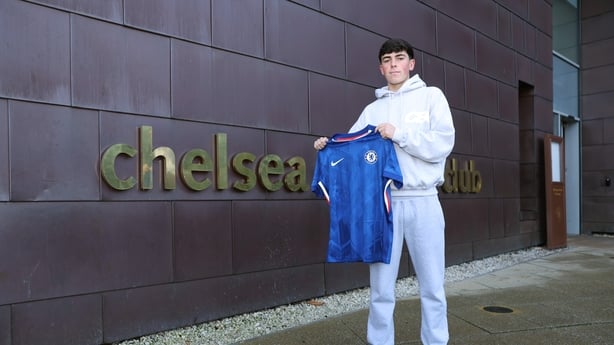
In 2020, FIFA changed the rules governing eligibility. It allows players who have made fewer than four competitive appearances in non-major tournament scenarios for their initial nation to switch country before turning 21.
In February, Chelsea youngster Christopher Atherton switched from Northern Ireland to the Republic of Ireland.
The 17-year-old ex-Glenavon player had represented the Northern Irish under-16 and under-17 teams between 2022 and 2025, but has since been capped twice for the Boys in Green's under-19s in March.
"Christopher (Atherton), he played competitively for Northern Ireland at 17s, which meant he needed a transfer. He can't transfer back. So they are big decisions for some of the young kids," Martin said.
"You see the English, like obviously they lost (Jamal) Musiala (to Germany), for example and they swear they'll never lose another Musiala, but it was different back then because they could play for 17s and then just go play for Germany. But now actually the transfer piece makes it a more serious conversation."
On players eligible for both the Republic of Ireland and Northern Ireland, Martin acknowledged that it's important that the FAI take the initiative to ensure that those who wish to represent the Boys in Green are approached.
"It is not specific to the north but we have to make sure we are doing our job. We know there are kids out there who want to play for Ireland who haven't been approached in the past. That's not right," he said.
"It is going back to Talent ID and making sure we have a presence and we understand all the players available to us, and they are being monitored and tracked.
"That is something we need to be better at. You don't want to lose out on a player that wants to play for us. We can't have that."
One example of an eligible player that the Republic of Ireland missed out on in the past is Liverpool's Conor Bradley.
The Tyrone-born right back represented Northern Ireland through the youth grades and has since gone on to win 30 caps at senior level for Michael O'Neill's side by the age of 22.
"Easy (example) isn't he. Fantastic player," Martin said.
"You hear second hand stuff that he is an Ireland fan. Asking the question is the bare minimum we should be doing, whether they are based in Northern Ireland, Germany or the UK."
Listen to the RTÉ Soccer podcast on Apple Podcasts, Spotify or wherever you get your podcasts.
