


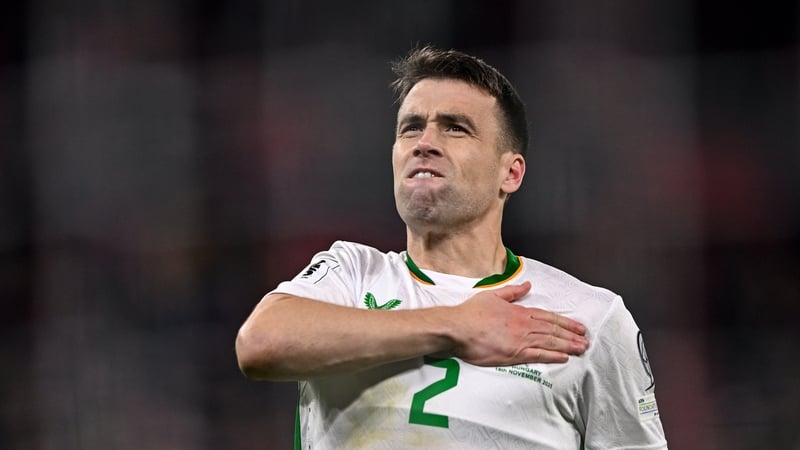

Heimir Hallgrimsson says it would be the Republic of Ireland's gain if Séamus Coleman opts to extend his international career into another campaign.
The Everton club captain will turn 38 in October, with his Toffees contract set to expire at the end of June.
In the wake of Thursday's penalty shootout defeat in Czechia ending dreams of going to the World Cup, question marks have been raised as to whether Coleman will call time on Ireland duty.
The Donegal native brushed aside talk of that issue in his post-match reflections in Prague, saying: "I would never think of myself that quickly after the nation got so disappointed. That's something that will come later down the line."
Speaking as the squad gathered together at the FAI National Training Centre on Saturday, Hallgrimsson admitted any retirement decision would be for Coleman alone to address in his own time.
RTÉ Sport's @Corktod reports from the Irish camp as the game nobody in green wanted to see scheduled comes into view. pic.twitter.com/YPmm11gLjR
— RTÉ Sport (@RTEsport) March 28, 2026
"That would need to be him talking about that," said the manager.
"I think it's just how he played and how he acts in the squad. It would be good for us that he will continue but it’s him (to decide).
"He is the one that answers these questions."
He added that he had not spoken to the long-time former Ireland captain about the future beyond Tuesday's Aviva Stadium friendly against North Macedonia.
But with the Nations League to come in the autumn and then the road towards a Euro 2028 which will be co-hosted by the Republic of Ireland, Hallgrimsson was in no doubt about whether he would like Coleman to remain part of his plans.
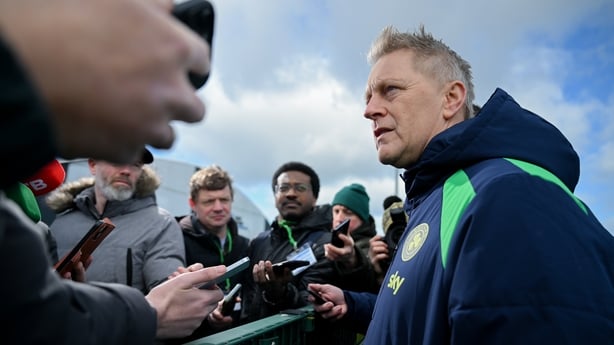
"It would be his move first. At the moment he is playing at that level. We definitely gain from having him. Our gain is him being with us," he said.
"So I would not ask that question. I think it's unfair (with) how he is playing."
And he added that age alone should not be considered a barrier to Coleman remaining on board in a playing capacity in the summer of 2028.
"I can't say (if Coleman will carry on). But just because of a number, it shouldn’t be a reason why he should stop if you’re implying he should stop," Hallgrimsson said.
The current core of the national playing pool is built around a group that were largely filtered into the senior team during the Stephen Kenny era.
Given how early they were fast-tracked, the majority have picked up significant experience at international level with some already into the 30s when it comes to their cap count.
Indeed, captain Nathan Collins is still just 24 years of age, while Caoimhín Kelleher, Gavin Bazunu, Dara O'Shea, Jake O'Brien, Liam Scales, Jayson Molumby, Finn Azaz, Jack Taylor, Jason Knight, Mikey Johnston, Troy Parrott and Adam Idah are all still in the 24-27 bracket.
And that's not counting a younger clutch led by 21-year-old Evan Ferguson.
It would appear to bode well for the future, in line with the improved statistical metrics that Hallgrimsson had spoken about in Prague.
But by the same token that he is treating Coleman's age as just a number, he also deemed it an unimportant factor for the aforementioned generation.
"Normally, I don't think age is relevant in the national team. Obviously it’s good to have players coming in the future and that’s now where we start to think about the future," he told RTÉ Sport.
"The future will come whether we’ll be ready or not and I think in the past [we] probably didn’t realise that."
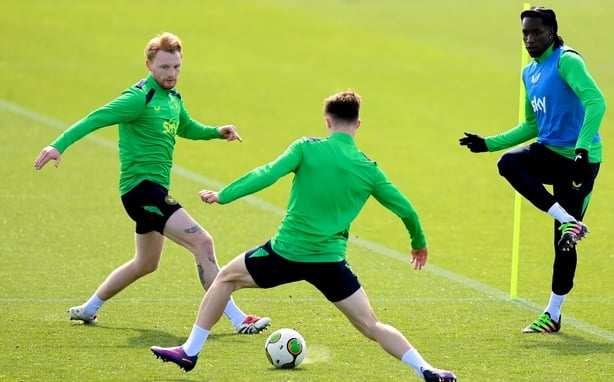
In the short-term though, the manager believes Tuesday against North Macedonia offers an opportunity to give fringe players more exposure, before further squads are put together for training camps and friendlies in May and June.
"What I have said, and I have been consistent in this, is that we have been playing really important games, so there has been no chance to try players and take risks, or whatever you want to call it. But now it's not much at stake, so if I am being consistent, now is the time to give some players a chance," he said.
"What we planned last summer was to have one camp that finishes in May, so the players who are playing in the Championship and the lower leagues and maybe some of the younger players can do that camp and then use the rest of the summer break for holiday and recovery.
"Probably there will be some players only in the May camp. Some players might be in May camp and the June camp, so it gives us an opportunity to see more players, a bigger squad, looking at the players that we've wanted to give a chance to be with us.
"That's one of the reasons why we did this, we spoke to senior players, not planning for the World Cup now but planning ahead."
After Tuesday's game, Ireland are scheduled to face Grenada in Murcia on 16 May, followed by Qatar in Dublin on 28 May and Canada in Montreal eight days later.
Listen to the RTÉ Soccer podcast on Apple Podcasts, Spotify or wherever you get your podcasts.
