


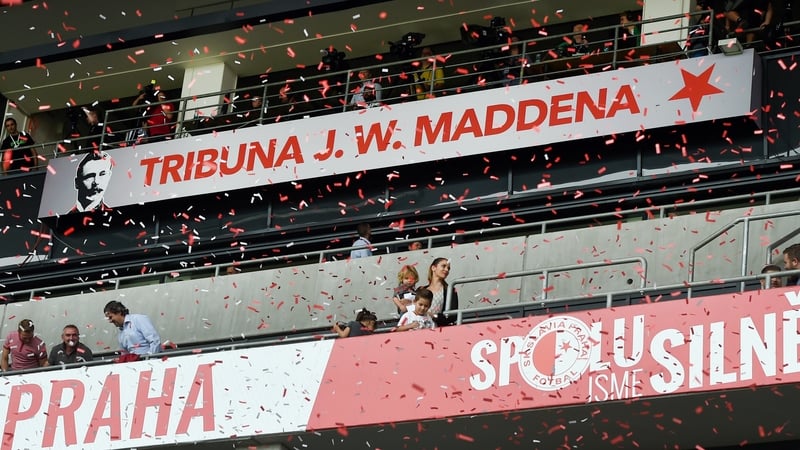
Ireland fans visiting the Fortuna Arena in Prague for the crucial World Cup play-off against the Czech Republic may notice that the main stand of Slavia Praha's stadium is named after a John W Madden.
John William Madden is hailed by some as the father of Czech football. Born in the Scottish town of Dumbarton to Irish parents, he played for Dumbarton FC, Dumbarton Hibernian, Tottenham Hotspurs and is best known for his time at Celtic.
While at Celtic, the team toured Austria and Hungary, which perhaps gave him a flavour of life on the continent. In 1905, he moved to Prague to coach SK Slavia Praha. He would remain as coach until aged 65 in 1930, in which time he established the club as one of the best teams in central Europe, particularly in the 1920s.
As the first real manager in Czech football, he helped the game by introducing new tactics, training and techniques, leaving a lasting legacy at Slavia, where he is still fondly remembered today. Every year a group of Slavia fans visit his grave in Prague to remember him.
Madden isn’t the only coach of Irish blood to make his mark on the continent. Born in Nelson, a Lancashire town in northern England to Irish parents, Jimmy Hogan trained as a priest in his teenage years before football became his true calling.
Even though he had an undistinguished playing career, he would become one of the innovative and forward-thinking coaches in the game. Hogan is barely known in England, with his legacy was on the continent, where he played a significant role in developing his style of football in the Netherlands, Austria and Hungary.
Having started his continental coaching career with Dordrecht in the Netherlands in 1910, he also acted as a consultant for Austria, who were developing a strong team in the 1910s under Hugo Meisl. Unfortunately the first World War meant that they never fulfilled their potential. This team would lay the roots for the Austrian 'Wunderteam' of the 1930s still under Meisl, with Hogan advising.
His importance is not really in his direct achievements, but more through the achievements of those he influenced. The Mighty Magyars of the 1950s defeated England 6-3 at Wembley, shocking the homeland of football. Gustav Sebes, coach of that famous team said: "We played football as Jimmy Hogan taught us."
Hogan had coached MTK in Budapest and led them to seven straight Hungarian titles, laying the seed for what was to come. Hogan is seen by many football historians as the father of Total Football. He influenced Austrian coach Josef Blum, who in turn influenced compatriot Karl Humenberger, who coached Ajax in the 1950s.
Humenberger in turn passed Hogan's theories on to Rinus Michels, who would go on to create Total Football with Ajax and the Netherlands to great effect, which in turn influenced Cruyff, who influenced Guardiola.
Hogan’s attempts to spread his ideas in England didn’t always go down well, and he lasted just 31 games at Fulham. However, a few years later, he oversaw Aston Villa’s return to the top flight after their first relegation. According to Jonathan Wilson, a leading football tactics historian, Hogan is one of the most important coaches in terms of developing the game.
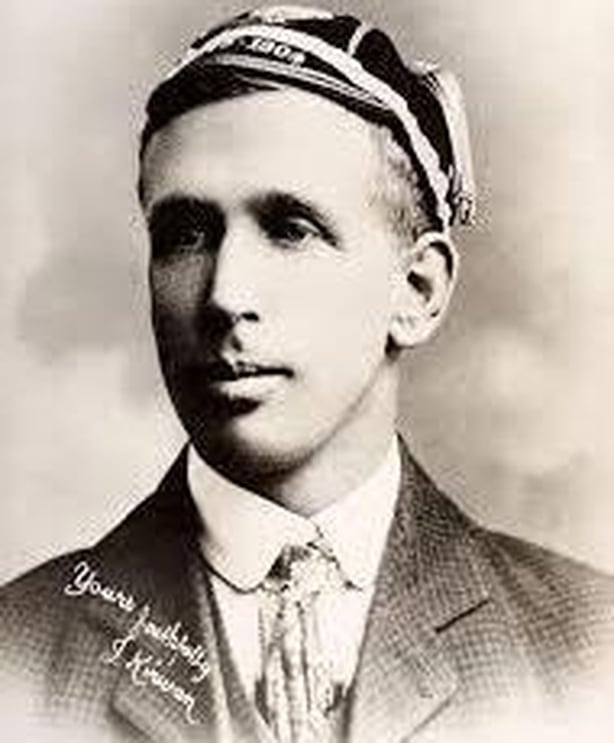
Speaking of Ajax, Wicklow-born Jack Kirwan (above) played a role in the club's early development and is responsible for their famous jersey. Kirwan's early success was not with a soccer ball, but with a Gaelic football. He won an All-Ireland with Dublin in 1894, defeating Cork.
He is best known for his time at Tottenham Hotspur, where he spent six seasons. His time at Spurs saw the team win the FA Cup in 1901, so Kirwan is most likely the first player to win both an All-Ireland medal and FA Cup medal. Spurs at the time were playing in the Southern League, becoming the first and only non-league team to clinch the FA Cup.
He was the first Spurs player to play for Ireland and later played for Chelsea and a number of lower league teams before retiring from playing in 1910. Kirwan became part of the wave that saw 'British' coaches going to the continent, and he ventured off to Amsterdam to take over a club with big ambitions.
Ajax Amsterdam was founded in 1900 and Kirwan became the club's first professional coach in 1910. He had an immediate impact, guiding the team from the second division to the top division for the first time. Ajax wore red and white stripes with black shorts, which now clashed with Sparta Rotterdam’s colours. It was Kirwan who suggested the now famous Ajax jersey of white with a single red stripe.
After two moderately successful seasons in the top tier, Ajax were relegated in the 1914-15 season and Kirwan left the club. While his tenure may have ended in relegation, he had helped bring recognition to the club. He was replaced by Englishman Jack Reynolds who would go on to become one of Ajax’s greatest managers, leading them to their first national title in 1917-18. It was under Reynolds that the club adopted their footballing philosophy and established the youth academy that the club is famous for.
Kirwan would coach Bohemians in Dublin for a short stint before coaching AS Livorno in Italy, where the team finished third and fifth in his two seasons. He returned to London and was the last surviving player of the Spurs 1901 team.
Another coach who went to Italy was Jim Donnelly, whose story is part mystery and part misfortune. Born in Ballina in 1900, he and his family moved to Sussex at a young age. He had a journeyman career as a player before becoming a football coach.
With the interest in British coaches on the continent, he was sent by the FA to help spread the gospel. After a stint in Belgium, in 1933 he found himself in Zagreb, coaching Gradanski, who in time became Dinamo Zagreb. The club was in turmoil but Donnelly helped steady the ship and success arrived shortly after his departure thanks to Marton Bukovi, a legendary Hungarian coach.
Donnelly would move further east, this time to Istanbul, where he coached the newly formed club Gunes SK, who had broken away from Galatasaray and were an up-and-coming team. Here the mystery begins. In some records, it is said he also coached Fenerbahce, one of the Turkish powerhouses, but it is likely that the records are confusing him with Jimmy Elliot, an Englishman in charge of Fenerbahce at that time.
Whatever Donnelly was doing, it impressed the Turkish footballing bosses as he was asked to take charge of the Turkey team for the 1936 Olympics in Berlin. While the tournament was a short one for the nation's team, the experience brought more notice to Donnelly.
His next move saw him go to Italy, then a fascist state under Mussolini. Unwelcoming to foreigners, it was a surprise move to make. Donnelly's exact role is unclear, but it seems he was effectively coaching Inter Milan – or as they were called under the regime, Ambrosiana. However, as a foreigner, the coaching credit had to be given to an Italian, in the form of Armando Castelazzi.
Then came the misfortune. He was sought out to become the new coach of the Austria in the spring of 1938 in advance of the upcoming World Cup. This was a team with much promise, thanks to the work of Hogan and Meisl, and promised to be an exciting chapter of Donnelly’s story. Yet, at the same time, Germany took over Austria. With the national team disbanded, Donnelly’s dream was shattered. Just 38, he left the world of football coaching and wound up in Morecambe, Lancashire, where he lived out a quiet life until his passing in 1959.
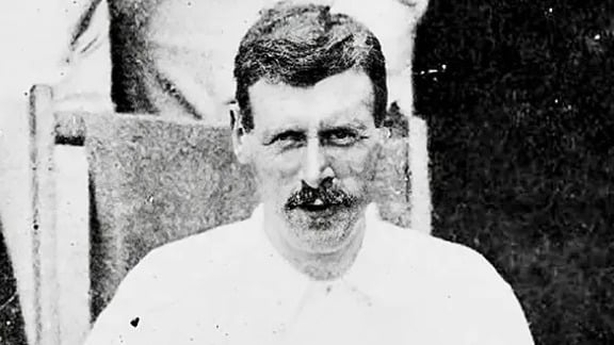
Although born in Dublin, Arthur Johnson (above) considered himself English. Johnson had played football at the famous amateur English team Corinthians and moved to Madrid in 1902. Johnson was a key member of Madrid FC in the early days. Even though he was just 24, his experience of playing in England was vital as football was still new to Spain.
He wrote out four principles to football that were published in a Madrid newspaper. He was the first captain of the team and suggested that the team play in their now famous all-white kit, based on the Corinthians kit. In their first competitive match as part of the Coronation Cup (now Copa del Rey) Johnson would score their first official goal in a 3 -1 defeat to now arch rivals Barcelona.
Johnson would later play many games in goal. Madrid would dominate the Copa for a few years but Johnson was not involved, having returned to England to work. Back in Madrid in 1910, Johnson became coach of the team and while they dominated their local league, they could only win one Copa during Johnson’s 10-year reign.
Shortly after his time, the Real title was added and in the 1920s Spanish football saw English coaches like Fred Pentland at Athletic Bilbao and Jack Greenwell at numerous Spanish clubs, including Barcelona and Valencia. Barcelona had a history of hiring foreign coaches and soon after Greenwell's second stint at the club, an Irishman would take the reins.
Patrick O'Connell is probably the most well known of the Irish managers on the continent, thanks to his time at Barcelona and recent interest in his story. He is regarded by some as the saviour of Barcelona, thanks to an important financially successful tour of North America during the Spanish Civil War, which helped the club survive. Nicknamed 'Don Patricio', the Dublin-born former Manchester United player’s importance in the history of the Catalan giants has been somewhat overstated in the opinion of this writer.
Barcelona are a club with strong regard for their history and they only have minor references to O’Connell. Before Barcelona, he had coached in Seville with Betis Balompie (now Real Betis) and there he is very well regarded as he coached the club to its only league success in 1935. His bust can be found outside the Real Betis stadium acknowledging his success with the club. O'Connell would go on to manage Real Betis’s city rivals Sevilla between 1942 and 1945.
He was the second Irishman to coach the club. Donegal man Charles O’Hagan was the first back in the 1923-24 season. Having unsuccessfully managed Norwich in 1920 after his playing career was cut short by the first World War, his arrival in the south of Spain was something of a surprise.
O’Hagan had finished his playing days in Scotland and fought in the war with a Scottish Regiment. Sevilla were a club with a strong Scottish foundation, so perhaps there is a link there. While he only stayed one season, that season is regarded as a success. The club won the local league and staged a number of exhibition matches against teams from Spain and abroad. Sevilla recently recognised O’Hagan’s contribution to the club in their St Patrick’s day social media post.
Watch Czech Republic v Republic of Ireland on Thursday from 7pm on RTÉ2 and RTÉ Player. Follow our live blog on RTÉ.ie/sport and RTÉ News app or listen to commentary on Inside Sport on RTÉ Radio 1.
