


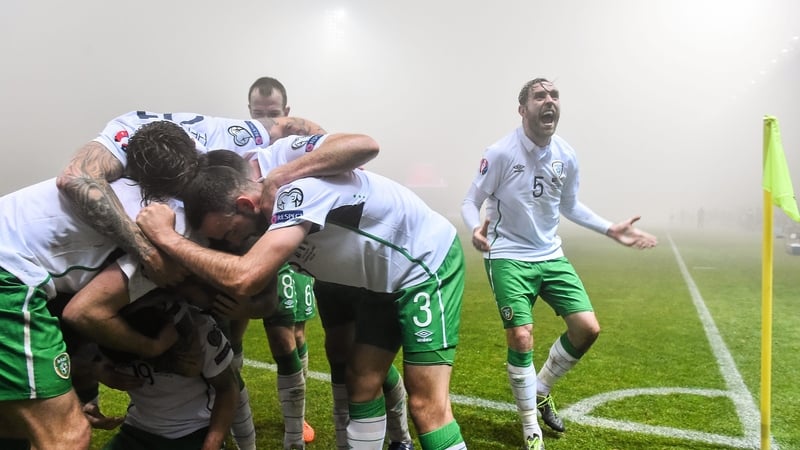

The expansion of the World Cup to 48 teams hasn't made it any easier for teams of Ireland's ilk - middle ranked UEFA nations - to reach the finals.
It's proof enough that having eliminated Hungary in dramatic fashion, the Boys in Green still have to navigate two ties which are fast approaching.
At least Ireland have ample experience of play-offs. They've been regulars at this stage for over 30 years now.
Netherlands - a deleterious (bad) set of circumstances (1995)
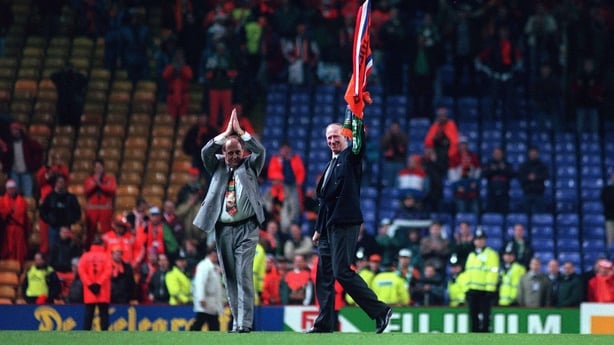
Jack Charlton's last stand as Ireland manager. The campaign to qualify for Euro 96 in England - purring along nicely until then - had imploded from the moment that Ireland "drew with a mountain-top" (as the Sunday Tribune's Peter Ball put it) in Liechtenstein in June 1995.
Two 3-1 defeats to Austria, a 3-0 trouncing under a deluge of rain in Lisbon, and a jittery 2-1 home victory over Latvia later and Ireland were lucky to limp into a one-legged play-off as one of the two worst performing second-placed finishers, only ahead of Northern Ireland in the group on goal difference.
Worse again, the Netherlands were somehow the other worst performing runner-up, after starting slowly in their group.
The portents were exceptionally bad heading to Anfield for a play-off 12 days before Christmas. The Dutch team had basically won that year's Champions League with Ajax. Eight of the starting team had played in the 1-0 win over AC Milan in the final, with Winston Bogarde on the bench. Dennis Bergkamp and Glenn Helder were the only exceptions.
They were taking on an Irish team with an average age of 32, with a couple of the players greying on top. Ireland's preparation wasn't as thorough as it might have been.
On the eve of the game, Charlton gathered the team around him and hit play on a VHS of the Dutch team in action. The late Alan McLoughlin recounted in his autobiography that it soon dawned on the players that they were watching footage of the Netherlands Under-21s playing in a sparsely populated stadium.
It dawned on the players quicker than it did their manager. Charlton drew their attention to a young blonde striker and implored them to "watch Bergkamp!" as laughter began to spread around the room. Eventually, Jack grew annoyed at the laughter and demanded to know "what's so f***ing funny?"
On being told, he shut off the recording and proceeded to blame Maurice Setters for the mishap, who in turned blamed the Dutch for selling them a pup.
In the game, Patrick Kluivert scored in both halves and the result was hardly in doubt. After a glorious decade, there was minimal recrimination on the night itself. Charlton, in wistful mood, basked in the grateful acclaim of the travelling Irish fans on what was clearly a farewell game.
Eamon Dunphy might have ripped into the departing regime but he had fallen out with RTÉ at the time. He spent the evening on Vincent Browne's wonderfully anarchic late-night radio show on 98FM, arguing about Jack's legacy with Nell McCafferty, Dermot Morgan, a national table tennis coach called Arthur, with John Giles also joining on the line.
Morgan was more annoyed with Dunphy's recent Sunday Independent column arguing for a No vote in the upcoming divorce referendum, accusing him of infantile contrarianism. "Why?" asked Browne. "He was offering a view on divorce. Having reflected on it he believed the social consequences of divorce would be deleterious."
"Deleterious means bad, Dermot," Dunphy interjected, as Browne collapsed into laughter.
But it had been a deleterious campaign for Ireland.
Iran - breaking down boundaries (2001)
The recent Saipan film portrayed the second leg in Tehran as rather more agonising than it was in reality. Éanna Hardwicke's Roy Keane was unable to watch the latter stages of the game after Iran went 1-0 up and sat out in the garden instead. When his wife wanders out to join him, Keane is assuming the worst that Ireland have missed qualification.
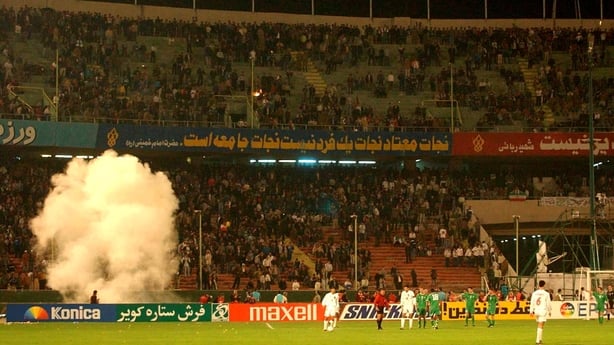
In reality, Iran's goal at the mammoth Azadi Stadium came in the dying seconds with Ireland on the cusp of qualification. The locals had already lit fire to the parts of the terrace, by all accounts a common enough reaction to defeat in those parts.
It was third time lucky for Mick McCarthy in play-offs, after defeat to Belgium in the '98 qualification playoffs and then the away goals loss to Turkey for the Euro 2000 playoffs, where Tony Cascarino had, like Eric Cantona, squared up to the local police.
Ireland, with Roy Keane hitting an incredible peak of performance, had played exceptionally well in qualifying, eliminating the Dutch in the process.
Revered English football writer Brian Glanville was outraged that Ireland had to go through the rigmarole of facing Iran at all.
Ireland won the home leg 2-0 thanks to goals from Ian Harte and Robbie Keane, after which an agreement kicked in whereby Roy Keane returned to Old Trafford for treatment for an injury, which caused a fair degree of unease in the lead-up to the away game.
In addition to the match itself, there was much coverage about the presence of 40 or so Irish female supporters, who had been granted a dispensation to attend, much to the chagrin of many Iranian clerics. They were allowed to attend the game provided they adapted to local custom and wore a veil at all times.
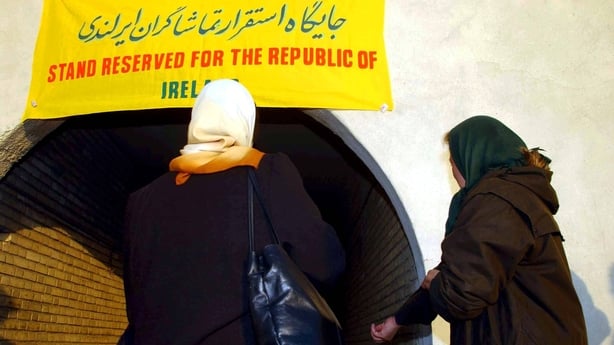
One of that number, Nicola Byrne, wrote an account of the experience in the Guardian under the headline: 'My journey to Iran with Ireland's fearless sisters'.
"Walking up the steps towards the ugly concrete bowl, it soon became clear it was a concession [allowing them to attend] to which many men in the stadium were vehemently opposed," Byrne wrote.
"Once inside, we were constantly harried by officials and Iranian supporters alike, who watched like hawks for any sign of aberrant behaviour.
"One woman let her veil fall momentarily, another unbuttoned her long coat. Both acts provoked an extraordinary tantrum by an Iranian Football Association official who complained bitterly to an FAI official."
Byrne reported that the atmosphere turned increasingly ugly and somewhat frightening as it became clear it was Ireland and not Iran who'd been heading to the World Cup.
There was jubilation on the pitch afterwards, with McCarthy declaring that he might be able to articulate his feelings better tomorrow "when I've a load of gargle on me."
France - The centre of world attention (2009)
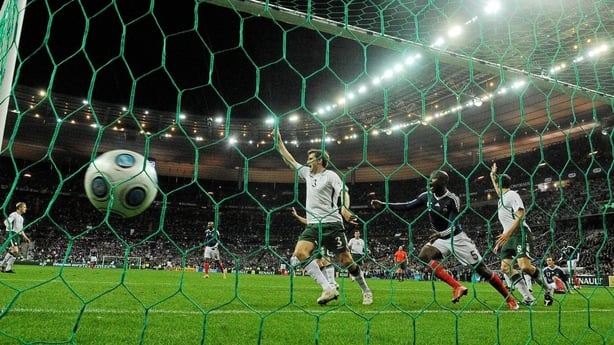
We take it most of you remember what transpired that evening. William Gallas's late header - there may have been an issue with the assist - denied Ireland a penalty shootout on a famous night in Paris.
A few snapshots and memories stick out. The Irish were already miffed after FIFA decided at the 11th hour that the play-off draw would be seeded, which encouraged a conspiratorial mindset before the off.
Of the exceptional Irish display in Paris that evening (which did, after all, deliver a 1-0 win in 90 minutes) it was suggested later that the players had decided to jettison Giovanni Trapattoni's pathologically defensive tactical template. Kevin Doyle told RTÉ.ie on the 10th anniversary that there was no conscious decision to do that and the adventurous mindset simply arose from the fact that they were starting the game 1-0 down from the first leg.
After the match, holy hell rained down on Thierry Henry. The Irish editions of UK tabloids all embraced an anlogcentric knockabout Francophobia for the week that was in it.
The Sun pushed a story alleging that cleaners in Dublin were refusing to handle Henry Hoovers. "It's bizarre because the machines have nothing whatsoever to do with Thierry Henry," a source supposedly told the paper.
One caller to Liveline advocated a boycott of Cuisine de France, which surely caused alarm for the Dublin-founded company.
John Delaney formally called for a replay at an Abbotstown press conference, though Trapattoni was rather more circumspect.
On the BBC's Newsnight, Kirsty Wark had Dara O'Briain on to discuss the matter with an extremely apologetic David Ginola.
In France, economy minister and future IMF chief Christine Lagarde called for a rematch, as did opposition leader Francis Bayrou.
Patrice Evra, for his part, said he'd be willing to replay the match on his Playstation.
Various French philosophers were quick to draw attention to the moral quandary in which the nation found itself.
Their universally hated manager Raymond Domenech had no such qualms. "We are not going to commit hara-kari because the referee made a mistake and this time in our favour," he was quoted as saying.
In the end, the unprecedented - and often satisfying - whingefest was halted when the mortifying 33rd team business was let into the public domain by Sepp Blatter.
While that did produce the regrettable headline 'Bono calls on FIFA to reinstate Ireland', most people took it as their cue to finally whisht about the whole thing.
Estonia and the jackpot ball (2011)
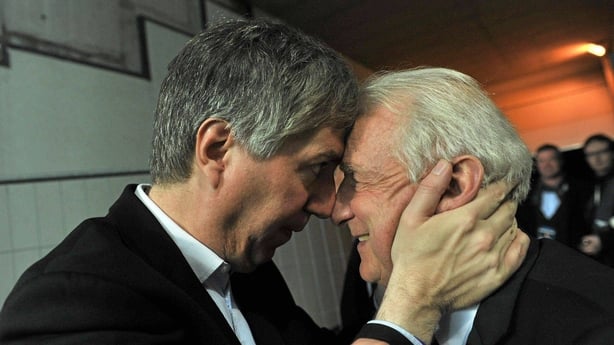
After Paris '09, the footballing Gods had decreed that Ireland were due some good fortune.
It duly arrived two years later, when Ireland pulled the jackpot ball Estonia in the Euro 2012 play-offs - the Estonians having mysteriously finished runners-up in their group despite losing 2-0 away to the Faroe Islands at one stage.
The group itself is best recalled for Richard Dunne's indomitable performance in Moscow where Ireland secured a truly miraculous 0-0 draw. Though in the end, this result wasn't needed as primary qualification rivals Slovakia imploded badly. That Ireland collected the maximum 12 points from the ties against Armenia (who ended up finishing third) and Macedonia proved decisive.
The mood around the draw from an Irish perspective was best encapsulated on the Guardian Football podcast, which was recorded while the draw was ongoing.
After presenter James Richardson noted that Ireland's name had been pulled out, there was a brief pause and then Barry Glendenning let out an ear-splitting cry of 'YAAAASSSS' to herald that Trapattoni's team had drawn Estonia, the outcome which everyone had universally agreed beforehand was the dream tie.
Viewed from a distance, it was all rather disrespectful to the Estonians who were on a heady journey of their own. No doubt it would have been sweet for them had they shoved Ireland's hubris down their throat.
But Irish confidence proved to be entirely well placed on this occasion. The 4-0 win in the first leg in Tallin, where the hosts were reduced to nine men, essentially sealed qualification at the halfway mark.
It sparked a raucous celebration in the Estonian capital, with CEO Delaney emerging as the chief cheerleader, sending his tie windmilling into the away section.
"Poland and the Ukraine, are you ready for us?" Darragh Maloney cried on commentary after Robbie Keane dispatched the penalty to make it 4-0 on the night.
Whatever about the bartenders of Poznan and Gdansk, their group rivals turned out to be more than ready for Ireland.
Bosnia & Herzegovina - finding a way through the fog (2015)
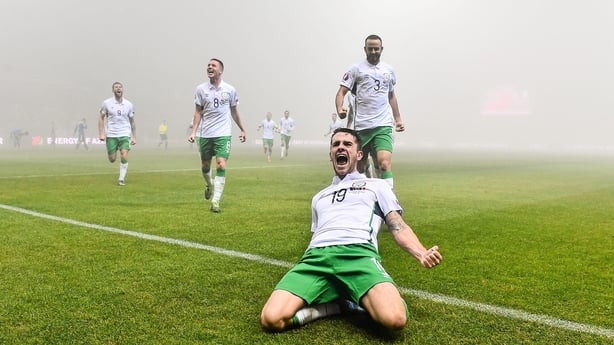
Ireland's last successful qualification campaign and a victory that occurred in the middle of a strange 15-month spell in which they took down four teams ranked in the World's top 30 in competitive games.
The Euro 2016 campaign looked doomed after Ireland had only taken one point from two games off chief rivals Scotland. But late in the day, they were thrown a lifeline after the Scots - as was their wont at the time - lost 1-0 away in Georgia in September (some of us may have been informed of this fortuitous result by the Scottish lead singer of Belle & Sebastian at Electric Picnic).
Ireland beat the Georgians 1-0 three days later to regain the initiative in the battle for the play-off spot. A month later came the famous win over Germany.
The Bosnians were ranked considerably higher than Ireland and entered the playoff as favourites, but Martin O'Neill's team were in buoyant mood after the events of the autumn.
RTÉ televised the game as per usual, though not many managed to see the second half. The pokey little Bilino Polje Stadium in Zenica (15,000 capacity or thereabouts) was enveloped in an incredible layer of fog which made things near impossible to see, even from the commentators' gantry.
Fortunately, Jim Beglin, on co-commentary duty, had a set of eyes which were able to penetrate the fog. "God bless your eyesight," George Hamilton remarked at one point, as his co-commentator brought him news of a Darren Randolph save.
Tony O'Donoghue, on the sideline, was called upon to don his meteorological hat and explain the weather patterns which were at play at one stage.
It was Beglin who spotted that Ireland had scored first, also. As the camera revolved in the direction of the Bosnia goal, with Irish jerseys faintly visible around the edge of the penalty box, Jim butted in. "They've scored!"
After a brief pause, George took up the baton again - "They've scored!? Robbie Brady has scored! That is sensational!!
Close-in replays showed Brady drilling a low shot inside the near post. The Bosnians equalised four minutes later but 1-1 was an excellent result.
"You're going to have to tell me about the goal because I didn't see it," Tony asked Brady after the game. "I don't know, I barely seen it meself," came the response.
Very grave news filtered through from elsewhere, as the Bataclan terrorist attacks had taken place in a Paris nightclub that evening.
Visibility was perfect three days later, as a Johnny Walters brace saw Ireland defeat Bosnia 2-0 in borderline routine fashion. Officially, it was the second time that Ireland had sealed qualification in Dublin, after Estonia four years earlier, though it felt like the first. They were on the way to Paris.
Listen to the RTÉ Soccer podcast on Apple Podcasts, Spotify or wherever you get your podcasts.
Watch Czech Republic v Republic of Ireland on RTÉ2 and RTÉ Player from 7pm on Thursday, 26 March. Follow our live blog on RTÉ.ie/sport and RTÉ News app or listen to commentary on RTÉ Radio 1.
