


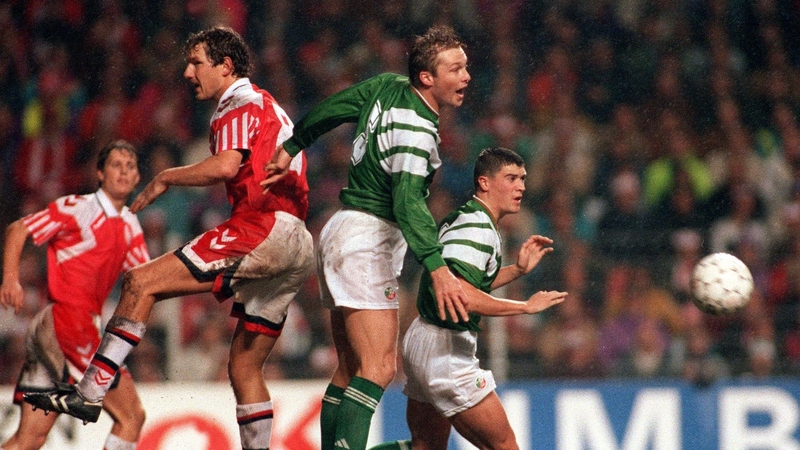

The last eight-team European championship was played in 1992 and was won, famously, by Denmark.
It was an outcome that many in Ireland retrospectively chose to regard as a sickener, as the two countries had a couple of things in common, the most pertinent being the fact that neither of them had qualified for Euro '92.
In the preliminaries, the Danes had the dumb good fortune to finish runners-up to Yugoslavia, a country which was in the process of breaking up and which was soon to play host to the most vicious and tragic ethnic conflict since the second world war.
Ireland, meanwhile, finished a close second behind the rather more politically stable England. Following the giddy high of Italia 90, England, under new manager Graham Taylor, rediscovered their own mediocrity, and only qualified by virtue of Ireland's frustrating failure to beat Poland either at home or away.
Eleven days out from the tournament, with the Yugoslav War escalating horribly, UEFA, under pressure from the 'international community', decided to ban the country from the Euros.
The Danish players were ordered to abandon their pool loungers in the Mediterranean and report for duty in Copenhagen.
Michael Laudrup, who had just won the European Cup with Barcelona, didn't bother doing so, perhaps influenced by his already frosty relationship with manager Richard Moller Nielsen.
A popular hypothesis these days, one recently advanced by Peter Schmeichel, is that the Danes wouldn't have won the tournament had the elder Laudrup played, as his presence would have complicated coach Richard Moller Nielsen's desire to play a defensive, reactive and hard-running game.
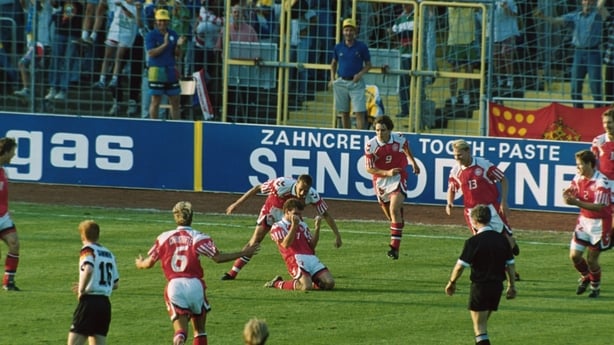
Another slightly dreamier and more marginal hypothesis is that Euro '92 was the great 'what might have been' in Irish soccer, with some bullish souls reasoning that if Denmark were capable of winning the whole thing, then surely Jackie's boys couldn't have been a million miles away.
After RTE's 'The Sports File' re-screened the England-Ireland game from March 1991 - arguably the footballing high-point of the Charlton era and a match which Ireland should have won 3-1 - George Hamilton ended the programme by noting that Denmark had won the Euros the following year.
"And we had a great team then," George continued, "Who knows what would have happened…?"
Ray Houghton isn’t inclined to dwell on it too much. That ‘what if’ involved is too big. The Danes got the luck but the far bigger story is in how they capitalised on it.
"You have your chance and unfortunately we didn't get through. For ’92, we didn’t lose a game in qualification… To miss out without losing was hard to take but the fact that Denmark got there, that’s just the way the rub of the green goes. You have to accept it.
"But they done well. I think they were on the beach. And then, all of a sudden, they had to come together. And they were fortunate. If you go through it, they didn't play great in all of their games. There was one or two very good performances.
"It's not always about having the best team. It's just about organisation and having a bit of luck going your way"
"But overall, as Portugal showed last year, and Greece did in 2004, it's not always about having the best team. It's just about organisation and having a bit of luck going your way."
Ireland had long known they were facing Denmark in the USA '94 qualifiers.
In the 'Road to America', a film chronicling Ireland's qualification campaign for the 1994 World Cup - more celebratory but less filmically memorable than 'Do I Not Like That' - Jack Charlton chided unspecified individuals for being relatively relaxed about the possibility of facing Denmark - until they won the European championships.
For Houghton, the fact that Denmark's standing had recently gone up in the world, didn't massively phase him one way or another.
"I was looking forward to playing against them... It was the same as if I was in a team playing Greece after Euro 2004. I wouldn't be overly concerned. I wouldn't be going over saying, 'Oh we're going up against the European champions.'
"You'd have known that they'd have had some good players. But, equally, we had some good players."
Peter Schmeichel, who has been interviewed by almost every sports reporter in Ireland this week, corroborates this, recalling Ireland as a powerful entity back then, and laying great emphasis on the granny rule.
"It was different. The team wasn't really Irish back then. Jack [Charlton] was very clever, and he got the pick of the best that didn't play for England. So he had the best kind of players back then.
"Now, it's true Irish. You don't have that happening anymore. But it was a really strong team back then. Strong players - players playing at the highest level: Andy Townsend playing for Aston Villa back then; you had Niall Quinn, you had Tony Cascarino; you had Roy Keane, you had Dennis Irwin playing for us; Steve Staunton - Aston Villa, Liverpool; Ray Houghton as well - Liverpool."
As far as the Irish players were concerned, the game which loomed large in the mind was not the Euro '92 final but a match played seven years earlier, when Eoin Hand's Ireland were slaughtered 4-1 in the final game of 1986 qualifying, one of the most famous non-events in Irish football history.
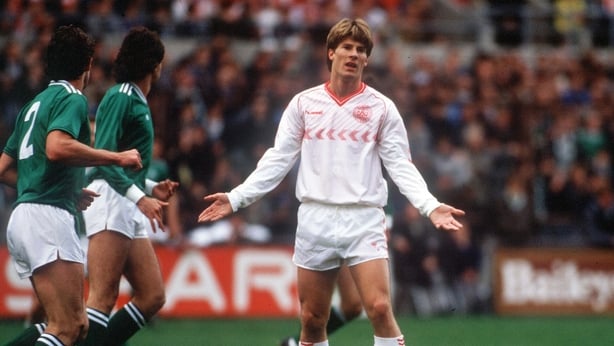
The 12,000 who showed up that day weren't treated to a particularly cheering experience from an Irish standpoint, but their reward would come in due course as they were able to hold it over the inflatable hammer brigade for the guts of the next decade. (For their part, the inflatable hammer brigade were having too much craic and were deaf to the moralising.)
As writer Damian Corless remembered this week, as the credits rolled on the televised highlights of the game, the RTE announcer said: "after the break, we'll have more comedy in Cheers."
The Danes, with a certain Mr. M Laudrup in a somewhat more prominent role, ripped Ireland to shreds. Tony Cascarino was up front that day and remembered it as one of the best displays he'd ever seen from a team.
The Danes, notwithstanding the silverware they had improbably snaffled in Sweden, were a less dazzling outfit by the early 1990s.
The 0-0 draw in Copenhagen in September ‘92 was heartily celebrated by the Irish players and fans afterwards, but it wasn’t an excruciating backs-to-the-wall affair either.
By the time of the home game in April 1993, Ireland were in terrific shape in the group.
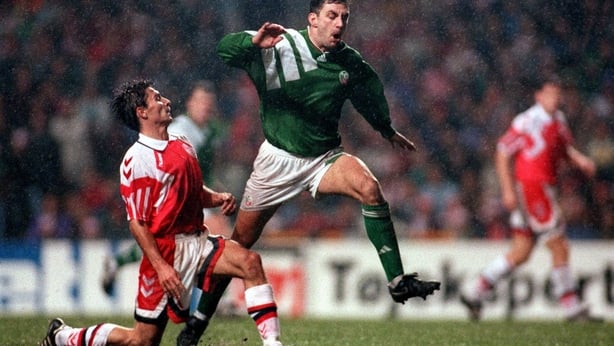
A month beforehand, they had smashed Northern Ireland 3-0 in Dublin, with all three goals coming in the first half hour. The North’s glory days were behind them but were still fresh enough in the memory that they were regarded as a dangerous side.
The March ’93 game offered final crushing proof of the Republic’s new superiority and Billy Bingham allegedly never forgot the triumphalism in the Lansdowne Road air that afternoon.
When the Danish game rolled around, Eamon Dunphy was bullishly predicting a win and, beyond that, a top spot in the group.
Things went awry in the first half as Kim Vilfort seized on a mix-up at the back between Packie Bonner and Paul McGrath.
Bonner raced off his line to collect a harmless high ball but McGrath evidently didn’t hear the cry from his goalkeeper and headed it sportingly into the chest of Vilfort.
The Brondby midfielder controlled it and lobbed the ball expertly into the net as Packie scampered back to his goal like Paddy Cullen.
Niall Quinn equalised with 15 minutes left, diverting a Staunton corner to the net with a glancing header.
Ireland had started the '94 qualifying group in mean fashion and looked the likeliest group winners for most of 1993. However, a kamikaze opening at home to Spain in the penultimate game resulted in Ireland’s first competitive home loss since Denmark in ’85 and teed up a messy finale.
Jimmy Quinn's superb volley for the hosts in the 73rd minute had the Republic briefly facing elimination but Alan MccLoughlin's most celebrated moment in an Irish shirt set Charlton's men en route to a point.
While the Republic were scrapping away anxiously in Windsor Park, Denmark faced Spain in Seville, in a game which marked Santiago Canizares's ascension to the Gary Mackay Hall of Fame.
A win would have assured Ireland of qualification but a draw in Windsor Park meant we needed one or other of the two sides to win in Seville. Draws in both games and Spain and Denmark would progress to America at Ireland’s expense.
Spain's goalie Andoni Zubizarreta was sent off early and the 23-year-old Canizares, then at Celta Vigo, was handed a debut in the most dramatic circumstances imaginable.
Things looked dire for Spain but Canizares repelled the Danes time and time again and, shortly after the hour mark, Fernando Hierro headed home from a corner, aided by teammate Jose Maria Bakero’s subtle foul on Schmeichel as the keeper came out to claim the ball in the air.
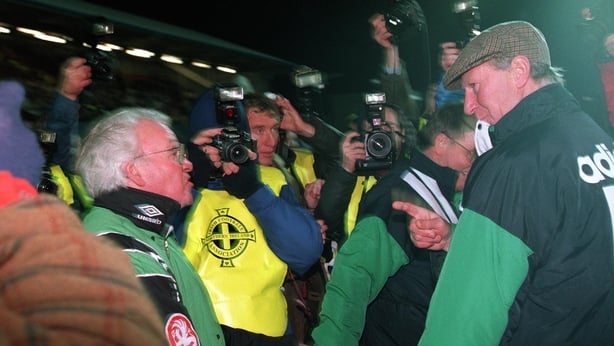
Having successfully shouted 'Up Yours!' in Billy Bingham's face at the final whistle, Charlton spent the aftermath of the Ireland game in Windsor Park, barking "is it over?" at the excitable reporters who gathered around him, refusing to accept Spain had won until the entire scrum were piping up, "it’s over, we’re through!".
The game in Seville dragged on a few minutes longer than the one in Belfast and Houghton remembers there being an anxious wait.
"Someone else had the feed up of the game somewhere. And people were telling us that the game's not over. We weren't going to celebrate in Windsor Park anyway. It was a case of getting into the changing room. I remember we had a bit of a wait. It was a very nervy time for all of us."
The Danes were bitterly sore at the goal which killed their chances. The headline on the back-page of Danish paper 'Ekstra Bladet' read 'ROBBERY'. It was the first time since Czechoslovakia in 1978 that the reigning European champions missed the subsequent World Cup.
As Houghton remarked: "They've gone from a team that had won the Euros in 92 that couldn't qualify for the World Cup in 94. And that was down to us."
Live coverage of Denmark v Ireland on RTÉ 2 (7.25pm), live radio commentary on RTÉ Radio 1's Saturday Sport and live blog on RTÉ.ie from 6pm.
