


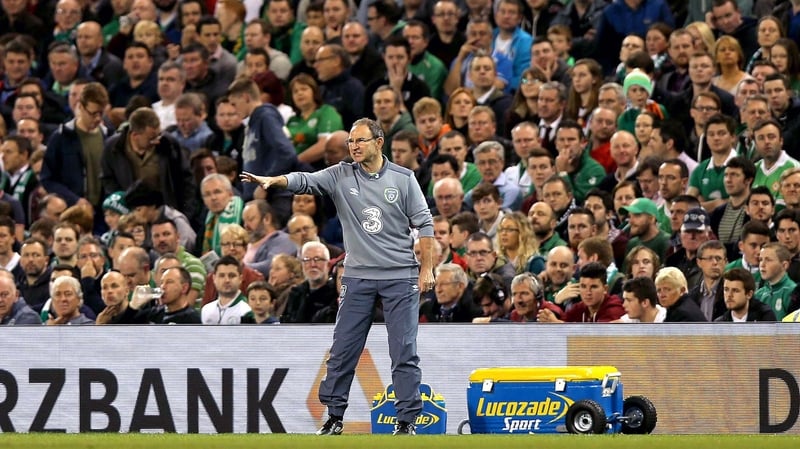

It always appeared the perfect fit: Martin O’Neill and the Republic of Ireland manager’s job should have been a match made in heaven.
The Giovanni Trapattoni era had brought a modicum of success with Euro 2012 qualification, but that peak was quickly followed by an immediate trough, and as the Italian departed, the clamour for the available O’Neill came from all quarters.
O’Neill, who told FIFA.com recently that there is no guarantee he would stay on in the job after Euro 2016, saying: "I genuinely don’t know...I have a very open mind on it all", played his international football for Northern Ireland.
However, the Derryman’s footballing CV was first class and while winning the European Cup as a player with Nottingham Forest could perhaps be seen as his own personal highlight, his experience as a manager in England and Scotland was what cemented his name as the frontrunner for the vacant Ireland job.
Learning his trade in non-league football, O’Neill really came to prominence in the early 1990s as he guided Wycombe Wanderers from the Conference into the Football League, before moving on to Leicester, via Norwich, where he guided the Foxes into the Premier League.
Two League Cup victories and European qualification followed at Leicester before O’Neill was lured north to Scotland and to Celtic, where more success followed, winning three league titles and leading the Bhoys to the UEFA Cup final.

O’Neill then proved his Premier League credentials, once again, bringing Aston Villa to the verge of Champions League football, before dramatically resigning on the eve of the 2010-11 season following a difference of opinions with owner Randy Lerner.
Failing to match his previous club successes at Sunderland resulted in O’Neill being available when the Republic came knocking after the summer of 2013 and he was duly appointed to the role in November of that year.
By now, O’Neill had pushed past the 60-year-old mark and fell into that perfect age for international management, away from the day-to-day madness of the club scene.
And the new Ireland boss would, no doubt, have eyed such a position – although perhaps a little earlier than anticipated – and have had a plan in the back of his mind how to set about such a task.
It is fair to say that the new Ireland manager caught most by surprise with his first decision in international management, by naming Roy Keane as his assistant.

There was method to the madness, no doubt, as O’Neill knew that Keane would take a lot of the media attention away from the manager in his maiden role in international football – a bit more than he anticipated perhaps – while also adding real gravitas to a dressing room full of players who would have grown up idolising the former Manchester United midfielder.
Burnt bridges were rebuilt between John Delaney and Keane and it looked as though Ireland had landed the dream management team.
But then came the long wait for a competitive fixture.
Ireland were drawn in a tough qualifying group for Euro 2016 alongside Germany, Poland and Scotland, however, with two automatic qualifiers and a play-off for third place, O’Neill must have been confident of at least making the play-offs in his first shot at the international game, despite his protestations that it was an extremely difficult challenge.
And O’Neill had to wait more than ten months for that first competitive game, a tricky test away to Georgia, which was a potential early banana skin on what would prove a long, tough road to Euro 2016 qualification.
Aiden McGeady got Ireland out of jail that night with a late, late goal; the winning strike showcasing the talent that the former Celtic man possesses and something that would have really struck a chord with the manager.
With little time to work with players ahead of the international games, O’Neill was happy to continue with the bulk of established Ireland players and already, it appeared, that the manager would rely on players like McGeady, who he knew from his Celtic days, and trusted goalscorer Robbie Keane leading the attack.
So the campaign got off to a winning start but the manager appeared genuinely surprised when he was challenged over the manner of the victory.
And in truth, perhaps it was a little early to be questioning the performance, being the first competitive match and rightly, O’Neill pointed out that the players morale was hugely helped by the manner of the win, away from home, in a hostile Tbilisi stadium.
But it was the first sign that this O’Neill tenure was not going to be the road to immediate success than many predicted while canvassing for the manager’s appointment.
In reality, apart from a lively opening, it was an awful display by an Ireland team that looked no better than the Trapattoni equivalent and provided a real reality check ahead of the big games that lay ahead in the qualifying group.
O’Neill would have to wait another month to rectify the failings of that performance and what followed in the opening home fixture of the campaign proved that this Ireland team could pass the ball through opposing sides as a free-flowing 7-0 victory followed with veteran striker Keane grabbing a hat-trick.
Unfortunately, little was really learned that night as the opposition were Gibraltar and a better XI could have been assembled from the Leinster Senior League, which meant that the only thing that could be taken from the game was the target practice that would have come with scoring seven goals.
But if nothing else, it was a confidence builder and self-belief was needed, as next up was an away trip to face the world champions, Germany.
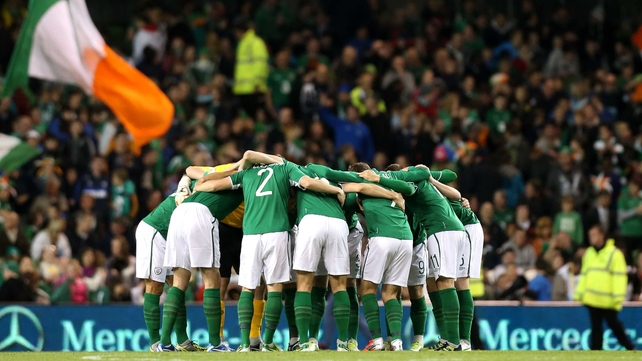
This was O’Neill’s first real test as Ireland manager as he brought his side to Gelsenkirchen to take on the World Cup winners, and while there were certainly signs that the manager was working relentlessly on bringing back Ireland’s famous team spirit, questions were rightly raised in relation to his team selection that night and in particular, the formation adopted.
Granted, Ireland were missing key players, however, McGeady’s selection in the number 10 role, sitting in behind an ineffective Keane brought valid questions about the manager’s tactics.
And then there was the other chestnut of the quite bizarre statement that Ireland’s most creative player Wes Hoolahan was not the man for the away matches.
As it turned out, the good and the bad of O’Neill’s management were on show that night; despite the unclear tactics and team selection, Ireland found that they were still in the game with ten minutes to play.
And the Boys in Green showed huge character in those remaining minutes – coincidently with Hoolahan now on as a second-half substitute – as John O’Shea pounced for that injury-time equaliser to hand Ireland the most unlikely away point. A result that looked like it could give Ireland a real edge in the race for qualification.
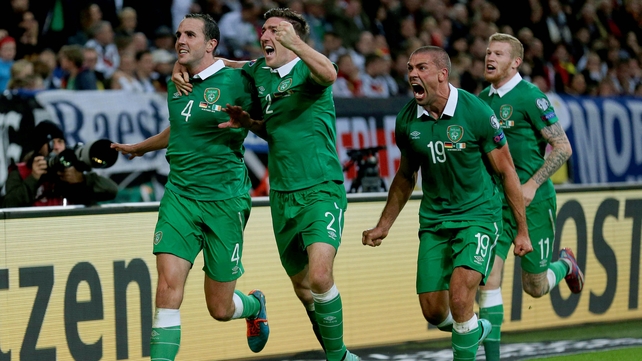
That night in Germany should have really highlighted Ireland’s tactical troubles but the result overshadowed everything and probably reinforced the manager’s appeared opinion that hard work, team spirit and a bit of luck was what was needed to succeed in international football.
Then it all went wrong in Scotland.
O’Neill came up against fellow former Hoops boss Gordon Strachan in this clash of Celtic cousins at the home of their former club, but the Scotland manager won the tactical battle and grabbed the victory to consign Ireland to their first defeat of the campaign.
O’Neill put on a brave face and remained adamant that his side could have and should have taken something from the game, but inside the Ireland boss must have realised that things needed to change and perhaps a different approach was required.
And who would have thought that it would only take four days for the manager to get the chance to erase the pain of the Glasgow defeat, as a real moment of revelation arrived in the most unlikely of guises – a home friendly against the United States of America.
Perception is a great thing in football, and as a result of becoming regular World Cup qualifiers, the USA are generally perceived to be a stronger side than the current Ireland selection.
So it matters little that the American side that showed up in Lansdowne were not up to much, because O’Neill’s new-look side shone brightly that night and none more so than left-back Robbie Brady.
Ireland played with real attacking intent, while other players like Cyrus Christie, David McGoldrick, Anthony Pilkington and even Anthony Stokes showed the manager that there were options available to strengthen and improve his ageing and ineffective side.
But Brady’s performance was the real bonus from that encounter as the then Hull City player scored twice and gave a real edge to the Ireland attack, while also filling the left-back berth, an area that Ireland were having real problems with in previous games.
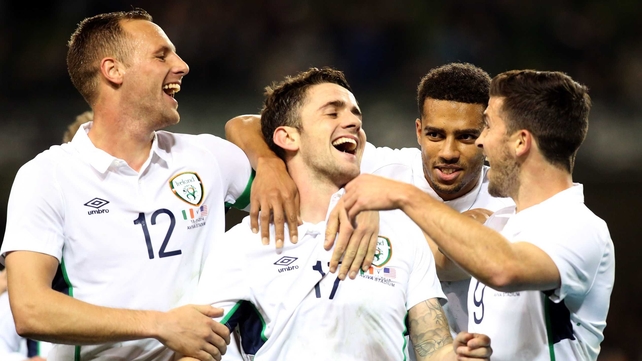
That USA game was a sign that O’Neill was starting to get what international management was all about, and paying particular attention to the cross-channel club scene would be key.
Brady would never have been selected at left-back had Hull manager Steve Bruce not started using him as a wing-back, a role that he was growing into as each club game passed.
The new Ireland management team proved much more visible at English league grounds, watching squad players and potential players, and O’Neill’s presence at a game watching then Championship club Bournemouth led to a chance meeting with Harry Arter in the car park.
O’Neill was immediately taken by Arter’s enthusiasm and was earmarked for future squads, while elsewhere on the club scene, some of O’Neill’s regulars were spending their weekends on the bench.
The manager began to realise that planning teams and formations was a futile exercise until he saw who was available by the time international week came along.
Perhaps this might explain his bizarre fondness for naming a 40-man squad but he certainly seemed to recognise the benefit of players playing week in, week out.
"O’Neill’s presence at a game watching then Championship club Bournemouth led to a chance meeting with Harry Arter in the car park"
McGeady’s loss of club form would later turn out to be Hoolahan’s gain as the manager turned to the Norwich playmaker and started to place a lot more trust in his ability to influence a game.
Following the USA victory, O’Neill must have been raring to go straight away but he would have to wait four months for the next competitive outing, with Poland visiting the Aviva in March.
But that defeat to Scotland was lingering and more and more questions were asked of the Ireland manager with automatic qualification now looking a lot less likely.
O’Neill’s team selections were proving difficult to predict but the manager had to be admired for the XI that were picked to start the home game with Poland.
Brady was thrown in at left back, which proved a brave move, while Hoolahan, McGeady, Walters and Keane were named in a very attack-minded formation.
And the manager must have felt a real hammer-blow when that brave decision backfired as Brady was at fault for the goal which gave Poland a first-half lead.
Something needed to happen.
O’Neill took dramatic action five minutes before half-time as he moved the ineffective McGeady from the left to the right flank with Hoolahan brought out to the left but encouraged to drop inside.
What followed in the second half proved Ireland’s best 45 minutes of the entire campaign as a Brady-inspired Ireland put Poland under huge pressure for the entire second period.
The intensity and confidence that Ireland exuded in that second half proved that O’Neill’s work was starting to bear fruit, while James McClean’s cameo off the bench encouraged the crowd to create an atmosphere that had not been experienced since the old stadium’s facelift.
The new-look O’Neill side was starting to metamorphose as Walters led by example while another manager’s call led to the late equaliser as Shane Long was sprung from the bench.
Two months passed before Ireland could resume from where they left off against Poland, however, the end of season nature of the Scotland home game, coupled with a distracting clash with England the week before certainly did not help preparations for what was looking like a straight shoot-out for the play-off place.
Ireland started well and found themselves in the unusual position of taking the lead against decent opposition, before a string of uncharacteristic concentration lapses and a wicked deflection handed Scotland the equaliser.
The second-half intensity from the Poland game could not be summoned as the jaded squad settled for a point to take into the summer break. Perhaps O’Neill, unlike his predecessor, would not be afforded the tag of being a lucky manager.
Or perhaps he would.
Scotland would go to Georgia and lose. Third place was back on as Ireland took to the field later that weekend at home to the side that had just handed O’Neill’s side a lifeline.
Another player would stick his head above the parapet as Ireland enjoyed a comfortable, albeit 1-0, victory over Georgia as Jeff Hendrick’s quality showed as he set up Walters to grab another goal in the green jersey.
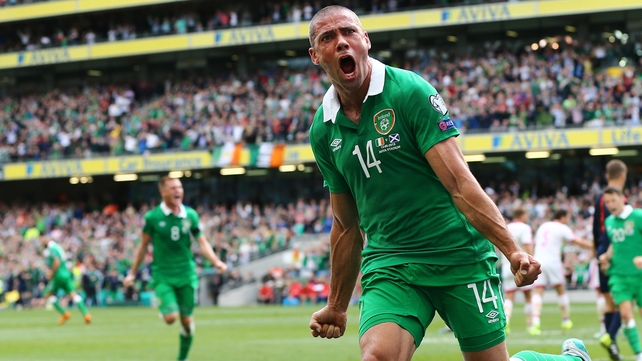
Walters’ goals were certainly welcome, but the heart that the Stoke City striker was showing in every Ireland appearance confirmed that a club mentality had indeed been built within the Ireland squad.
O’Neill’s first campaign was coming to a close and it is fair to say that the learning curve had been steep throughout those opening eight encounters. But suddenly that perfect fit was starting to take shape.
The apprenticeship had been served; the world champions were coming to Dublin.
