


With nine league titles in the trophy cabinet Alex Ferguson is by some distance the most successful manager in English football.
But as Manchester United marked the 50th anniversary of the Munich air crash today, he will remember the man who made it all possible.
‘A special man,’ is how Ferguson describes Matt Busby, the legendary United manager who fought for his life for two months in a Munich hospital after being dragged from the crash which killed 23 people, including eight of the 'Busby Babes'.
‘It took him a long time to get over it in terms of how he could face them again when he was lying in hospital knowing that he had lost all those young lads,’ continues Ferguson.
‘But he had to get back and face the ones who were still there, who had survived the crash.
‘Facing them again was his hardest moment and he felt a commitment to do something about it and I think that's what gave him the drive and purpose to rebuild the team again.
‘It takes special people to do what he did, to come through that and carry on managing. I think if he had retired there and then, people would have understood, with all the emotions of dealing with footballers, so it tells you about what sort of character he was and the sort of steel that he had.’
It was that steel which allowed him to put aside haunting doubts that he could not continue and instead, once he had recovered from serious injuries, enabled him to throw his energies into building a third great team with the likes of Pat Crerand and Denis Law and Munich survivors Bill Foulkes and Bobby Charlton.
And, of course, augmented eventually by the genius of a precocious George Best.
For a decade following the events of Munich, Busby was desperate to make sense of the tragedy and ensure that the legacy of those who died would be preserved in the talents of those who took their places.
His passion was to resurrect the 'Babes' by investing in youth and the club's home-grown talent.
But it was also the enormity of the tragedy which shocked the football world and prompted an enduring sympathy which Ferguson is convinced has made United into the romantic and glamorous club it is today.
Ferguson says: ‘What we see today has all its foundations back in those days. The saddest part is that all those young players had lost their lives before they even started to really enjoy their football.
‘Duncan Edwards was 21, Eddie Colman, David Pegg were just young lads just starting their careers. It was a terrible tragedy for them but it probably brought us a great deal of sympathy at the time.
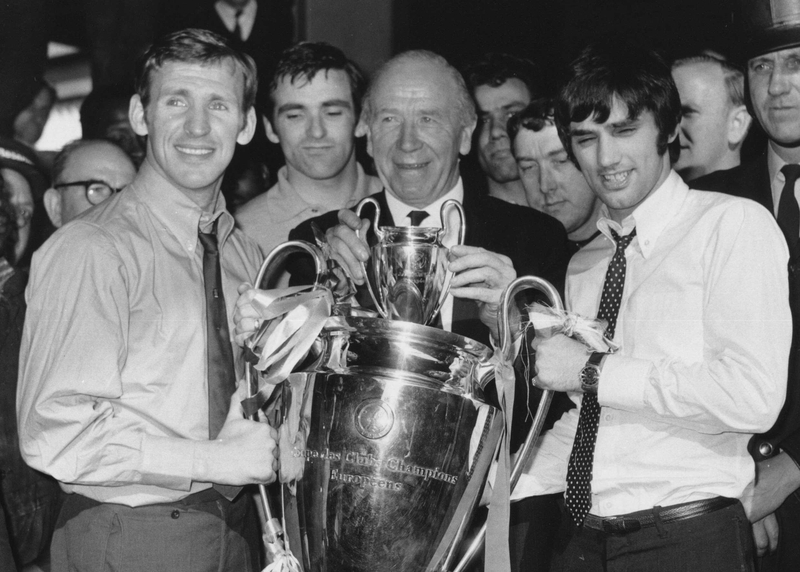
‘From there on, the romance has built, purely because of the way Matt rebuilt the team and won the European Cup in 1968. He did it the right way and in the final itself, eight or nine of them were produced by the club and that's an amazing feat.
‘That created the romance we see today, the affection throughout the world, because we play the right way. The club has always played the right way. It's always had entertaining, attacking footballers but when today, 50 years on, it's an emotional day around this place. It is felt by everyone.’
Ferguson has a particular empathy with Busby, who was hewn from a Scottish mining community much as his own family values were forged in the harsh environment of the Govan shipyards.
Ferguson, of course, was a mere boy of 16 when the news came through that British European Airways Flight 609 had crashed on the Munich runway as United returned from a European Cup tie against Red Star Belgrade.
He had been studying in the local library before heading off for training at his junior club.
‘Training of course was cancelled,’ recalls Ferguson.
‘Grown men were in a terrible state and that was my first knowledge of it, at about 6.30 at night.
‘It had an impact on everyone and for Scottish people in particular, because Sir Matt was the manager here. I think he had garnered a great affection for the way Manchester United were playing and the way he had built his teams.’
Ferguson had seen Busby's team play in 1953 in the Coronation Cup when they played Rangers and then watched them again against Celtic.
Little was he to know that one day he would follow in Busby's footsteps and mirror his philosophy of building United's youth academy and putting the emphasis on attacking football.
Ferguson says: ‘I always remember going to St Mirren as a manager at 32 and trying to get the young kids in every night of the week to develop them. What I felt - and I'm sure Sir Matt felt the same - was that you get far more satisfaction from producing your own players.
‘You get a far bigger degree of loyalty and you build up a sort of family base through that. At Aberdeen it was the same and coming down here was the perfect club for me.
‘Bobby Charlton was desperately keen to have a rebirth of Manchester United in terms of developing our own players and without question he was my main supporter.
‘He, along with Martin Edwards, saw the right way to develop Manchester United and that was the support I needed because I felt it wasn't a football team that they needed, it was a football club.
‘That meant having a supply of young players with optimism and hope that they would get a chance in the first team.’
