


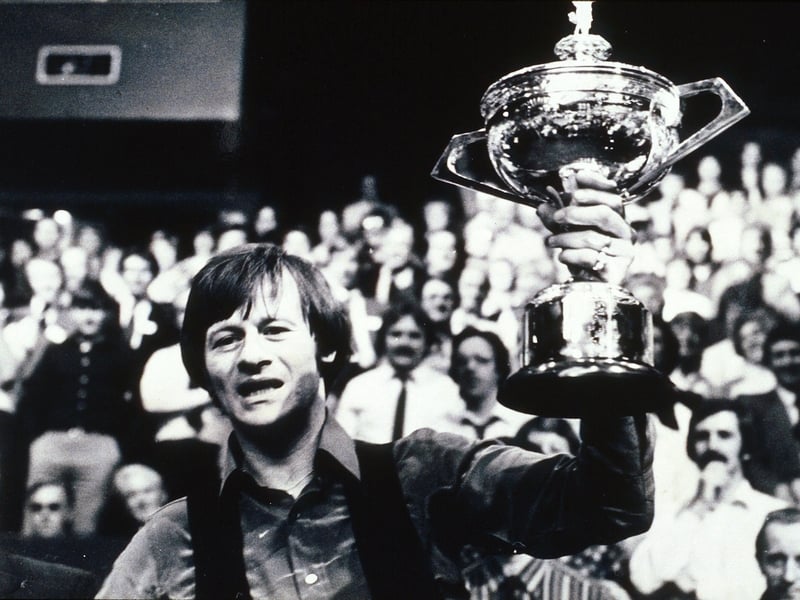
Snooker legend Alex Higgins has died at the age of 61, after succumbing to a long battle with cancer.
Outrageously talented on the table and often simply outrageous when off it, Higgins was among the group of sporting heroes whose personal appeal went beyond the game he played.
Born in 1949, Higgins honed his natural ability in the clubs of Sandy Row in Belfast from the age of 11.
At 16 he left the city for England in the hope of becoming a jockey, but issues with his weight turned him from whiphand to cue master, and he turned professional at the age of 22.
In his own words he was ‘the most natural, charismatic player who ever lifted a cue’.
Steve Davis said Higgins was the ‘one true genius that snooker produced’.
Davis said: 'To people in the game he was a constant source of argument, he was a rebel. But to the wider public he was a breath of fresh air that drew them in to the game.
'He was an inspiration to my generation to take the game up. I do not think his contribution to snooker can be underestimated.'
As to his own encounters with Higgins around the table, Davis said: 'He was quite a fierce competitor, he lived and breathed the game, very much a fighter on the table.
'It was a love/hate relationship with Alex Higgins. The thrill of playing him was fantastic, but the crowd that came along were not your usual crowd. They were much more noisy and you had to play the crowd as well. To many people in the 1980s he was the only player they came to watch.
'I used to be quite frightened of him as an individual, he could be quite vexatious. But on the snooker table, my admiration was immense.'
Davis added: 'No one player has ever been bigger than the game. But he brought a genius quality that possibly hadn't been seen before. He was one of two or three people I would put the word 'genius' to when it came to the table.'
That genius won Higgins a world title in 1972, when the game still had a limited cohort and appeal.
He lost finals in 1976 and 1980, but for a generation for whom his style and speed helped popularise the game and bring it to a mass audience it will be the scenes around his 1982 triumph that will live in the memory.
He would have been the world’s top-ranked player that season but for the forfeit of ranking points for disciplinary reasons.
In his rollercoaster career Higgins was penalised for headbutting a referee, punching an official and was banned from the game for threatening to have Denis Taylor shot.
That self-destructive personality, combined with drink and drugs, meant Higgins fulfilled his potential only intermittingly.
In 1998 he was diagnosed with throat cancer and spent many years hustling in back street clubs, and was often homeless.
Higgins was a self destructive individual but such was his speed, agility, and persona he was for a time the most exciting player in the world with the ability to elevate snooker, mesmerise fans and opponents, and briefly allowed his inner talent win the battle with his demons.
Snooker promoter Barry Hearn said Higgins would be remembered as the 'original people's champion' and the man who transformed the popularity of the sport.
Mr Hearn said: 'I have known him for nearly 40 years. He was the major reason for snooker's popularity in the early days. He was controversial at times, but he always played the game in the right spirit. We will miss him - he was the original people's champion.'
