


The opening game of the 2026 Six Nations will kick off in unfamiliar circumstances on Thursday night.
Ireland will begin their campaign in Paris in a clash of styles against the French.
While the Irish rugby team has been successful in previous years under Andy Farrell, they'll be trying to improve on their third place in last year’s championship.
Their previous successes feel distant considering the challenges Irish players have faced coming off the back of a long international campaign, leading into a British and Irish Lions year where Ireland were the primary contributors to the squad.
There will be many challenges to overcome if they are to take the more difficult route to Six Nations success.
We’ve seen the concerning injury reports coming from the camp across the last number of weeks.
France have experienced their own injuries and some of those are also in the front row.
The Against the Head panel of Donal Lenihan, Bernard Jackman and Darren Cave set the scene ahead of the start of the 2026 Guinness #SixNations #RTESport #RTERugby pic.twitter.com/b2sk0Zo71B
— RTÉ Sport (@RTEsport) February 2, 2026
However, Ireland doesn’t have the same rugby-playing population as France and can ill-afford to lose any more bodies in key positions.
Les Bleus are unpredictable by nature.
Add to that the omission of key players such as Greg Alldritt, Damian Penaud and Gael Fickou.
They are preparing for change, which makes them a difficult team to preview or predict.
Perhaps the visitors will focus on themselves while knowing the threat that French rugby carries.
France are known for their power up front and flair out wide, with magic in between from their half-backs.
If they struggle in one strategic battle, they can rely on another area of the game, once they get their mindset right.
The scrum will be Ireland’s first test.
With all the talk about the squad’s injuries and depth at loosehead prop, France would be crazy not to target that area.
Tadhg Furlong has trained with the team this week. His inclusion on the tighthead side would add serious stability as the cornerstone of the scrum.
The scrum is the fulcrum of a pressure game, and France are well-versed in overpowering teams with scrummaging props and sizeable tighthead locks.
If you don’t get parity in the scrum it can be a long day.
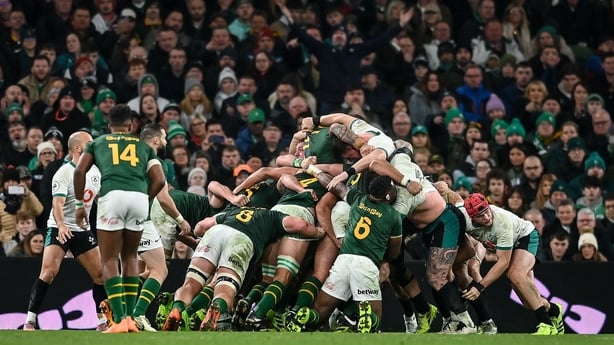
A dominant scrum can get a team out of trouble. A struggling scrum can affect your penalty count, psychology, and attacking platform.
Attacking scrums can survive some pressure. The hooker, number 8 and scrum-half can get the ball in and out of a scrum on their own terms, unless things are going very badly.
Fluidity and attacking rhythm can be affected, but possession can be maintained.
However, on the opposition feed you have little control over how long the ball stays in the scrum.
When you know there are question marks over the scrum and your opposition decide to turn the screw, it can be a horrible place.
Repeated infringements lead to cards and periods of disadvantage. It could lead to easy access into your 22 area, or difficult exits.
Generally, the scrum battle can change the complexion of a game if the dominant team are given the opportunity.
Expect Ireland to focus heavily on their handling and aerial skills. They won’t want to roll the dice in any excess scrummaging battles.
This is just one aspect of the power game that the defending champions can play.
Their pack has a mix of mass, athleticism and rugby IQ.
We saw La Rochelle taking Leinster on with a power game involving offloads, moving the point of contact and avoiding the ruck contest that Leinster and Ireland have often thrived on.
Expect Fabien Galthie’s side to bring an element of unstructured attack to unsettle the Irish influencers like Caelan Doris.
Antoine Dupont is back to his tantalising best in the Top 14, and despite an injury to Roman Ntamack, Matthieu Jalibert is in unstoppable form for Bordeaux and was arguably their first choice out-half regardless of injuries.
They have pace that the Irish team doesn’t possess, with threats all over their back line.
It’s not a foregone conclusion.
Ireland, under Farrell, have outperformed top opposition in the past and extended periods of training time tend to bring the best out of this team.
Their structured approach to setpiece, defence and attack will give them a chance at Stade de France.
Intricate and high tempo setpiece strike-plays have always been a feature of the Irish game, although it will depend on their performance in the setpiece itself.
Their relentless attacking phase-play through structured understanding can unsettle the best defences.
They will aim to move the French pack to all corners of the pitch and back their physical conditioning across the 80 minutes.
Their attacking template allows the team to play a high phase-count which could exhaust the French.
Add an accurate kicking strategy to Ireland’s attack and they could gain control, limiting the French flair and freedom in possession.
Contestable kicking options will reduce the French transition attack. They need to cut the supply of quick ball to the likes of Louis Bielle-Biarrey.
Individually, the Irish provinces have been inconsistent since the beginning of the season.
Leinster have regained some momentum of late and have found a way to win on numerous occasions.
However, they’re the team that rotates the most and their season so far may not help Ireland much across this campaign.
The Irish rugby team is a different prospect collectively and the sum of the parts often outperforms their individual provincial components.
It couldn’t be a tougher start for Andy Farrell and his team.
With some forced changes and a fresh approach, Ireland could surprise everyone and make a dream start to the 2026 Six Nations campaign.
Follow a live blog on France v Ireland in the Six Nations on Thursday from 8.10pm. Listen to live commentary on RTÉ Radio 1
Watch France v Ireland in the Under-20 Six Nations on Saturday from 7.50pm on the RTÉ News Channel and RTÉ Player
Watch live coverage of England v Ireland (21 February) and Ireland v Wales (6 March) on RTÉ2 and RTÉ Player


