


Connacht put themselves further into the mix for a URC play-off spot with a dominant win over a lacklustre Munster side on Saturday evening in Galway.
Physicality and contact skills separated the teams and Munster came off second best. The hosts were able to dominate collisions in the opening quarter and sucked the air out of any competitive edge in the fixture.
The breakdown is where Connacht made the most impact in the early exchanges of the game. However, the closer you look at the breakdown in any rugby match, the more you realise that rugby's identity has changed, without any corresponding changes in the laws. We’re so focused on creating a better product that we have now blatantly ignored what’s written into the laws of the game.
This isn’t solely about Connacht. They were the dominant team in the game and the breakdown is the part of the game where they really showed their superiority. They arrived early to the collision, stopped any Munster threat at stealing their ball and put their opponents in vulnerable positions where they subsequently conceded penalties for being in the way.
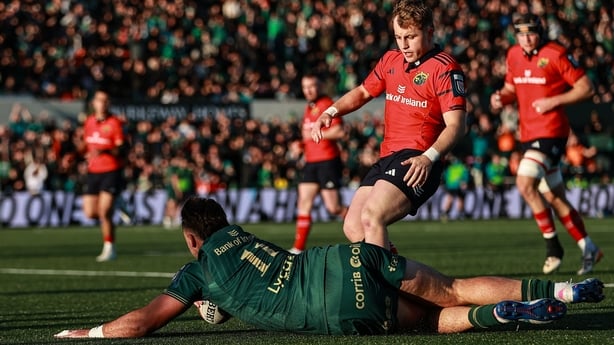
Most teams are playing some variation of a 1-3-3-1 shape where they have two pods of three forwards as the driver of their whole attack with one forward player on both edges of the pitch. We often see the out-half and other backs in deeper positions behind this shape, pulling the strings and directing the attack.
The three forwards work together to win collisions and to kill the breakdown threat by arriving early, not allowing any window of opportunity for opposition poachers. This is all within the confines of the game.
Where we have blurred the lines is by over-refereeing the defender's role in slowing the ball and affecting the attacking speed, which is often the metric bandied about when we speak about watching an enjoyable game, or rugby as a product.
What we don’t realise is that the arriving attackers are now actively trapping the defender into the ruck and being rewarded with penalties, all in the name of sanitising the breakdown and rewarding the attack.
Yet, if we allow these attackers to enter the breakdown whatever way they want, at whatever height they want and to take an opposition defender off their feet before they have time to reload out of the tackle, then they are actively slowing down their own ball in some circumstances.
Connacht move to must-win territory as URC regular season comes to a close #RTERugby #RTESport pic.twitter.com/h7D3vEPIoO
— RTÉ Sport (@RTEsport) May 12, 2026
Attacking support players are now standing over the defender who is intending on rolling away or re-entering the contest before they can get back on their feet. The attacking scrum-half is then digging for possession, often slapping or attempting to remove the defender in dramatic fashion to grab the attention of the referee.
What’s also being ignored in this instance is that the attacker entering the breakdown is going straight off their feet while trapping the defender in a position that will get him penalised. Some referees respond by penalising the defender that can’t move.
Others don’t fall for the gamesmanship and wait for the ball to be available. This results in slower ball, slower attack and most likely another kick contest. What doesn't come under the microscope is the attacking support player that has negatively affected the game.
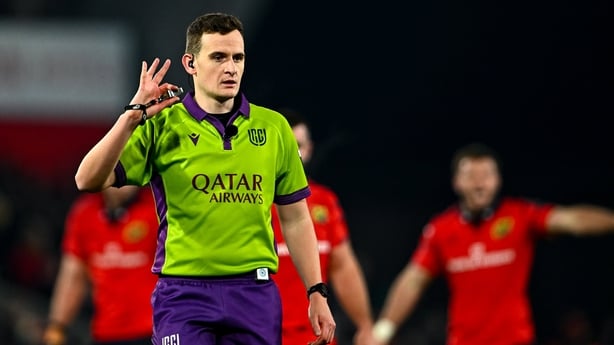
Law 15.12 states that 'players must endeavour to remain on their feet throughout the ruck'. If attacking players had to remain on their feet then the ball would become more playable in some situations. Currently, the grey area of this law is that it is accepted that players will go off their feet when initiating contact. Therefore, it gets extrapolated to a point where attackers are being told that once they take another body away from the ruck and make contact, it will be accepted that both will end up on the ground.
However, we’ve now taken this to the extreme and there is a race between the defender and the attacker to arrive first and arrive low. The attacking support player is often arriving in the ruck with knees and hands on the ground, underneath any defensive threat, and in an unrealistic position to allow a contest.
It happens in every second ruck and it isn’t unique to any team over another. Connacht happened to win that battle last weekend and won more collisions which gave the impression that they were in more control, and therefore more legal.
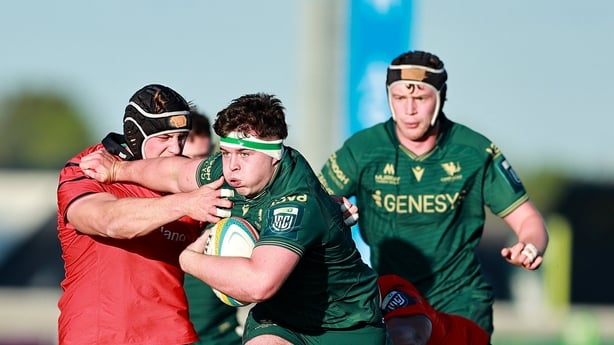
Ironically enough, the action last weekend that caused the most controversy was Diarmuid Barron’s 20-minute red card for his assist tackle on Dylan Tierney-Martin. Complaints are still rolling in because Peter Martin upgraded the original yellow card to a red for what was described as a croc roll, which is outlawed in the game because of increased risk of danger from a pulling or dragging action.
The issue here was in the use of 'croc roll’ to describe the contact. Under section 14.8 of the law book, tacklers must not pull, twist or roll an opponent who is involved in the tackle. That’s what Diarmuid Barron did at the back end of the tackle. Therefore, Peter Martin was right to penalise Barron. The problem is more to do with his communication or the labelling of what the action was.
Law 9.20 also states that a player must not drop their weight onto an opponent or target the lower limb. This is the law that got extrapolated to penalise Barron further with a yellow and then a red card. It’s also where the laws become grey because we are forever tweaking things and often the game can be ahead of the law book.
There’s no way of telling whether there was an intentional act in what Diarmuid Barron did. It’s safe enough to suggest that the hooker intended to twist or roll the tackler away from the ball, but that he couldn’t have targeted the lower limb of Tierney-Martin. It was an unfortunate ending for the Connacht hooker, and something that others feel was a ‘rugby incident’.
Unfortunately, it’s becoming very unclear as to what the sanction should be in any of these cases. Even after stating the laws of the game, I can see how the referee arrived at the sanction, but I couldn’t say confidently what the outcome should have been.
The game is confusing itself, yet ignoring very blatant outlawed actions in every second breakdown.
We desperately need a recalibration of the laws. Either the law book needs a complete overhaul to start fresh and improve the understanding of the grey areas within these black and white laws, or we need to return to the original sanction and quite clearly state what is and isn’t accepted within this contact sport.
One thing that isn’t good for the game is confusion. We’ve made the game far more uncertain by trying to make it safer while protecting the product.
Follow our live blog on Ireland v Scotland in the Guinness Women's Six Nations on Sunday from 2.30pm and listen to Sunday Sport on RTÉ Radio 1. Watch Wales v Italy (12.15pm) and France v England (4.45pm) on RTÉ Player
