


The modern format of the Champions Cup has its flaws in the earlier stages, but the quarter-finals delivered knockout rugby of a high level with a few upsets along the way.
Bordeaux Begles and Toulouse had the feel of a final about it. Their attacking rugby was typically French with fluid ball movement mixed with sheer physicality and a sprinkling of flamboyant decision making.
Toulouse enjoyed the vast majority of the first 40 minutes in the Bordeaux half, but couldn't make their dominance count enough on the scoreboard. To beat the reigning champions, you can’t waste that amount of possession and territory.
The Bordeaux defence found an answer for much of the half. Toulouse tried to bludgeon their way into a lead, presumably aiming to wear their opponents down so they could take off in the second half.
However, it was one moment of madness and a few moments of ill-discipline that really separated the sides, and an action that made me question my understanding of the increasingly complex laws of rugby.
As Damian Penaud kicked the ball forward for Bordeaux, Dorian Aldegheri chose not to pull out of his attempted tackle and left a trailing shoulder which struck Penaud on the head. Both players hit the floor, only one of them left the field and remained off the field after a HIA.
The other hit the deck as if he had been the victim.
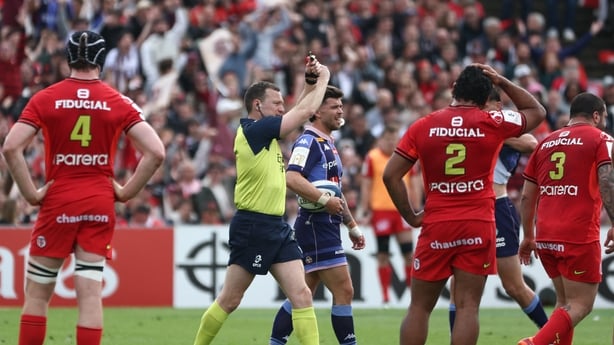
None of us will truly know how intentional his contact was. I don’t think any player goes out to shoulder another player to the head. My own view is that he meant to initiate contact with Penaud to rough him up, and may not have thought through his actions fully.
Whether he fully intended on hitting Penaud on the head or not is not the point that should be argued. He intentionally hit the player in such a reckless manner that he couldn’t control how the contact played out. Therefore, Aldegheri lost any rights to mitigation or the reduction of any sanction.
Yet, this is where rugby is making a huge error. The Toulouse prop was given a 20-minute red card by referee Matthew Carley. He explained the decision: clear shoulder directly to the head, with force, high danger and with no mitigation.
Before the 20-minute red card trial, this was a very straight forward situation and not many people were dissatisfied with the outcome. A small portion of people were outraged that there had to be a numerical difference between the teams, but if you carry out an intentional act of foul play then you should suffer the consequences.
The reasoning behind that is to make the game safer, more sustainable in the future and to protect people.
My understanding of a straight red card is that it is for highly dangerous and intentional foul play, or serious acts of foul play, like punching. I don’t understand how an arguably intentional shoulder to the head isn’t as dangerous as a punch or other dangerous acts.
Understandably, the argument will be around the players intent and whether the outcome of the injury and the contact is what he intended to achieve. In my view, Aldegheri has lost all rights to that discussion as soon as he commited that act.
Toulouse should have played the remaining 43 minutes of the game with 14 players. I can’t see any reasoning to protect the perpetrator or his team-mates.
It’s also much more complex for referees to reach the right outcome. The pressure they are under is ever-increasing. The real issue with decisions like this is that you could slow it down, replay the incident as many times as you’d like, you could discuss it for days, and different stakeholders within the game will still have opposing opinions. That’s not good for the game or the referees.
As it happened, the act of ill-discipline didn’t hurt Toulouse in the immediate actions before the break. Ironically, they were the team that scored before half-time and took a seven-point advantage into the second period.
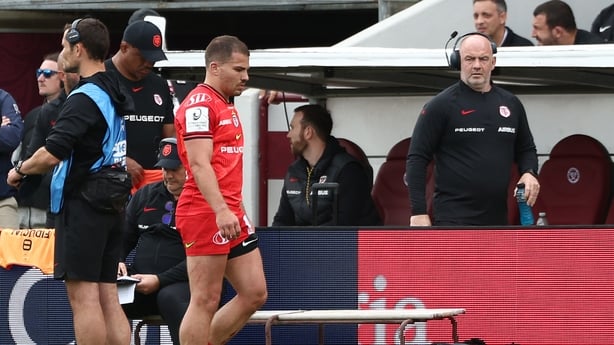
Bordeaux turned up the heat and Toulouse couldn’t stop the dam from bursting. It didn’t help that their talisman, Antione Dupont, received a yellow card for a foot trip as Bordeaux looked like scoring.
The incident happened about a minute before Toulouse were restored to their full complement of 15 players. It meant that they played roughly 30 minutes of the remaining 43 minutes of the match with just 14.
Their ill-discipline cost them the match. Bordeaux might still have gone on to win the game with 15 on 15, but we won’t know if they were able to do that because of how the game played out. In any contest, discipline should matter and Toulouse were on the wrong side of it in this quarter-final.
Bordeaux put them under enough pressure to make poor decisions which led to their exit from the competition.
The quarter-final had all the makings of a Champions Cup final, with the power, style and intensity of two French clubs. Unfortunately, it was marred by an incident deserving of a red card. That’s part of the game too. Teams with better defence, attack, discipline or moments will progress.
Bordeaux will face Bath for a place in the final, and it’s very hard to see past their success in this season’s Champions Cup.
Follow our live blog on Ireland v Italy in the Women's Six Nations on Saturday from 5.40pm. Listen to Saturday Sport on RTÉ Radio 1
