


United Rugby Championship action returned last weekend with a dismal showing from the Irish provinces.
Munster will be the most disappointed with their performance. They were physically dominated by the Sharks in Durban in the first of their two challenging fixtures against South African opposition.
Rugby can be a simple game. If you compete in the contact elements of the sport, you'll have a chance. If you’re being dominated in contact, it will be a very long day, unless some aspects of your attacking game are extremely effective.
Contact starts at the setpiece with the scrum, and mauls from lineouts. There was a long passage of the game last Saturday evening where a scrum wasn’t completed without a penalty or a penalty advantage to the Sharks. It’s a fundamental part of rugby union. A disparity in the scrum can change the outcome of the game.
Not only did Munster not have enough to compete in the scrum, they were up to double digits in handling errors not long after half-time. The result of those handling errors? More scrums. It was a double whammy in terms of their game management. They didn’t affect the Sharks tackle line too often, and then got dominated in the resulting setpiece.
When Munster managed to get access into the Sharks half, there were four or five lineouts in the second half that went astray. There was another one on the Sharks five-metre line just before half-time when they could have closed the gap to just one score and removed the zero on the scoreboard. Again, the lineout was contested and Munster lost possession.
You can survive some games without either a scrum or a lineout. But, being away from home against a South African side without an effective setpiece means trouble. Munster would have to find a way into their phase play attack without having to rely on the structured setpiece. The only other way into the game is through transition phases.
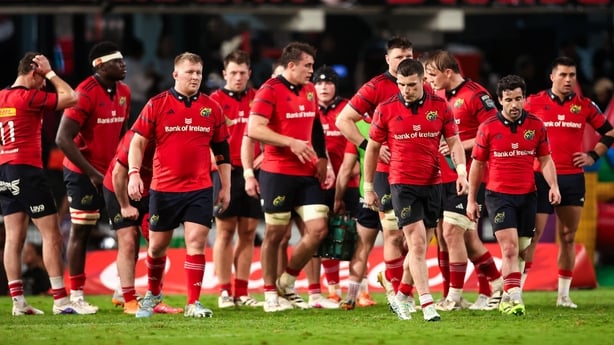
Munster tried to create quicker transitions by taking tap penalties and attempting to speed up the game. On the day, they definitely chose to avoid extra setpieces, however, they definitely set themselves up to play a faster and wider game against the Sharks as part of their game strategy too.
The South Africans are well able to live in a transition game and they showed that on Saturday. Munster did well at times with crisp handling under pressure and a recognition of space. However, when they managed to go forward on the edges, they were well contained once they had to play back towards the middle of the pitch. They couldn’t find a way to win collisions, which is a vital part of the game.
Even for teams that attack into space better than others, the effect of doing so means getting less direct contacts and controlling that collision area, so you’re attacking arms instead of bodies and you have a better chance of winning the physical confrontation.
Once you win the collision, you’re moving forward and the defence has to scramble backwards. That takes the line speed away from the defending team and it generally makes them more passive in the collective defensive structure.
That’s the part that Munster couldn’t crack. They got some forward momentum around the 30-minute mark when they won the scraps from a kick-off and managed to win a penalty to get access into the Sharks 22-metre area. From there, they were direct enough to move towards the five-metre line and were rewarded with another penalty.
Unfortunately, Munster didn’t double down on what got them into that area. They set up a wide tap and go penalty which was swallowed up by the Sharks defence and Munster never put their name on the scoreboard.
It was similar to the opening exchanges of the game. Ironically, Munster launched a very effective wide lineout play, but once they got on the front foot, they were pinned back by the defensive collisions. In contrast, the Sharks' first try came from a scrum penalty, a maul to launch their attack, and ill-discipline from Munster on the offside line because they were worried about the Sharks' power, which led to a maul try.
Munster clearly set themselves up to move away from the Sharks' big bodies and to play away from the line speed. To some degree it worked. They moved the ball to space but never really troubled the South Africans. The Sharks scrambled well, consolidated and then destroyed Munster's attack in the middle of the pitch. There was little penetration after the initial attacking starter play.

Munster shipped the ball so much that they forced errors upon themselves and the Sharks grew taller throughout the game. Playing into line speed and dominant defences, you can’t hide from the fact that you must confront it physically, and Munster failed to do that.
It won’t get any easier against the Bulls this weekend, although Munster will replace their half-backs and reinstate Craig Casey and Jack Crowley. This could be enough of an impetus to change the dynamic of the game. Casey will challenge the fringes of the breakdown a bit more, while Crowley will penetrate the tackle line as a first receiver, which will ask different questions of the defence.
While the half-backs can bring a different challenge and play in different areas to move teams around, Munster’s forward pack will still need to find a way to move their team forward in the middle of the pitch.
The game is quite difficult without a fully functioning lineout, some bit of parity in the scrum, or momentum in the contact area. Munster will need to find answers in these areas to come up with a much-needed victory in Pretoria.
