



Ireland fell short of their Six Nations championship target, but their approach to the game against Scotland restored a lot of faith in the direction that the team is travelling in.
The opening quarter at Aviva Stadium was an attacking clinic.
Both teams scored, Scotland with a very quick response to Ireland's opening try. The hosts then got a handle on the Scottish rhythm. All told, it was a masterclass from Andy Farrell and his team.
At this stage of the tournament, there’s a body of evidence to analyse and there’s a psychology around your approach to the game.
If a team analyses Ireland, what would they be expecting? After Saturday’s exhibition, I’m not convinced that the opposition would be confident in knowing.
Their first opportunity came after Jack Crowley’s line break resulted in a knock-on, and Tom O'Toole was rewarded a scrum penalty because of a Matt Fagerson infringement.
The resulting kick was put right to the corner, which logically means that teams will set up a maul to physically and psychologically inflict damage on the opposition.
This is where the Irish reverse-psychology and analytics began. They set up a dummy maul with the ball delivered to Jamison Gibson-Park on the move.
I was sceptical when he uncharacteristically missed half a defensive gap in front of him to play Robert Baloucoune into a carry. Gibson-Park then threw a flat pass to Caelan Doris, who would usually pound his way towards the line, as would any other player, realistically.
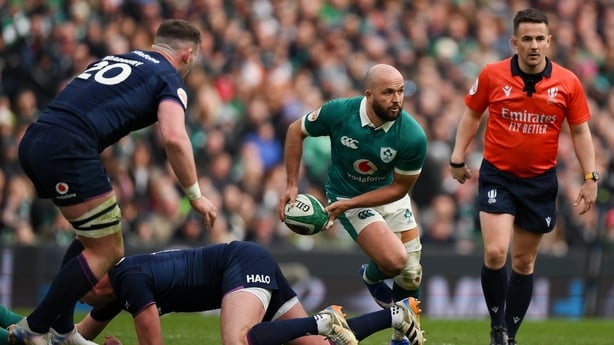
In that area of the pitch, you don’t need the opposition to miss any tackles. You simply need to go forward enough to reach the try line, and it doesn’t matter how many carries you take once you look after the ball at the breakdown.
This time, Ireland clearly set up a two-phase play because Doris threw a pass back to Crowley, who fizzed his pass to Jamie Osborne, scoring under the posts.
There are clues that this was a set-up play, considering Gibson-Park wouldn’t normally miss a chance to go after a defender who gave away his inside shoulder in defence.
The Ireland captain would usually take that carry himself as well. Ireland had clearly analysed Scotland’s defensive shape in the 22, and they delivered the sucker punch after just three minutes.
On their next entry, Ireland scored off a maul. This is where the psychological warfare becomes interesting.
Scotland expected a maul in the first play, and they got a peel around the back of the lineout. When they were worried about another variation, Ireland went to their maul, spun it and gave Dan Sheehan a chance to dart for the line.
He doesn’t usually miss from close range. Scotland didn’t know what to expect from Ireland after that, they certainly couldn’t make any assumptions after the first two entries.
Between those two tries, Scotland showed some attacking prowess of their own. They held possession for 20 phases before Darcy Graham dotted down.
They’re clearly well capable in attack as well, evidenced by their 50-point tally in a victory against France.
Their possession-based attack, along with a deadly accurate breakdown execution, allowed Finn Russell to pull the strings, and they struck back with immediate effect.
The difference between these two potent attacking teams was the defensive plan that Ireland had for Russell and the Scottish backs.
They gave up line speed for connections and shielded their defensive line until they were confident in their read.
Russell had time on the ball but had no clear options because Ireland never came out of the line to give him the answers. When he hung on to the ball for too long, they accelerated and hit him, which led to Ireland escaping the rhythm of sharing every second score.
Instead, they forced a turnover which Crowley used to relieve the pressure. They then stopped the Scottish maul, and on the second attempt from the scrum, they revealed another attacking strategy.
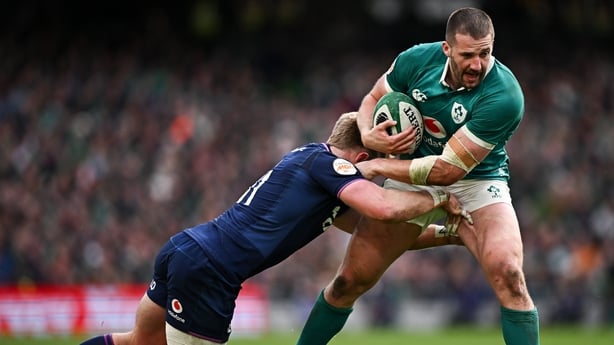
Stuart McCloskey, Ireland’s battering ram in midfield, threw a huge left-handed pass to assist Baloucoune's try in the right-hand corner. McCloskey has carried so well for Ireland throughout the campaign that teams are now forced to step in a bit narrower to stop him.
If everyone steps in by half a defensive channel, then it forces wingers to connect and promote early, which forced the full-back to close early as well. There’s little doubt that the Irish coaching staff recognised this in their preparation.
Instead of a dominant carry, McCloskey fired a long-range pass to Baloucoune, who used his deceptive speed and footwork to finish in the corner.
Only the first quarter of rugby had been played and there was already enough attacking impetus to recognise that Ireland are developing.
They have also changed their attacking shape in the 22-metre area. Usually, teams race around the corner and see who will run out of bodies first.
Forwards are told to think less and move with more efficiency. However, Ireland moved away from that style last week. Most other teams work hard in the same direction.
Gibson-Park was getting to rucks and looking both ways before delivering to the side that would gain the most ground.
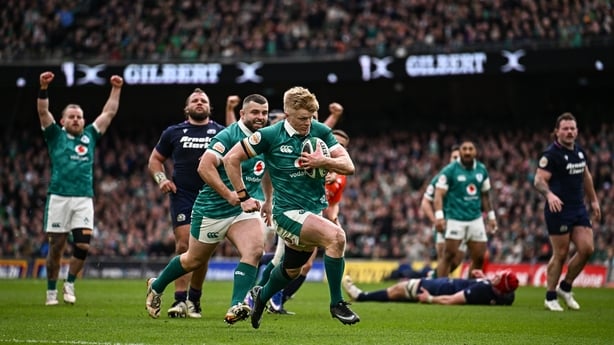
No game plan can rely solely on attack to win the game. Ireland stopped Scottish entries with their defence and Tadhg Beirne’s special ability to find a turnover just when his team really needs it.
However, for those who questioned Ireland’s attack and it’s future direction, Farrell and his team just provided enough excitement for the future.
After round one we questioned whether the game plan had become blunt. Ireland lost a kicking battle and as a result had little else to draw on against France in dominant form. Now, Ireland have shown that their game is evolving.
The championship as a whole had a profound effect on the excitement of the international game.
It’s as exciting as ever, and attacking rugby is on the up. France won the tournament, yet they averaged 48 points conceded across their last two games, with one of the most successful defensive coaches in their staff.
Ireland used 35 players across the tournament and rebuilt their attacking strategy. Second place won’t be treated like a major success, but they have put foundations in place to hit new levels under Farrell.
