


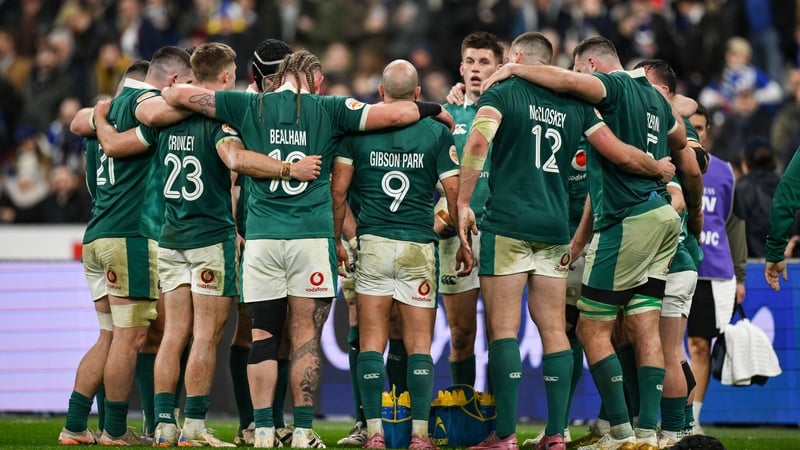

In the immediate aftermath of Ireland's defeat to South Africa last November, Andy Farrell struck an upbeat tone.
Despite his side being overpowered, outmuscled and emasculated at the scrum, the head coach chose to stress the positives of how they stayed in the fight against the best team in the world.
There was a similar second half rally from Ireland in Paris on Thursday night. When Louis Bielle-Biarrey raced in to score France’s fourth try and make it 29-0 early in the second half, many in the ground would have been checking the record books, just in case.
Farrell got a response from his bench, with Michael Milne, Nick Timoney, James Ryan and Jack Crowley all making strong cases to start against Italy next Saturday.
However, the head coach knew he couldn’t publicly stress those positives, such was the nature of their first half humiliation.
More worrying, defeats like this are no longer a once-off. As pointed out by analyst Russ Petty, Ireland’s last four games against top-five ranked teams are defeats by 17, 13, 11 and 22 points respectively, the latest a 36-14 hammering.
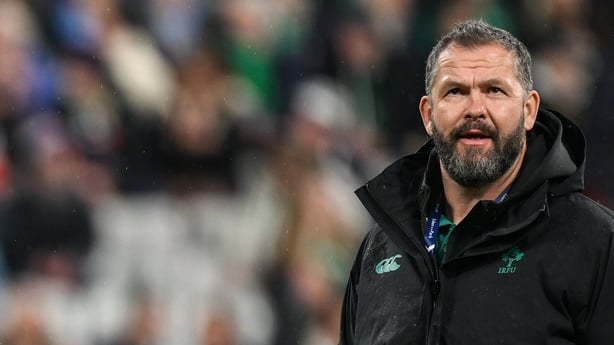
The head coach (above) was asked what gives him confidence his team can close the gap that has emerged between them and the world’s best.
"I am [confident], because I know the people that we've got," he replied.
"I know the good people that we've got, the good players that are not just here but who are at home as well.
"I know that there's a determined group to make sure that we are constantly up there at the top of world rugby to be able to compete. That will always be the case."
As the head coach pointed out, a chastening like this is new territory for a lot of this squad.
Even for some of his frontliners like Caelan Doris, Dan Sheehan, Joe McCarthy and Jamison Gibson-Park, Ireland have been an elite side for most, if not all, of their Test careers. Add in some of the newer class, like Thomas Clarkson, Cian and Sam Prendergast, Tommy O’Brien and Jamie Osborne (below), who would have been experiencing Stade de France for the first time.
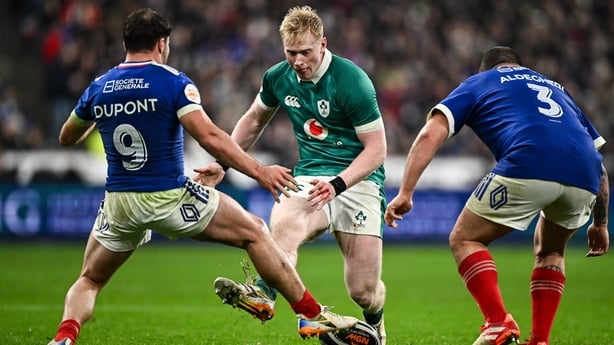
If that group of players are to become the pillars of the next era in Irish rugby, defeats like Thursday have to at least give them some calluses.
"That has to stand to us down the line," Farrell added.
"I said during the week that whatever happens it has to stand to us, because it's another experience for a different enough group, with all the injuries, and firsts for people who are not established internationally just yet.
"I learned a lot about the team and the individuals. I suppose these type of occasions, these type of events are a first for quite a few of our group.
"Every game that you play for your country, whether it be a big win or a tough loss, there has to be a learning curve. We have to take those learnings from that.
"As a group and as individuals, we need to use it in the right manner and move on."
The head coach gave a damning assessment of the performance, in particular the first half where Ireland fell 22-0 behind, with a kick-heavy approach that backfired dramatically as France either dominated in the sky before sweeping up any crumbs on the floor.
Those breaking balls on the ground, in particular, hurt Ireland, who were hapless in defence against a French side that played at a ferocious speed, despite the dreadful weather conditions. In total they missed a whopping 35 tackles, with 17 of those coming from Sam Prendergast, Jamison Gibson-Park and Garry Ringrose.
"It was almost as though we were ready for them to play wet weather rugby and they wasn't, you know?," Farrell continued.
"You earn the right to offload and that's because you're winning collisions. The way that they were playing, we were allowing them to do that because of that.
"They earned the right, through the contact. It's not as though they were throwing risky offloads or 50-50s or whatever. They'd earned the right to do that and the pace they've got to finish that off is there for everyone to see."
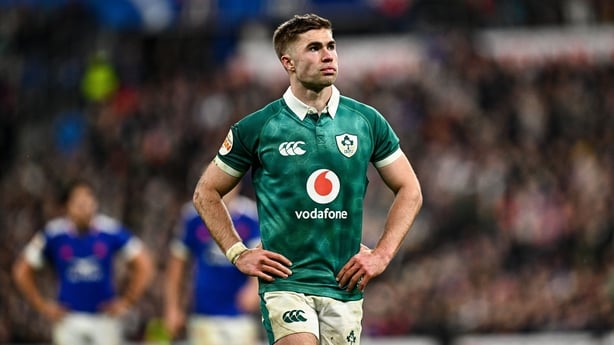
The head coach disagreed when it was put to him that Ireland benefitted from having a second playmaker on the pitch when Crowley (above) came in for O’Brien early in the second half, believing their improvements were born from their attitude rather than any tactical tweaks.
"It's through intention, that's the go forward. That's why that was happening.
"Jamie [Osborne] is a good player as well, he's a second playmaker as well but we never really got into those positions because of all that.
"I actually thought they showed up in the second half with a bit of intention.
"We could have been better as far as our execution of stuff, but at least we had the right intention.
"It's too late or too easy to have that, when it was so lacking in the first half.
"Sometimes you want a bit more grunt and I suppose that's the opposite of composure really.
"I think that's what was lacking."
Watch England v Wales on RTÉ2 and the RTÉ Player from 4pm on Saturday, with France v Ireland in the Under-20 Six Nations to follow from 7.50pm on the RTÉ News Channel and RTÉ Player.
