


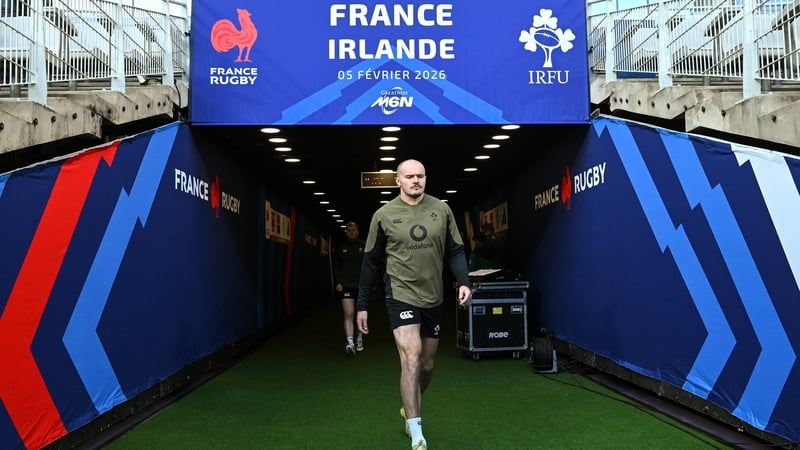

If you were to try sum up the rise and fall - and rise again - of Jacob Stockdale, this would be it: Only five of tonight's starting Ireland team to face France have more Test caps than him (40), and yet this will be his first Six Nations appearance in close to five years.
He was still just 21 when he scored a then-record seven tries in the 2018 Six Nations, the Player of the Championship among an Ireland team that won a Grand Slam.
At the time, he was the future of Ulster and Irish rugby, seemingly a nailed-on 100-capper and one of the most lethal finishers in the game.
Sport, however, isn’t linear, and Stockdale is the perfect example.
Having made his Ireland debut during a Lions summer in 2017, he continued in the squad that November, scoring three tries against South Africa and Argentina, before establishing himself as a genuine global star with his Six Nations bonanza of scores.
Just to prove it was no fluke, he finished 2018 with one of the most famous tries ever scored at Lansdowne Road (below) as Ireland beat the All Blacks on home soil for the very first time.
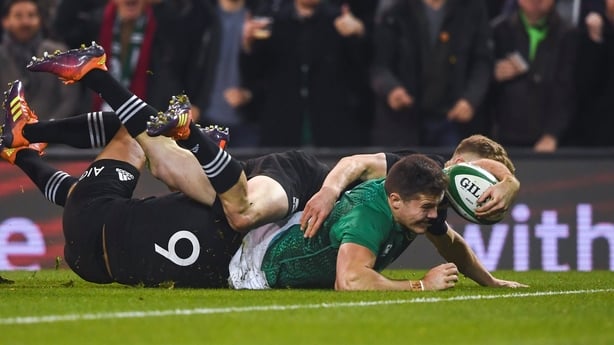
Still just 22 at that stage, he’d racked up 12 tries in just 14 Tests, 26 in 51 for Ulster, and his ability to score tries from a kick-and-chase down the wing had many wondering if he’d cracked the elusive code for predicting how a rugby ball would bounce.
"All of a sudden, people are taking photos of you in the street and there are paparazzi outside the hotel, which was very strange to me," Stockdale said in a 2019 interview, as his fame grew.
The first bump in the road came in April 2019, and Ulster’s Champions Cup quarter-final defeat to Leinster, when his casual one-handed attempt to ground the ball for a try was spilled forward.
Ulster had been two points ahead at that stage, early in the second half, and Leinster would come back to win 21-18.
Such was the size of the error, the Lurgan man posted an apology on social media in the days after the game, and later admitted it left him in "a pretty dark place".
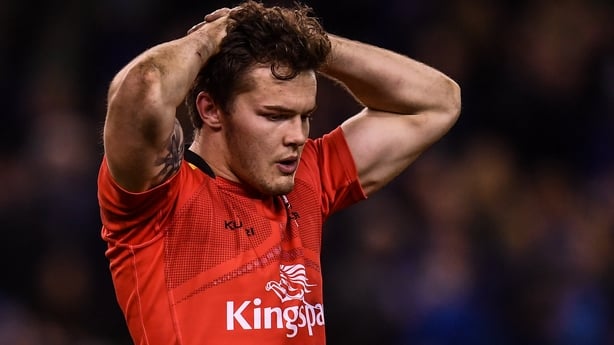
"A lot of people said to me that I shouldn't have felt that way, but I just felt like I had cost us a semi-final," he said at the time.
"If I get that ball down it's a one-try or two-try game and we're looking pretty comfortable. All of a sudden I drop it and Leinster get back into the game."
It’s hard to tell how long that error played on his mind, but even as he retained his place in the Ireland team through the World Cup that summer, he looked off-colour at the tournament and failed to register a try.
When Andy Farrell took over, he was a centrally contracted international with 16 tries in 25 caps and kept his place in Farrell’s first, Covid-interrupted Six Nations.
When rugby returned after lockdown in 2020, Farrell experimented by switching Stockdale from the left wing to full-back, but his defence was badly exposed in a Halloween horror show against France in Paris.
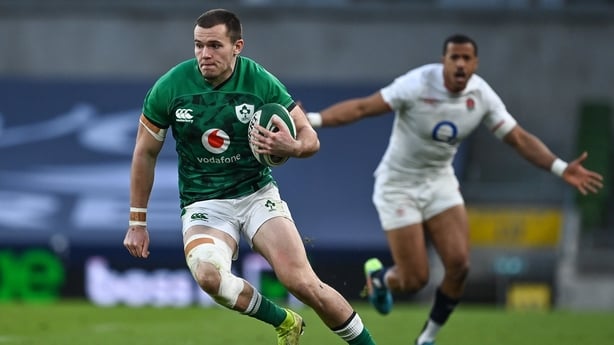
Injury, coupled with the arrival of James Lowe and Hugo Keenan, saw him play just once in the following Six Nations, that 32-18 win against England remains his last outing in the championship, until today.
Already under pressure for his place in the team, a serious ankle injury on the opening day of the 2021/22 season saw him out of rugby for close to a year, and by the time he was fit and available, Ireland were coming off the back of a Test series win in New Zealand. There was no breaking into that team.
He played two warm-up matches for Ireland before the 2023 World Cup but didn’t make the final squad, although five tries in his first four games of that season for Ulster indicated he still had plenty to offer, even if he had dropped down from a central IRFU contract to a provincial deal at Ulster.
In the last couple of seasons, there has been a willingness to adapt his game to better suit modern rugby, coming in off his wing and picking holes in the defence, which has contributed to Ulster’s impressive attacking game this season.
While he has only scored two tries this season, it’s not reflective of his overall form, primarily from full-back, where he has been a constant line-break threat, bringing others into the game. His hand-off looks as strong as ever.
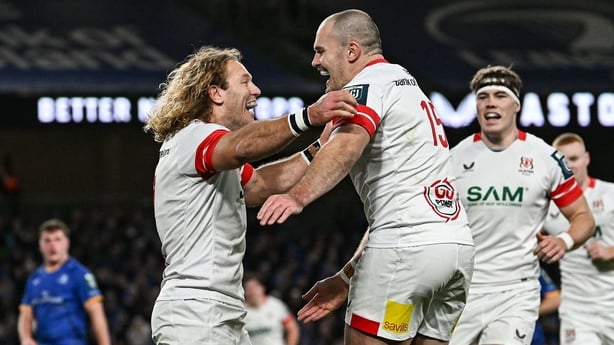
His recall for tonight in Paris hasn't come from the blue, with a couple of false dawns in the last 18 months, neither of which he could be blamed for.
He was in a rich vein of form when he was named to start for Ireland in November 2024 against Fiji – his first cap since the World Cup warm-ups – and he had been arguably Ireland’s best player that night before suffering a hamstring injury, which ruled him out until February, taking him out of the shop window for last year’s Six Nations.
His next Irish outing also ended prematurely with a shoulder injury against Georgia last summer, and he was yellow-carded in his most recent start against Japan a few months ago.
In reality, each of his last six Irish appearances have come in games where Ireland have been playing weakened or rotated sides.
Being selected on form, for a Six Nations opener, has been a long time coming.
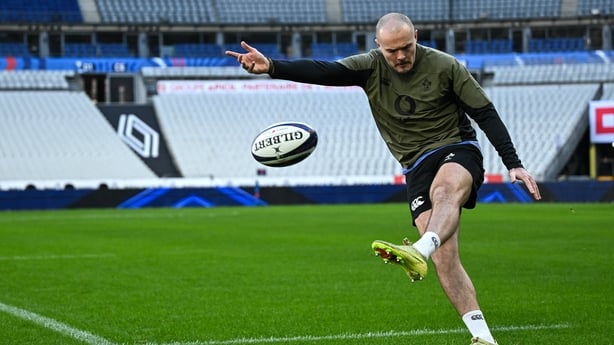
"It's been a journey for him, really, hasn't it?," Ireland captain Caelan Doris said.
"He came on to the scene and was playing some unbelievable rugby, then a few years through injuries and whatnot and form, now he's back in there and he's been playing very well with Ulster.
"He's gotten a couple of opportunities over the last while with Ireland as well. I'm excited to see him show up and do what he's capable of doing tomorrow."
The Ulster wing turns 30 in April, and time is still on his side to re-establish himself as a top-level Ireland international.
If he takes his chance in Paris, it will be hard to wrestle the jersey away from him.
Listen to the RTÉ Rugby podcast on Apple Podcasts, Spotify or wherever you get your podcasts, and email us at sportpodcasts@rte.ie
Follow a live blog on France v Ireland in the Six Nations on Thursday from 8.10pm. Listen to live commentary on RTÉ Radio 1
