


Leinster edged La Rochelle in a thrilling encounter at Aviva Stadium on Saturday evening through a last-minute Harry Byrne penalty.
La Rochelle's attacking strategy was the story of the match as far as I’m concerned, showing a blueprint that the Jacques Nienaber defence may not be overly comfortable with.
In the early exchanges, La Rochelle went toe-to-toe with Leinster. It was a more structured game and Leinster were clearly in control, moving from set piece and kick transition, into attacking opportunities, mainly through Tommy O’ Brien’s work-rate and speed down the left-hand touch line towards Joshua Kenny.
However, as the half wore on, La Rochelle were able to claw back some control and they hit their stride eventually.
It was the third quarter where they really got under the defensive skin of Leinster and they should have been out of sight.
Jacques Nienaber’s defence has been the talking point of Leinster since he joined the club. It’s either the reason that they’re able to strangle teams into a submission, or it’s been too heavily relied upon, and some find it distracting for their previously free-flowing attacking style.
Unlocking that defence is key to making Leinster less comfortable and before Saturday evening you’d have argued that their attack wouldn’t manage to get on top against some of the more powerful sides in the competition.
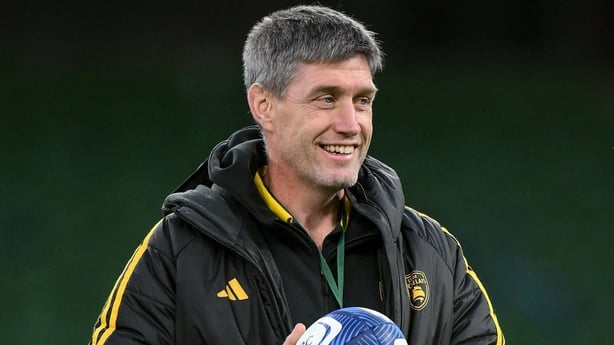
What Ronan O’ Gara’s (above) La Rochelle team did to regain control against Leinster was simple in theory, yet it takes a highly skilled group of players, bravery with the ball in hand and an accuracy to finish off the opportunities created.
La Rochelle decided to move the ball and avoid rucks. In their more successful campaigns, O’Gara’s 'keep ball alive’ slogan became synonymous with their play. Despite their faltering league form, they managed to pull out a third-quarter display that would have you question that domestic form. However, their inability to finish the chances created would lead you to understand their struggles.
Dominant defences, like Nienaber’s, depend on slowing the ruck speed, getting organised enough to sprint off the line and pressurise the attack into mistakes. La Rochelle decided to avoid the first part of that equation. By keeping the ball alive, they never allowed the defence to settle and there was no time added to the breakdown because it didn’t exist.
Fijian Simeli Daunivucu at inside centre was a vital cog in this process. His ability to break through the defence and avoid direct contact allowed La Rochelle to get in behind the Leinster defence. He dominated the midfield exchanges and Leinster will be frustrated by how that played out.
La Rochelle’s firepower up front also made a huge effort to physically dominate in their carries. They rarely died with the ball in the third quarter, instead opting to slip tight passes to other powerful forwards or to offload in tight spaces.
Oscar Jegou was an unsung hero in these narrow channels. His ability to run on to offloads with impactful timing, rip the ball from other forward carriers and pick through the ruck allowed La Rochelle time to add other layers on to their attack. By quickly picking the ball at the base of a ruck, it means the defence must continuously shift and retreat onto their back foot, meaning they weren’t able to steady themselves and race off the line in a dominant defensive fashion.
Once La Rochelle got in behind Leinster with clever identification of space and then their use of ball skills in the tight exchanges, they were also able to shift the ball from side to side with a less aggressive Leinster defence.
It wasn’t a loose offloading game. There were plenty of well-connected passes from forwards to deeper backs who were then able to throw wider passes to another line of deep backs. If Leinster were well set at the ruck and had time to identify their defensive roles, these passes would have been intercepted.
Instead, La Rochelle bought themselves attacking time to identify space and execute with wide passes from their playmakers.
An unfortunate injury to Jules Favre meant that Ihaia West and Antoine Hastoy shared their half-back duties on the pitch and West, in particular, caused trouble with his distribution in the wider channels. He was able to pass under pressure on numerous occasions to release the ball into softer spaces on the edge.
Unfortunately for O’Gara, La Rochelle wasted far too many chances, and they let Leinster hang on for long enough to regain control.
West missed a two-on-one chance early in the second half. Gregory Alldritt was arguably just too far away from him to draw the defender and pass for an easier score. It was a hugely wasteful attacking opportunity. Only a few minutes later, Niniashvili passed the ball back inside, intended for Hastoy to cross the line, but Wardi tried to catch it, and another try went astray when only one more pass would have completed the move.
You don’t get too many chances to waste against Leinster, and despite being five points up and surging towards Leinster’s line, a Sam Prendergast double-tackle effort resulted in a turnover and Leinster kept their chances alive. Had it become a two-score game in La Rochelle’s favour, with all the momentum behind them, Leinster would have struggled to respond.
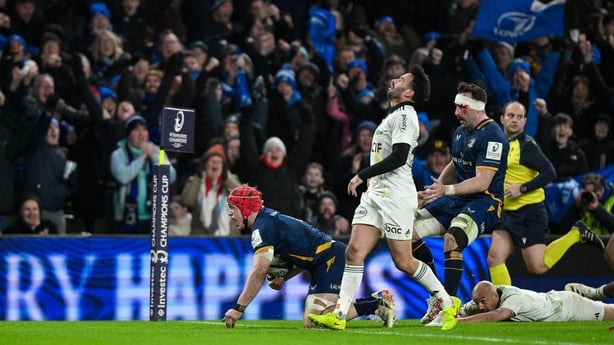
However, they are no strangers to a fast-flowing game, and they won a loose transition battle. La Rochelle’s strengths also became their weaknesses and Leinster were able to live with the fast pace. The first resulted in a Josh van der Flier (above) try and soon after Robbie Henshaw looked to put an end to La Rochelle’s chances.
La Rochelle fought back through a West try before Harry Byrne stepped up confidently to knock over the winning penalty.
The French side will be kicking themselves. They regained possession in the 79th minute from a Leinster goal-line dropout. A knock-on turned to penalty gave Leinster a chance to get into position and a wild attempt at a tackle allowed Byrne the opportunity to decide the game.
La Rochelle came with a strategy that might have only fallen into place with the introduction of their second choice out-half. Their ball movement made Leinster unbelievably uncomfortable. Yet, their strengths became weaknesses when they failed to stick the passes so close to Leinster’s line.
Leinster deserve the credit for staying in the fight and they found a way to win, especially when it didn’t seem to be in their control.
It provides a blueprint for other teams to take Leinster out of their defensive comfort zone. However, that depends on quality and even with a squad as strong as La Rochelle, they made errors which stopped them from finishing the job.
It was a fascinating European Rugby clash, restoring faith in the competition after many dead rubbers in the opening two rounds.
