


European rugby returns after a series of interprovincial derbies across the Christmas period.
It's easy to recognise that some of Ireland’s top players are going through a mentally challenging season coming off the back of last year’s British and Irish Lions tour and the international window.
It means that many Irish players have been on the road for an extended period.
You can argue that they are being managed through the IRFU protocols and their minutes are being coordinated between club and country, however, that doesn’t serve as the same break as if there were no rugby action whatsoever.
When the game continues, players will have one eye on where they need to be when they get back on the pitch, others are taking their jersey while they’re resting, and players generally don’t want to rest when there are matches available.
Some players have been completely rested at times, and that adds to the perception that they’re not at the top of their game.
Out of sight, out of mind.
Someone else is in the spotlight trying to impress. While it’s also true that there are other players who aren’t shooting the lights out.
It makes for a reasonable argument for Ireland to use the Six Nations as a chance to blood new players.
If it’s not the best platform for blooding truly new talent, then maybe it can be used to examine those on lower caps with high energy and potential.
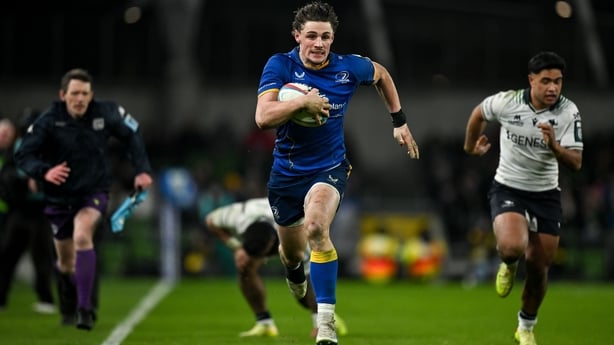
The interprovincial games are hugely important for Irish coaches to see what these players are like among their Irish counterparts. However, domestic games are only one piece of the jigsaw.
European action is up next before there will be any major decision made on blooding new talent. This is where the next few games might work against Connacht and Ulster.
Competing in the second tier of the competition against the likes of the Cheetahs may not give Andy Farrell what he wants when choosing his squad. It might not be an issue, depending on the lens that he’s looking through.
However, playing against La Rochelle, as Leinster do on Saturday, and getting an opportunity to go one better will always provide more of an evidence-base that a player is ready to step up to the next level.
Champions Cup games are a natural step towards the intensity of a Test match. Challenge Cup games don’t provide the same environment by way of physicality, defensive challenge and breakdown intensity.
If someone like Charlie Tector or Joshua Kenny was given an opportunity in the next couple of games, they would put their hand up for inclusion in Farrell’s squad.
Maybe it won’t be enough to get into a matchday squad, but it would bring them into the right position heading into the latter half of a World Cup cycle and it wouldn’t be too late to break through, given Ireland’s aging squad.
Ulster is the squad that is quietly bubbling away, waiting to make more Irish internationals in the coming year or two.
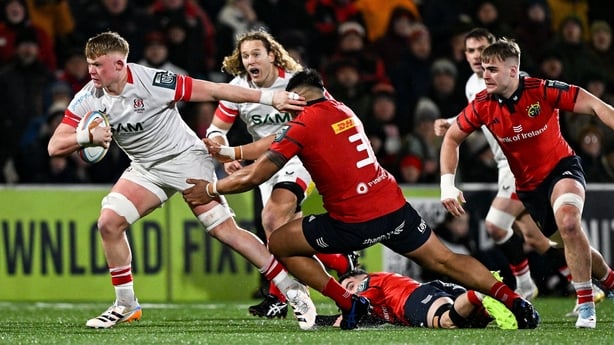
Bryn Ward (above) shone brightly against Munster last weekend, while others like Jude Postlethwaite, Scott Wilson, David McCann and Jack Murphy are still plugging away waiting for their opportunity.
The squad is also waiting to reintroduce those that are more established. Will Jacob Stockdale get the chance he’s been patiently waiting for? Tom Stewart has been highly impressive and is well worth another punt in a fully competitive Six Nations game.
Between Leinster and Ulster, there may also be a solution to Ireland’s speed issue in the back three.
Hugo Keenan is nearing a return, and while he doesn’t possess electric speed, he’s never been short of a turn of pace. Yet what Ireland are really looking for is the athleticism of Zac Ward and Joshua Kenny.
Two different athletes, but very promising when it comes to international potential. Kenny in particular offers raw pace and dynamism that we don’t often see. He needs an opportunity with Leinster to challenge in the bigger games. That’s his next realistic step into Farrell’s plans, yet the head coach has never waited for domestic selection before taking a calculated punt on a player.
The answer might also be hiding in plain sight.
Robert Baloucoune has the type of pace, athleticism and previous experience that Ireland are looking for. Ulster’s interprovincial form will do their playing squad no harm when it comes to catching Farrell’s eye in the coming weeks.
Despite mixed form, Munster, who are away to Toulon on Sunday, can make arguments for some of their own squad.
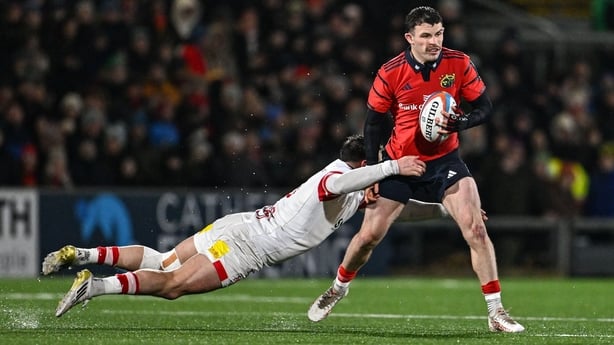
Calvin Nash (above) was a favourite of Farrell before injury knocked him back a bit.
Edwin Edogbo has been fighting to stay fit at the right time to be included by Farrell, and Brian Gleeson has returned from his latest disappointment. Add Dan Kelly to the list of potential longer-term internationals.
Connacht’s questionable form won’t help their squad to make inroads.
Both Ben Murphy and Matthew Devine could slip into the Irish squad and kick on, but Nathan Doak’s impact on Ulster may well take that chance away. Other Connacht players have put their hands up too, but it feels like much of their potential is still a bit further away from forcing Farrell’s hand.
The rest of the selection will come from the tried and trusted across the provinces, and mostly from Leinster. Tommy O’Brien is possibly the form player across the country.
Again, the solution to Ireland needing pace has already been selected in the last few games.
Leinster have been going about their business in the last few weeks. They’ve dropped players into the mix naturally with Kenny and Tector having some of the biggest impacts. Guys like Diarmuid Mangan, Brian Deeny and Fintan Gunne have been tracking well too.
Leinster can make their own arguments for the resurgence of guys like Ciarán Frawley and Harry Byrne.
European games may provide more clarity for the Irish coaches, with players potentially confirming the ability to shake things up in the national squad selection.
If changes are to be made in the Irish team, now seems to be the right time to change the landscape slightly and introduce some of the many budding talents that Ireland possesses.
