


Leinster restored winning ways against Munster, and despite errors running through the game, it's great to see the real rivalry returning to the derby.
Clayton McMillan’s side will be disappointed not to win back-to-back games against their main rivals, while Leinster’s emotion early in the game showed what it meant to lay a marker in Thomond Park.
Try-scorer Josh van der Flier was enveloped by team-mates after Leinster’s only try, with plenty of niggle in the interactions between players, as well as from Leo Cullen in his post-match comments.
Unfortunately, the breakdown battle ruled the game, with both sides aiming to upset the rhythm of the opposition’s attack. Counter-rucking is a huge part of the post-tackle action in the current format of the game, aiming to slow the ball and hinder the service given from scrum-halves.
The visitors were penalised a couple of times at the breakdown. Rónan Kelleher went off his feet in the act of counter-rucking and Paddy McCarthy blasted through a ruck only to get his hook wrong and was penalised for kicking the ball.
The hosts didn’t escape referee Peter Martin either, Jack O’ Donoghue pinged for taking Robbie Henshaw away from a breakdown.
Several times the ball squirted out of the breakdown due to the contest on the ground, with Munster fortunate to turnover the ball a few times in that style.
Leinster could count themselves lucky as well that captain Caelan Doris was given a bit of leeway with his hand on the ball asking the referee if his actions were legal, despite knowing that he had lost the contest.
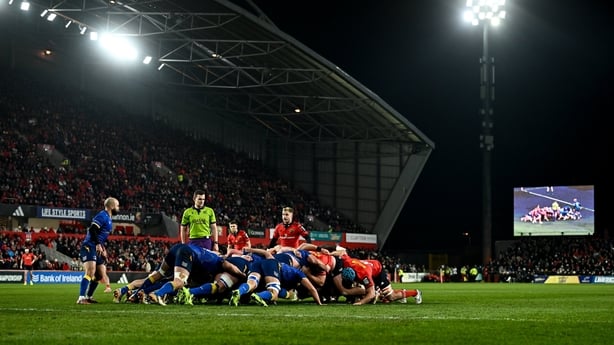
In these intense derby games, the breakdown is one of the biggest factors that needs to be sorted out early. By allowing too much of a contest at the ruck, attacks will be slower, and the flow of the game is taken away as teams will opt to kick more.
Already dominant defensive lines get more structured and playing into those defences is a fool’s game.
On occasions, Munster attempted some nice attacking phases. Full-back Mike Haley knocked the ball on from one set of intricate passes, while Dan Kelly’s try in the final quarter came from positive handling in attack, a rarity within the game itself.
Leinster learned their lesson from the Croke Park defeat and chose not to over play. They opted to run out of their half once, but Reiko Ioane didn’t release the ball on the ground and was penalised.
Other than that, out-half Harry Byrne managed their game plan very effectively and pinned Munster into their own half numerous times at the start of the second half. The men in red struggled to exit, with Leinster picking up two crucial penalties to put a bit of daylight between the teams.
Attacking rugby was rare for a few reasons. Both defences stood strong against onslaughts in their 22 and never wanted to give their opposite number an inch. Strong defences thrive on a personal battle.
The breakdown was another obvious reason for hindered attacking plays. With the way the game is being structured with laws around access in the air and messy breakdowns, there’s little advantage to playing for long phases before kicking the ball.
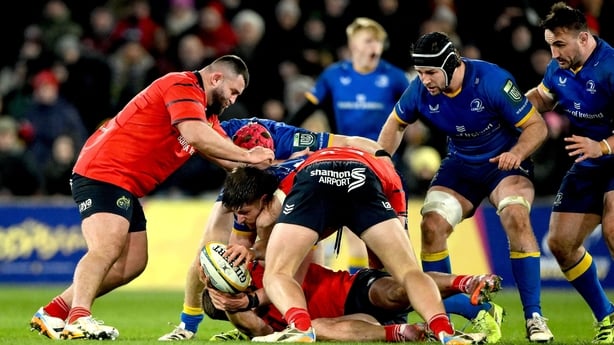
Teams are aiming to take to the sky now that they can have a free run at getting into the air in a one-v-one battle. If they win the ball back, they have unstructured the defence and can then restart with an attacking advantage and potential space.
Even if they fail to regather in the air, they’ll have a structured kick-chase and an organised backfield, so there is no significant risk. They’re looking to get the ball returned in a better position.
But first, they’ll pile bodies into the breakdown when the catcher lands and hope to cause a mess at the ruck.
The breakdown itself is increasingly difficult to police with so many different actions for the referee to look at. The official’s first aim is to police a safe tackle, then ensure that defenders are rolling away from the tackle area to allow a fair contest on the ground.
Jackalling the ball can be a risky action because referees might be forced to call a penalty for the tackler not getting away early enough, or the jackaller not supporting their own body weight.
This is why counter-rucking has become more commonplace. If you can blast past the ball, your second defender has easier access to pick the ball up and complete the turnover.
If the counter-rucking player doesn’t get fully past the ball, then they’ll still create a fight for possession and upset the scrum-half’s rhythm.
Counter-rucking makes a mess of the breakdown, which is the intention of the defending team, but it can also spoil the attacking spectacle if it’s not tidied up early enough.
Attacking rugby isn’t the only factor that makes for a good game. A close and intense physical battle can also provide a fierce contest, which is what we saw on Saturday night.
While Munster stay ahead on the league table, Leinster are closing the gap by picking off their Irish rivals.
On Saturday they will look to complete their Christmas clean sweep when Connacht visit Dublin.
