


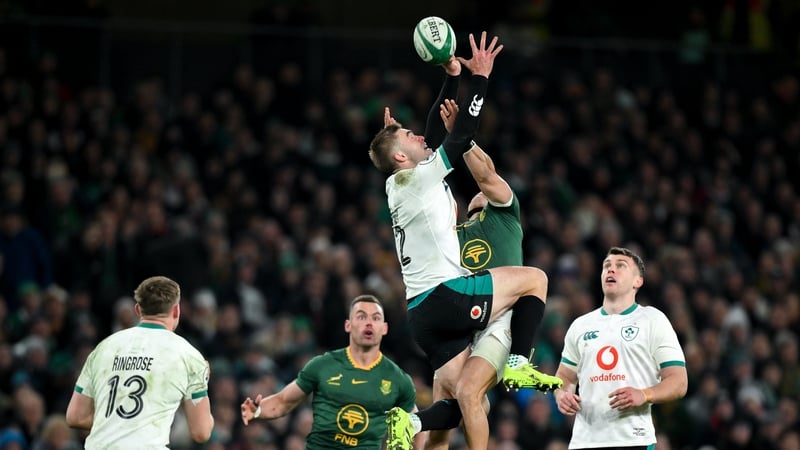

Bernard Jackman doesn't believe the current laws around the kick-chase are having a negative effect on the game.
It comes after recent criticism of how rugby's officials are being instructed to referee the kick-chase, with the escorting of a kick-receiver now outlawed.
The clampdown came into effect just over a year ago, where teams were penalised for effectively blocking the chasing players on the kicking team from contesting for the ball.
The move was designed with the intention of creating more opportunities for one-on-one aerial contests, which in turn would lead to more chances of attacking unstructured defences.
Ireland international Ross Byrne spoke out against the current state of the game earlier this week while Munster senior coach Mike Prendergast also expressed his frustrations with the kick-heavy approach many teams are adopting, with his belief that the number of knock-ons is leading to a stop-start game.
However, Jackman believes the current approach remains the way forward to encourage attacking rugby.
"I don't think it's perfect, but I think it is creating more transition," the former Ireland hooker told the RTÉ Rugby podcast.
And Jackman says teams will reap the rewards if they can adapt their game accordingly.
"The team being kicked onto still have a better chance..."
— RTÉ Sport (@RTEsport) December 10, 2025
🎙️ @bernardjackman and @steeno10 don't believe the kick-escort clampdown has negatively changed the game...
But they do suggest one potential tweak... 🔧
📺🎧Full pod: https://t.co/qXYMXr0BYF pic.twitter.com/MvRWmwdwJB
"Your prerogative on this is, if you're currently coaching, is how it suits your team. It's influenced by that.
"And I don't think at the moment it suits Munster. This is because they have become a very good structured team, so when they are secure in possession, they have an attacking philosophy and shapes that can ask questions of the opposition.
"So Munster, for whatever reason, Irish teams, for whatever reason, at the moment are really struggling in the air. And normally we tend to be ahead of the curve. We don't seem to have found any real joy out of this law change.
"Felix Jones was very much involved in this law change with World Rugby. And I remember when he was on gardening leave, or leave absence from England, we met for coffee and he told me about it and I didn't like it.
"I didn't like it at all because it was different. And I thought the game was actually quite OK.
"But he explained to me that they felt that they want to create more opportunities for transition, for unstructured play. And this effectively will."

Byrne (above), now playing his rugby for English Premiership side Gloucester, speculated that the amount of contestable kicks could lead to the end of smaller, faster wingers, as teams prioritise size
But Jackman believes that rugby will remain a game for all shapes and sizes.
"I watched Toulouse at the weekend against Sharks. This idea that you're going to put second rows on the wing, it hasn’t stopped Ange Capuozzo running amok.
"It's literally the mindset you have around it. And the skills that you give your wingers, or the wingers you pick.
"And probably just as Irish provinces and the national side, we just haven't benefited from it. So we have probably a negative opinion on it.
"I think we're losing the run of ourselves here. Obviously, the team who kick it now have a better chance of getting it back if it's contestable, but there's still a contest.
"Either evolve or keep giving out about it, but my understanding is the game isn't going to change.
"We might have some interpretation change, but my understanding is that these are the rules now, the laws that we're going to have to the World Cup," he added.
Jackman was joined on this week’s RTÉ Rugby podcast by former Exeter rout-half and current Ireland women’s assistant Gareth Steenson.
And while the Ulsterman agreed that the current law interpretation is working, one tweak could appease some people’s frustrations.
"It's actually encouraging you to get a ball in the air, contest, knock-ons will happen as part of that," he said.
Steenson highlighted how the strict approach to deliberate knock-ons in open play could potentially be applied to aerial contests.
"If you wanted to try and change the narrative a little bit, it's a bit like whenever you're going for a try-scoring pass or something and someone slaps the ball down.
"If you're going up to catch the ball and you don't generally make a genuine attempt to catch the ball and you knock it on, that could be a penalty against you. So that might just change the thought process.
"Whenever you're talking about this type of thing, there's a real narrative, if you're chasing kicks, it's to get up on someone's face. It's to try and make a distraction. It's literally to try and put your hand up in the air.
"Effectively, you could nearly say it's a deliberate knock-on if you were to go up with one hand to try and slap the ball down, because you're not actually trying to catch it, but you are trying to tap it back to your team.
"So it could be that risk adverse that if you're going up for it and you knock it forward, it could just be a penalty off you."
Listen to the RTÉ Rugby podcast on Apple Podcasts, Spotify or wherever you get your podcasts.
Listen to live commentary of Munster v Gloucester on Saturday from 5.30pm on RTÉ Radio 1
