


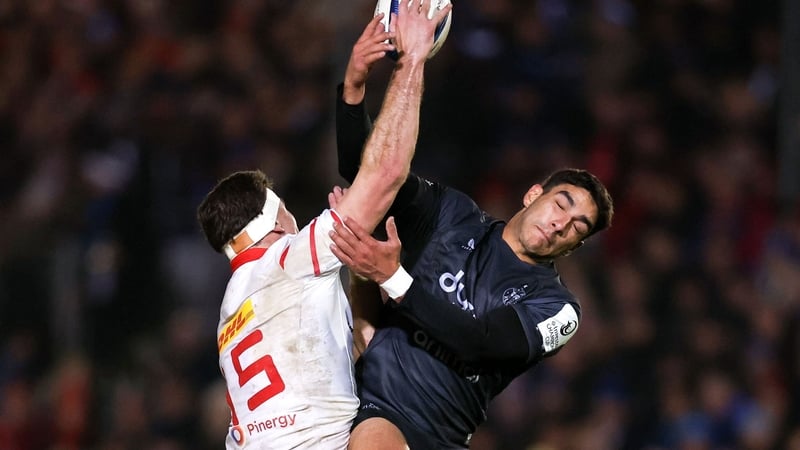

Munster's attack coach Mike Prendergast is the latest figure to voice his frustration with the way kicking has changed rugby in the last year.
It’s just over a year since World Rugby clamped down on "escorting" kick-receivers in a bid to create more one-on-one aerial contests, which they believed would lead to a more attacking game.
Prior to the clampdown, players from the receiving team would effectively form a shield of bodies around their team-mate who was jumping for a high ball, with that now deemed as obstruction and a penalty offence.
There had been murmurings of discontent throughout the last year as teams tried to adjust to the new interpretations, but with a larger body of evidence to work off, players and coaches are now making the frustrations heard.
Earlier this week, Gloucester out-half Ross Byrne gave a brutally honest assessment of where he believes the game currently is, ahead of his team’s meeting with Munster on Saturday.
"Unfortunately I think it’s changed how everybody plays," the former Leinster out-half told The Guardian, adding that it was a backwards step for rugby.

"Everybody knows the stats: because of the new rules whoever kicks the ball is most likely to get it back. If those are the stats, which the top teams generally tend to follow, why would you not kick the ball?"
And the 22-cap Ireland international went as far as suggesting the game could soon become dominated by height and size, as teams look to give themselves the best possible advantage in the air.
"If I was a head coach of a country right now and the World Cup’s in two years, you’re going: 'OK, is there anyone who’s 19, 20, a second row or backrow who’s a really good athlete? Can we make him into a winger in two years? Go chase some kicks?’ Genuinely, why would you not do that?"
Byrne's Gloucester side travel to Cork this weekend to take on Munster in Pool 2 of the Investec Champions Cup at SuperValu Pairc Uí Chaoimh.
While the out-half's comments weren’t specifically addressed by Prendergast, the Munster senior coach was asked for his opinions on how the law interpretations in the last year have changed the game.
And the former scrum-half (below), who has been attack coach at Munster since 2022, made his feelings clear.
"In terms of the flow of the game, it is impacting it and it's impacting it to watch it visually, I think," he said.

The logic behind World Rugby’s plan was that more one-on-one aerial contests would lead to more breaking ball, which in turn would create fractured defensive lines, and as a result more opportunities to play unstructured and instinctive attack.
But Prendergast believes with the aerial contest now weighted so heavily towards the kicking team, the kick-heavy gameplans are leading to more knock-ons, which are creating more stoppages, and deflating the air from games.
"If you're receiving a kick and you get tackled and there's a breakdown there, it's very hard to play against that because you generally have 13 players.
"What teams are generally doing, the trend is two, three phases, you're not really going anywhere and a kick goes in the air, it's a knock-on, it's a scrum.
"The game, for me, it's becoming quite long. I would feel very, very strongly about it, to be honest with you.
"I think it was probably something that, when the rules were being changed, that they probably felt that it would help the attacking aspect of it. For me, it's gone the other way around.
"There's so many stoppages through it and there’s knock-ons in the air. That's a reality.
"What we're looking at is teams are looking to tap the ball back. Knock-ons can happen there or it becomes a bit of a s**t fight for that ball, I suppose, putting it in best terms."
And the Munster assistant believes that the quality of rugby has deteriorated as a result.
"I think when you had the escorts, it did statistically stop teams kicking more and, we had more ball in play.
"Again, I look at the games this year, there hasn't been many standout games, if I'm honest. The trend has been going that way. The ball in play seems to be lower.
"As an attack coach in the game I love to watch and see movement. I think, as spectators, that's what people want to see as well.
"Hopefully, it's something that we see changed quite soon," he added.
