


Most teams that win a Champions Cup game 45-28 while scoring seven tries along the way would be happy with their day's work.
Not Leinster.
Putting away an under-strength Harlequins side with a flurry of tries in the final quarter isn’t how we expected them to perform last Saturday evening.
This weekend they will face Leicester in a much tougher tie at Welford Road, and with the way the competition format has played out, you’d expect the hosts to field a much stronger side than what Harlequins fielded last weekend.
Realistically, the group stages of the Champions Cup should be played out in Leinster’s full control.
They can face resistance against good quality English and French sides, however, qualifying as a top seed means that they won’t play their biggest opposition in the group stages, and they should have far too much fire power for anyone else.
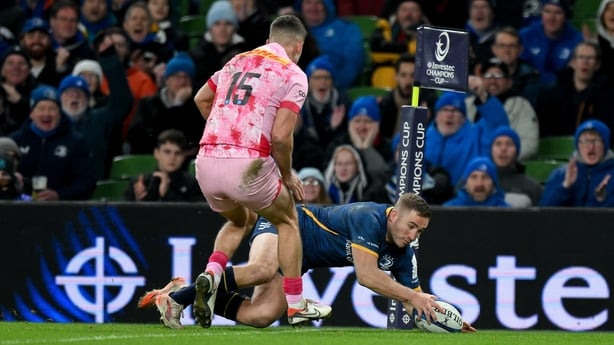
The evidence of this is how they generally perform in the final quarter.
Whether it’s because of the depth of their bench, or the defensive dam bursts, better quality teams will pull away as fatigue sets in, and the gulf in ability across the pitch shines through.
That’s all well and good on paper. Yet, there’s something stopping Leinster from reaching their optimal performances of late.
Sport is fascinating because what is written on paper is partially irrelevant to how the game plays out.
If games were won based on who has a stronger team selection, then we wouldn’t have big upsets, late drama and fascinating matches.
Team selection and squad strength is a strong predictor, of course, but that’s not always how things play out.
Leinster hammered Harlequins last year in a knockout game, yet they were within a score and down a body at 50 minutes in their game on Saturday evening.
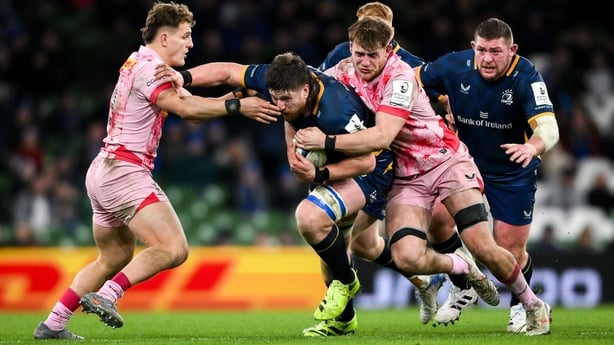
Leinster’s success has contributed to their own shortcomings.
Their contribution to the national side is fast becoming a problem for their ability to build a game plan throughout the season.
Their success at international level also meant that much of Ireland’s coaching staff toured with the British and Irish Lions and naturally enough both the success of the Irish team and their coaches’ involvement meant that we would see a lot of these Irish players on the tour.
Longer seasons, limited preseasons and awkwardly timed rest periods have been a drain on Leinster’s ability to train together as a squad.
Their Lions were unavailable for selection for all but one or two URC league games before heading back to national camp for the November series and then back on duty with Leinster again for the European campaign.
You would expect them to be rested again at some point in the inter-provincial rounds at Christmas time before becoming available for the other two Champions Cup group games afterwards.
They will then return to national camp for the duration of the Six Nations before resurrecting at club level for the business end of the season.
The international season has to hinder the bulk suppliers to the national team.
Not only did 14 players go on the Lions tour, others have a strong involvement with Ireland.
The Leinster starting team on paper would have a strong involvement in every match day squad for Ireland.
You have to wonder what kind of mental strength is needed, not only to tog out and gear up for each of these highly pressured games, but also to return to club action and to be heavily relied upon again.
The expectation to perform is enormous, and Leinster’s recent delivery on those performances has fallen short.
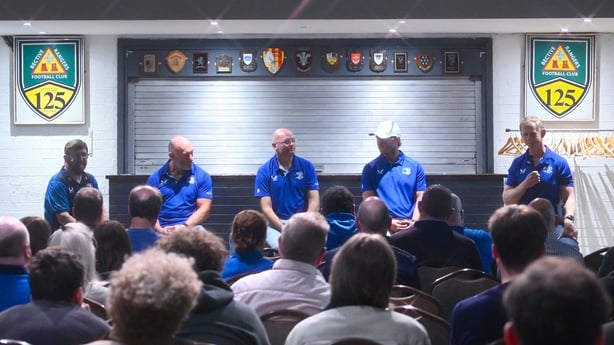
It means that frustration and tension builds, the efforts to reduce expectations heightens, but in reality, the pressure on these players is growing.
Not only can this lead to poor performances, it can also lead to injuries.
Leo Cullen has been without key players across the last few months.
Joe McCarthy returned from his injury that was exacerbated on the Lions tour just in time to fill in for the suspended James Ryan.
And just as Ryan’s return is imminent, RG Snyman left the field with an injury against Harlequins.
Robbie Henshaw has had injury troubles in the last couple of seasons, Hugo Keenan hasn’t been available since his heroics in a Lions jersey and even their durable captain Caelan Doris missed months of action, including a Lions tour, because his body finally showed signs of weakness.
A group game against Harlequins was never going to challenge the minds of these players enough to bring out their best performance.
They’re nowhere near the point in the season where they have to be at their best. However, Leinster normally show up and blitz teams that aren’t strong enough.
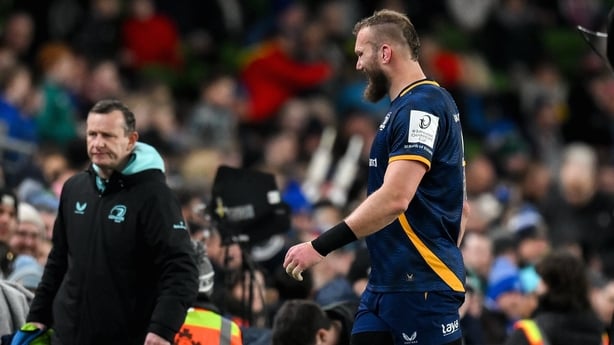
Leinster conceded 28 points last week, though one try was gifted to Quins from a turnover.
It’s still not part of their DNA to just do enough or to allow teams to compete with them early in the campaign. Bad habits can form quickly, and flicking a switch to your best performance isn’t a reality.
Despite the strong expectations and the thinning patience of supporters, this could be a very difficult season for Leinster to reach the right pitch to beat the best available in Europe.
Some other clubs have strong international representation too, but none quite like the Lions that Leinster boasted last summer. Their resources have been tested more than others.
Throughout this time, the four-time European champions have nearly operated with two different squads.
Some weeks must look vastly different to others on the Leinster training pitch.
Jack Conan spoke to RTÉ Sport about Leinster's start to the season
How much can Leinster coaches even influence the habits and human behaviours of their international stars?
How much training time do they have with a full squad, without enforced rest, knocks and niggles to recover from, and a well-connected and consistent squad to build some competition?
Professional teams can work smart and make their time on feet at training more efficient by creating clarity in meetings etc.
But, you can’t beat the real thing and a lack of training time together must hinder their preparations on weeks like these.
If last week’s win against Harlequins is seen as a negative then Leinster are still in a very positive place.
However, if they want to overturn what it seen as a drought in terms of trophyless European seasons, then they need to find more cohesion in short spaces of time, and crucially, they’ll need some luck on their side to avoid injuries in what must feel like two seasons blended into one for some of their more experienced players.
Friday night’s tie against Leicester will be another level up in terms of challenge.
Going on the road together and eking out a hard-fought and gritty win might be just what is needed to springboard the European journey for Leinster this season.
It’s still early days, but this could become a very challenging Champions Cup season for Leinster.
