


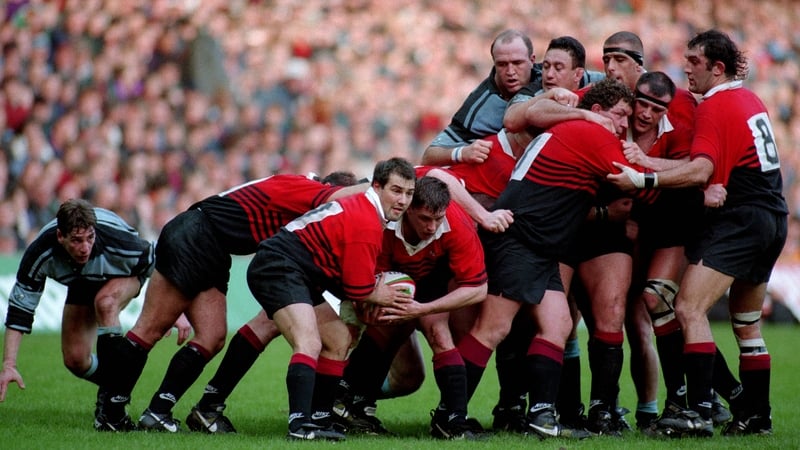

Rugby's European Cup is 30 years old this winter.
The tournament has been an indispensable component in Ireland's rise from a team which was relieved at finishing second-last in the Five Nations to one which, by 2024, was inclined to look down its nose at a championship won without sufficient swagger.
The inaugural edition was very much the rickety Ford Model T of Heineken Cups compared to the sleek Masserati of the mid-to-late 2000s.
Like the first Rugby World Cup in 1987, it was viewed as an experimental, toe-dipping exercise, whose significance largely eluded the masses at the time.
It began in an incongruous location, in the city of Constantu on the Black Sea in Romania on a Tuesday afternoon.
The locals hosted Toulouse, then as now a dominant force in French rugby and eventual winners of the first edition.
The opening game was commemorated on a video on the tournament's YouTube channel 11 years ago, in which Thomas Castaignede remarked that there were "probably more policemen at the game than spectators."
The Irish made their opening bow the following afternoon, Wednesday 1 November.
Munster hosted Swansea at Thomond Park, while Leinster were away in Milan - to take on the rugby arm of the Silvio Berlusconi-owned 'Athletic Club'.
"I remember going to Milan and thinking this was the hub of fashion and arriving it was anything but. It was just very industrial where we were," Leinster winger Niall Woods told this writer several years ago.
"The pitch was very bad, there was very few people watching it. There was no travelling support. There might have been a handful of alickadoos but nothing like there is now..."
In an indication of where Irish rugby stood at the time, Ireland had six months earlier become the first 'Tier 1' rugby nation to lose to Italy, in a World Cup warm-up game.
The Italians had engaged in some skulduggery beforehand, with the bus that was to transport the Irish players from their hotel to the stadium in Treviso failing to arrive, leading to a situation where Noel Murphy had to frantically hail down taxis from the foot-path in his IRFU blazer.
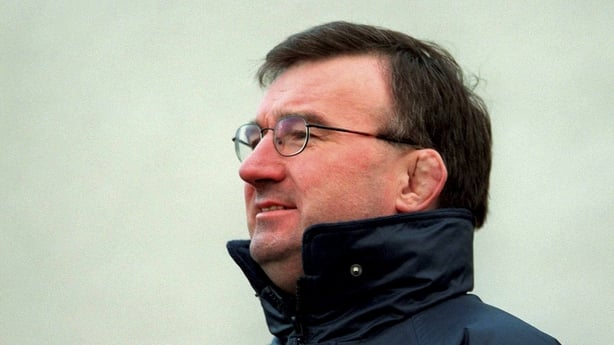
This prompted Leinster head coach Jim Glennon - former Ireland second row and future TD - to do a recce beforehand, travelling out to Milan to oversee the logistics prior to the squad heading out.
In the intervening period, the alickadoos had waved the white flag in their long battle to stave off professionalism.
Brendan Fanning recalled in 'From There To Here' how an ashen-faced Syd Millar walked out of the fateful IRB meeting in late August 1995 where the game decided to go 'open', and announced "it's gone" to his fellow IRB compadres, sounding like a man emerging from an operating theatre to tell his siblings that their father had died on the table.
At the time, the onset of professionalism was regarded as a death knell for Irish rugby, which had already been struggling for the guts of a decade at that point, with the 1985 Triple Crown the last success of any note.
The angst-ridden mood of the time is best captured by an emergency one-off debate on BBC NI - fronted by the legendary Jackie Fullerton, during which The Irish Times long-time rugby writer Edmund Van Esbeck struck an especially funereal note, grieving the passing of the amateur era while saying flatly that he didn't think Ireland was capable of sustaining a professional game.
Former Ireland coach Jimmy Davidson, seated at the same table, took a much chirpier tack, stressing that the way forward was to build a professional game along provincial lines, as was to eventually happen.
Perhaps unsurprisingly, it was the Ulster cohort - who were most committed to the interpros during its off-Broadway years in the 1980s and early 90s - that were the most adamant in pointing out that the provincial path was the only way forward.
By that stage, a European club competition was already in the pipeline, having first come onto the agenda the previous year, though its implications received little air-time on the Fullerton programme.
The IRFU swiftly determined that their clubs wouldn't be of the standard required to compete with the French and English behemoths and nominated the provincial sides to enter.
Ireland were initially only granted two slots though IRB board member Tom Kiernan managed to swing a third, leading Leinster coach Glennon to phone him up in advance of their opener in Milan to thank him for securing their entry.
In any case, the English clubs pulled out of the competition, and not for the last time, on the basis that it couldn't be accommodated alongside their league schedule. Arguments over fixture scheduling and, perhaps more crucially, the distribution of TV money saw them again withdraw from the 1998-99 competition, the year of Ulster's victory.
It meant that the 1995-96 Heineken Cup, when it kicked off, was a slightly shrunken, truncated affair compared to subsequent editions, consisting of four pools of three, with three Irish, French and Welsh sides, along with two Italian teams and - for the final time - one Romanian outfit.
Part of the reason for the widespread fatalism in Irish rugby around the arrival of professionalism was that the provinces, Ulster excepted, were regarded as moribund entities at the time.
The northerners, for understandable cultural reasons, were possibly more attached to their provincial brand than their rivals and they created a formidable club ethos under Davidson in the 1980s. Ulster went nine seasons unbeaten in the competition from 1984 to 1992.
Leinster had enjoyed a period of dominance under Mick Doyle's stewardship in the early 1980s, with a side which provided the core of the 1982 Triple Crown winning team.
"Mick Doyle created a club team called Leinster," Phil Orr later observed on 'The History of Leinster Rugby' DVD. However, that ethos faded when Doyler assumed the Irish job and they slipped back into the familiar role of talented under-achievers.
In Limerick, where the AIL had been embraced with incredible gusto, the Munster rugby team inspired only apathy, mingled with a touch of resentment over a supposed Cork-bias in selection.
Interestingly, Munster, under Gerry Holland, did win the inter-provincial championship for the first time in 16 years at the end of 1994, perhaps the earliest sign that the fruits of the AIL boom were about to benefit the provincial set-up.
With the game in a state of flux, there was still some confusion as to whether the provinces were bona fide club teams or representative outfits.
Leinster's first ever Heineken Cup try was scored by Ireland full-back Conor O'Shea, who was playing for London Irish at the time. Even after the English clubs joined the fray the following season, Paul Wallace, contracted to Saracens, played for Leinster in that year's European competition.
Nonetheless, the arrival of the Heineken Cup saw a shift in gear for the provinces. A new era had dawned.
"1995-96 was the first year where Leinster played around 10 or 11 games," Woods recalled.
"Before 1995, when you played with your club, you played with your club to play with Leinster, and the club was the primary focus really. But definitely, there was a bit of a shift that year towards Leinster being a club."
Their first ever Heineken Cup team included future World Cup final referee Alain Rolland at scrum half, Olympian shot-putter and subsequent Ireland back-row stalwart Victor Costello and a second row duo of Brian Rigney and a youthful Malcolm O'Kelly.
They appeared set for defeat against the Diego Dominguez-inspired hosts until international winger Woods rustled up a try out of nothing in the closing stages.
On the same afternoon, Munster likewise stole victory at the death at home to Swansea, Shannon full-back Pat Murray taking a pass from Paul Burke, breaking a tackle to dive over for the winning score.
Writer and rugby historian, Liam O'Callaghan, who attended the game, said the significance of the fixture was largely lost on the crowd.
"There were a few thousand at it, there was no real fuss about it, and everybody in the crowd was just talking about the club fixtures of the previous weekend. This Munster thing was just a gentle distraction from the much more important business of AIL fixtures," O'Callaghan recalled.
However, it did have longer term implications as it did start what was a 12-year long unbeaten streak for Munster in Thomond Park - they were to lose a home match to Cardiff in 1997 but crucially that was played in Musgrave Park.
Ulster, who had been the dominant force in the interpros for the preceding decade and a half, didn't make their opening bow until the end of the month, shipping a surprisingly heavy beating to Cardiff in the Arms Park.
Munster would exit the pool phase following an away defeat to Castres - the two sides have met each other roughly every second year since, being yoked together more than the Republic of Ireland and Cyprus were back in the 2000s.
Leinster, placed in the softest pool, edged out Pontypridd in Lansdowne Road to progress to the semi-finals. A defeat at home to Cardiff on the penultimate day of 1995 denied them a spot in the inaugural European decider.
Cardiff became the first and only Welsh team to contest a Heineken/Champions/Investec Cup final in the new year - though their successor franchise club were a whisker away from following suit in 2009. They were edged out by Toulouse in the final.
While energised by the European fare, Glennon insisted to the Irish Times that their priority remained the dear old inter-provincial championship, which they would win outright that season for the first time since 1983.
The late '90s exist as a kind of forgotten pre-history of the Heineken Cup from an Irish perspective. With the international team still going through a painful transition, the provinces struggled for traction as the game in Ireland sorted through the ramifications of professionalism.
A little remembered bit of trivia is that Cork's Brian Roche, a squad player at Bath, was the first Irish player to win a European Cup medal in 1998. The following season, Ulster, who had barely won a game in the first three seasons, won the Cup out of the blue in 1999, a success which is under-rated in the eyes of posterity due to the absence of the then dominant English sides.
The following year, Munster embarked on their emotional odyssey to the 2000 final, the campaign concluding with Richard Harris and Peter O'Toole belting out 'Carrickfergus' in the Twickenham hospitality tent before making a bolt for their seats. The Heineken Cup's halcyon days were about to arrive.
O'Callaghan, an attendee on that listless afternoon back in November '95, had a front-row seat as the Munster bandwagon took off.
"The Munster branch used to have their offices on Penrose Quay in Cork and in advance of a semi-final, I think in 2000, I just walked in there and bought tickets. They were selling them over the counter.
"The next year, just 12 months later, the queue was down as far as the train station."
