


Given Ireland's tortured history at the Rugby World Cup, Andy Farrell knew well enough to avoid getting sucked in by the permutations of Ireland’s draw when he spoke to the media on Wednesday.
The supporters and us in the media can speculate and plot Ireland’s path in public, but if Farrell is thinking ahead about who stands in the way of his side and World Cup glory, he will be doing so privately.
The Ireland coach wouldn't be drawn on the ifs, buts and maybes of potentially sidestepping South Africa and New Zealand on their side of the draw, but there is one undeniable certainty about Ireland’s World Cup hopes: winning your pool is imperative.
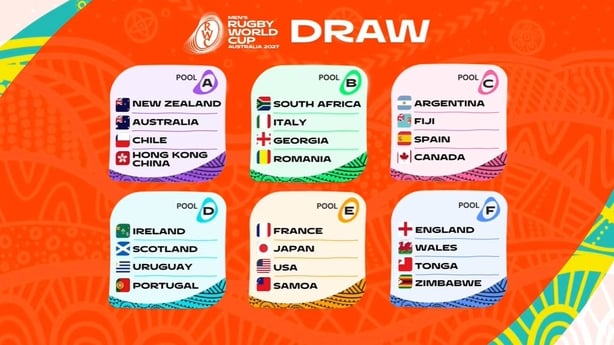
Even aside from what comes later in the tournament, the fact of Pool D is that Ireland’s meeting with Scotland is enormous.
Two years ago, the difference between finishing first and second in the pool was negligible. Ireland finished first and lost to New Zealand a week later.
Had they finished second, hosts France wouldn’t have been much easier.
In 2027, the winner of Ireland’s pool will take on a side that finished third in their group in the Round of 16.
The runners-up of Ireland’s pool will face the winner of Pool C, who, barring a mega shock, will be France.
Even as he tried to stay coy about Ireland’s path, Farrell conceded there’s a big difference between first and second in this pool.
"You would have thought so, that's for sure, and you obviously look at the importance of that," he said.
With Ireland’s ambitions extending beyond just breaking their quarter-final hoodoo, Farrell isn’t getting bogged down by how they get there.
"There are ways that things can happen a little bit differently as well and obviously everyone gets carried away with different sides of the draw, which is stronger and which is not," he added.
"But ultimately we don't want to just get past a quarter-final, so ultimately you're going to come across whoever it is that are unbelievably strong quarter-final, semi-final, final-wise, and you have to be good enough to aim for that.
"I suppose that's the main point from it.
"Obviously I back myself and the rest of the coaches and the players and all the staff to go as far as we'd all hope, we'd have the ambition to win a World Cup. Otherwise, what's the point?"
Between now and then, Ireland have four international windows to get themselves in shape, with two Six Nations Championships and the summer and autumn Nations Championship blocks coming up in 2026.
"It’s not a long time at all and we need to use all that wisely, that’s for sure," Farrell continued.
Based on their 2025 form, there is plenty to improve on.
Eight wins from 11 games, including a Triple Crown, is a reasonable return on paper, but the story of the last year shows a team that has struggled to bring their game together.

The scrum and discipline are major areas for improvement, as evidenced by the most recent defeat to South Africa just under two weeks ago.
Farrell said: "I agree that from the autumn it [discipline] is certainly a little bit of a work-on.
"Obviously South Africa are a lot to do with that and we’ve seen that in other games that they’ve played as well.
"It isn’t just the discipline, it’s how you handle the pressure of the game within itself. It’s something that needs to continue to improve."
While the current Irish squad still contains a core of players in their late 20s and early 30s, it was pointed out by assistant coach Johnny Sexton how the squad has seen several hundred caps of experience depart in the two years since the World Cup in France, with Sexton, Keith Earls, Peter O’Mahony, Conor Murray and Cian Healy among those to have stepped away.
And Farrell believe that his current leadership group will continue to develop in the lead-up to Australia in two years’ time.
"It’s just fact, isn’t it, and it’s just part of life that that’s where we find ourselves," said the 50-year-old former Wigan rugby league star.
"That’s good, because then you’re asking others to fill that space but fill it in a way that their team’s going to be propelled forward.
"We’re not trying to do the same as what we did two years ago, we’re trying to be better than that.
"These things, experiences, take a little bit of time for people to understand, 'OK, I know how to deal with the pressures of international rugby, how do I become a better leader within that?
"How do I help the team get better?’ It’s part of everyone’s growth.
"You have to go through that to understand what it’s going to take to propel the team forward."
Listen to the RTÉ Rugby podcast on Apple Podcasts, Spotify or wherever you get your podcasts.
Listen to live commentary of Bath v Munster on Saturday from 8pm on RTÉ Radio 1
